

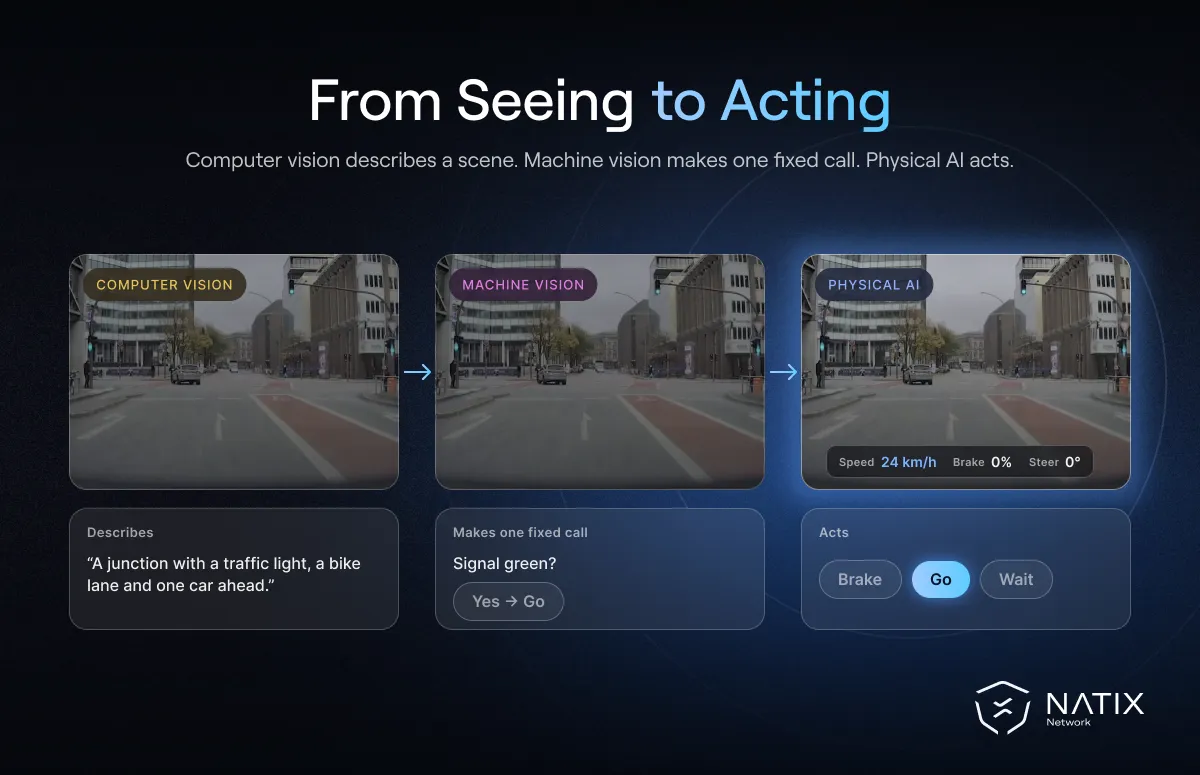
Machine vision vs computer vision is one of the most common mix-ups in AI. Adding Physical AI to the list only makes it harder to keep straight. The three terms appear side by side in product pages, research papers and investor decks, often as if they meant the same thing. They don't. Each describes a different stage in how machines use sight, from interpreting a picture to acting on what they see.
The short version is this. Computer vision is the field that teaches computers to understand images and video. Machine vision is computer vision built into a machine or process to make a specific decision, such as rejecting a faulty part. Physical AI goes a step further. It uses perception to understand the world, reason about it and act in it, the way a robot or a self-driving car must. Each step needs different data. The last step needs the most: large volumes of real video, such as a real-world driving dataset recorded on public roads. This guide walks through where each term begins and ends, and how they connect.
Computer vision is the broad field of AI that enables computers to interpret images and video. It covers tasks such as recognizing objects, reading text, tracking movement and estimating depth. In practical terms, it answers the question "what is in this picture, and where?"
The Association for Advancing Automation (A3) is the trade body for the vision and imaging industry. In its explainer on computer vision vs machine vision, it describes computer vision as the capture and automation of image analysis. That covers a wide range of theoretical and practical applications. That breadth is the key point. Computer vision is not tied to one device or one industry. It is a set of methods and models that can be applied almost anywhere images exist.
Computer vision also does not need a live camera. As Zebra Technologies explains in its overview of the two terms, a computer vision system can work from saved images and can even use synthetic images. A model that sorts a photo library, reads a scanned document or analyzes satellite imagery is doing computer vision. Nothing in the room needs to be looking at anything.
So what is machine vision? Machine vision is computer vision put to work inside a machine or process. A3 describes it as computer vision used in an industrial or practical process. There, the system must carry out a function based on its image analysis. Typical examples include sending products down a specific packaging line, re-routing defective items or stopping a production line altogether.
That makes machine vision more specific and more constrained. It usually involves a camera, lighting, a processor and software working together as part of a larger system, according to Zebra. The environment is controlled, the task is narrow and the output is a decision: pass or fail, left or right, stop or continue.
A bottling plant is a classic case. A machine vision system checks that each bottle is undamaged, filled to the right level, capped and correctly labeled. It then triggers an action for any bottle that fails. The system does not need to understand the world in general. It needs to make one kind of judgment very quickly and very reliably, thousands of times an hour.
The simplest way to separate machine vision from computer vision is to ask what each one is for. Computer vision is about understanding images. Machine vision is about using that understanding to make a machine do something specific.
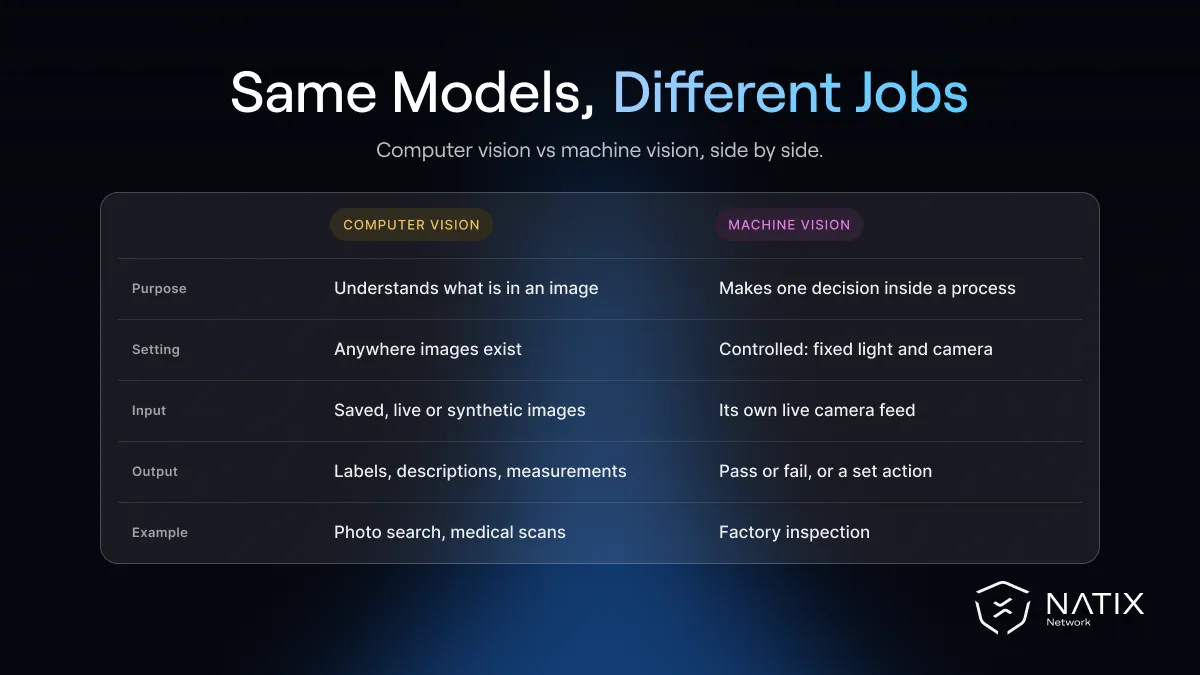
In practice, the two differ in four ways:
The line is blurring, though. Machine vision is now used outside factories too, in areas such as high-end surveillance, biomedical work and life sciences. Modern machine vision systems also rely on the same deep learning models as general computer vision, so the technology underneath is increasingly shared. The difference today is less about methods and more about context: open-ended understanding versus a defined job inside a system. Our guide to computer vision examples shows how wide that range has become.
The order in which these ideas appeared explains a lot about how the terms are used today. Machine vision came of age on factory floors, where cameras inspected parts, read barcodes and guided simple robot arms. The settings were tightly controlled, so rule-based image processing could work reliably as long as the lighting and camera position never changed.
Computer vision, as a research field, aimed higher from the start. It tried to make machines understand images in general, not just check one feature on a conveyor belt. For decades that goal was hard to reach, until deep learning changed what was possible. Models trained on very large image collections began to recognize objects, faces and scenes with an accuracy that rule-based systems could not match.
That shift pulled the two worlds closer together. Machine vision systems began using the same deep learning models as general computer vision, which is one reason the terms are now blurred. It also opened the door to the next stage. Once machines could reliably understand what they saw, the obvious question became whether they could act on it outside the factory. That question is what Physical AI is trying to answer.
Both computer vision and machine vision stop at perception or at a narrow, pre-defined action. Physical AI goes further. NVIDIA uses the term widely. Its Physical AI glossary defines it as AI that lets autonomous systems such as cameras, robots and self-driving cars perceive, understand, reason and perform complex actions in the physical world.
The important word is "act". A machine vision system on a production line can stop the line, but it is following a fixed rule in a fixed setting. A Physical AI system has to decide what to do in situations nobody scripted in advance. Think of a robot reaching for an object it has never seen, or a car merging into traffic that behaves differently every day. Perception is only the first step in a loop that also includes understanding, planning and acting, then perceiving the result.
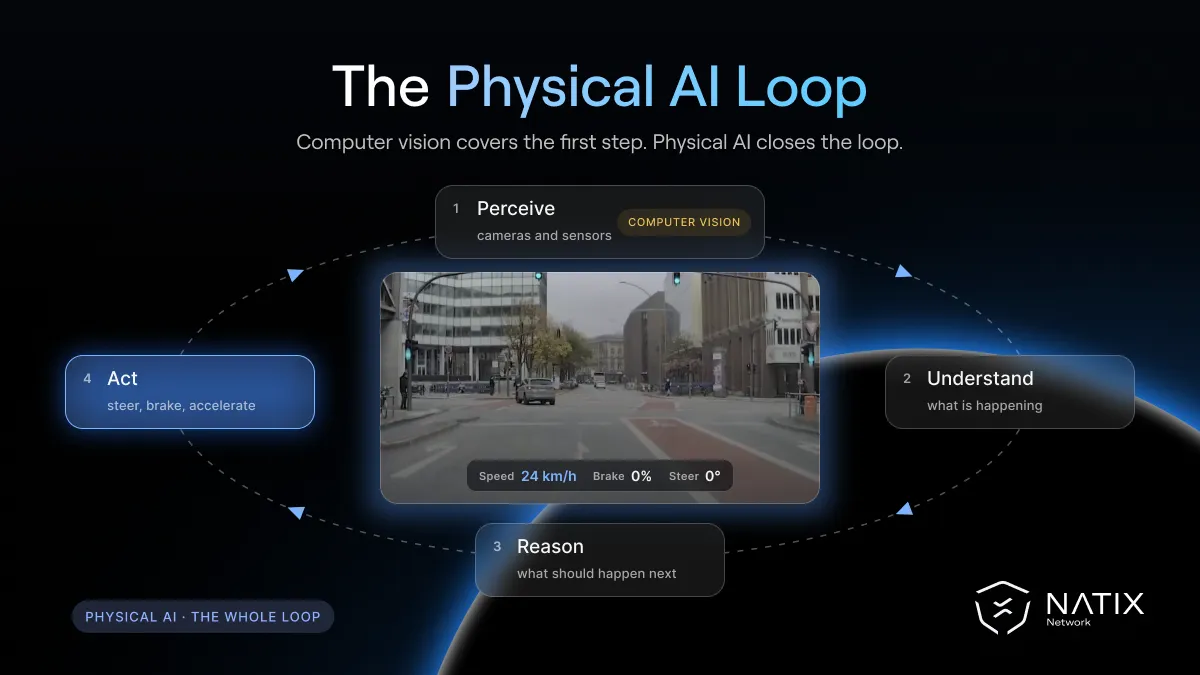
This idea is closely related to embodied intelligence, the view that intelligence develops through a body interacting with its surroundings. It also explains why the term now covers so many kinds of machines. Examples range from warehouse robots to autonomous vehicles, as our roundup of physical AI examples shows.
It helps to see the three terms as a progression rather than as competitors. Computer vision gave machines the ability to recognize what is in an image. Machine vision put that ability to work in controlled, repetitive tasks. Physical AI extends it into open, changing environments where the machine must act on its own.
Robots show this progression clearly. Early industrial robots used robotic vision mainly to locate parts in fixed positions. Newer robots need to understand cluttered spaces, handle unfamiliar objects and work alongside people, which is a Physical AI problem rather than a machine vision one.
Cars show it even more clearly. Driver assistance features use computer vision in autonomous vehicles to detect lanes, signs and other road users. Higher levels of automation must turn that perception into driving decisions. That is why data needs change as autonomy increases, a shift we covered in ADAS data vs full autonomy. Camera-first approaches push this furthest, as we argued in our piece on vision-only, mapless autonomous driving.
The first misconception is that machine vision is simply an older name for computer vision. The two overlap heavily, but the machine vision vs computer vision distinction is still useful. One names a field of study; the other names a way of applying it inside a system that has to make a decision.
The second misconception is that machine vision means low-tech and computer vision means AI. Many modern machine vision systems run deep learning models that are just as advanced as those in research labs. What makes them machine vision is the job they do and the setting they work in, not the age of the technology.
The third misconception is that better computer vision automatically produces Physical AI. Recognizing a pedestrian in an image is computer vision. Deciding how to slow down, steer around them and keep going safely is Physical AI. The gap between the two is filled with prediction, planning and a great deal of real-world experience. That is why the machine vision vs computer vision debate is only the first half of the story.
A useful test is to ask what happens after the image is processed. If nothing happens except a label or a report, it is computer vision. If a machine takes a pre-defined action, it is machine vision. If the system weighs options and chooses how to act in an open environment, it has crossed into Physical AI.
Despite their differences, machine vision, computer vision and Physical AI share much of the same technology. All three start with cameras or other sensors that turn light into data. All three increasingly rely on neural networks trained on large amounts of visual data. All three also face the same practical constraints. Compute on the device is limited, responses must be fast, and models must cope with conditions they have not seen before.
The differences sit in the layers above perception. Machine vision adds a fixed decision rule and a controlled setting. Physical AI adds understanding of how the world changes over time, the ability to plan, and a body that can move. A team building a Physical AI system can borrow many tools from computer vision. It still has to solve problems that machine vision never had to face.
Edge computing is a good example of the overlap. A machine vision camera on a production line and a robot in a warehouse both need to process images locally and respond in milliseconds. The robot, however, must also update its plan as people and objects move around it, which turns a perception problem into a decision problem.
Each step along this path changes what a model needs to learn from. Classic computer vision can learn a great deal from large collections of labeled still images. Machine vision often needs only a modest, carefully controlled set of examples for one specific task.
Physical AI needs something different. NVIDIA's glossary notes that training physical AI models requires large, diverse and physically accurate data about spatial relationships and the physical rules of the real world. A model that will act in the world has to learn how scenes change over time. It must also learn how people and vehicles behave, and what happens after an action is taken. That is the domain of physical world modeling, and it depends on video rather than snapshots.
Real-world video also captures what simulation leaves out. Simulators and synthetic data are valuable for exploring variations, but they only contain what their designers thought to include. Real recordings show the true mix of situations, lighting, weather and human behavior, including the rare moments that matter most for safety. Large collections of autonomous driving data are becoming training material for Physical AI more broadly, as we explored in our article on driving data that trains robots.
When teams weigh machine vision against computer vision for a project, the right term depends on what the system actually does. If it analyzes images or video to extract information, without controlling anything, it is computer vision. If it uses a camera to make a defined decision inside a machine or process, machine vision is the more precise term. Accepting or rejecting a part is the classic case. If it perceives an open environment and acts in it, adjusting to situations nobody scripted, it belongs to Physical AI.
Getting the term right matters beyond vocabulary. It shapes what a team should expect from the system, how it should be tested and what data it will need. A machine vision project can often succeed with a controlled setup and a few thousand examples. A Physical AI project needs far broader exposure to the real world, which makes data sourcing one of the first decisions rather than the last.
NATIX was built for the Physical AI stage of this progression. Its network has collected 207,000 hours of multi-camera footage from factory Tesla cameras driven by everyday drivers. Each recording shows the road from several synchronized viewpoints at once. That is the kind of continuous, real-world video models need when they move from recognizing scenes to acting in them.
NATIX describes its approach as decentralized physical AI, or DePAI: a network of contributors whose everyday drives become training data for robots, autonomous vehicles and world models. It is one practical answer to the question of where Physical AI will get the real-world experience it needs.
Yes, in most definitions. Machine vision applies computer vision techniques inside a machine or process to make a specific decision. Every machine vision system uses computer vision, but most computer vision work is not machine vision.
Not exactly. Robotics is the engineering of physical machines. Physical AI is the intelligence that lets those machines, and other systems such as autonomous vehicles, perceive, reason and act in the real world. A robot can exist without Physical AI if it only follows fixed instructions, and Physical AI can run in systems that are not traditional robots.
Yes. Computer vision models often learn from large labeled image collections. Machine vision systems usually need smaller, task-specific examples from a controlled setting. Physical AI needs large volumes of real-world video showing how scenes change and how agents behave over time, ideally from many places and conditions.
It can move in that direction. A system that starts with a fixed inspection task moves closer to Physical AI as its job grows. That happens when it must handle open, changing environments, choose among many possible actions and learn from new situations. Many warehouse and logistics robots sit somewhere along that path today.
The difference between machine vision and computer vision comes down to scope. One interprets images in general; the other uses them to make a specific decision inside a system. Physical AI is the step beyond both. It takes perception out of controlled settings and into the open world, where machines must understand what they see and act on it safely. As AI moves from recognizing images to acting in the physical world, its data has to move with it. Labeled pictures were enough for the first stage; the next one needs real experience.
For anyone choosing between the terms, the practical takeaway is simple. Use machine vision or computer vision to describe what a vision system does with what it sees. Reserve Physical AI for systems that act on their own in the open world.


