

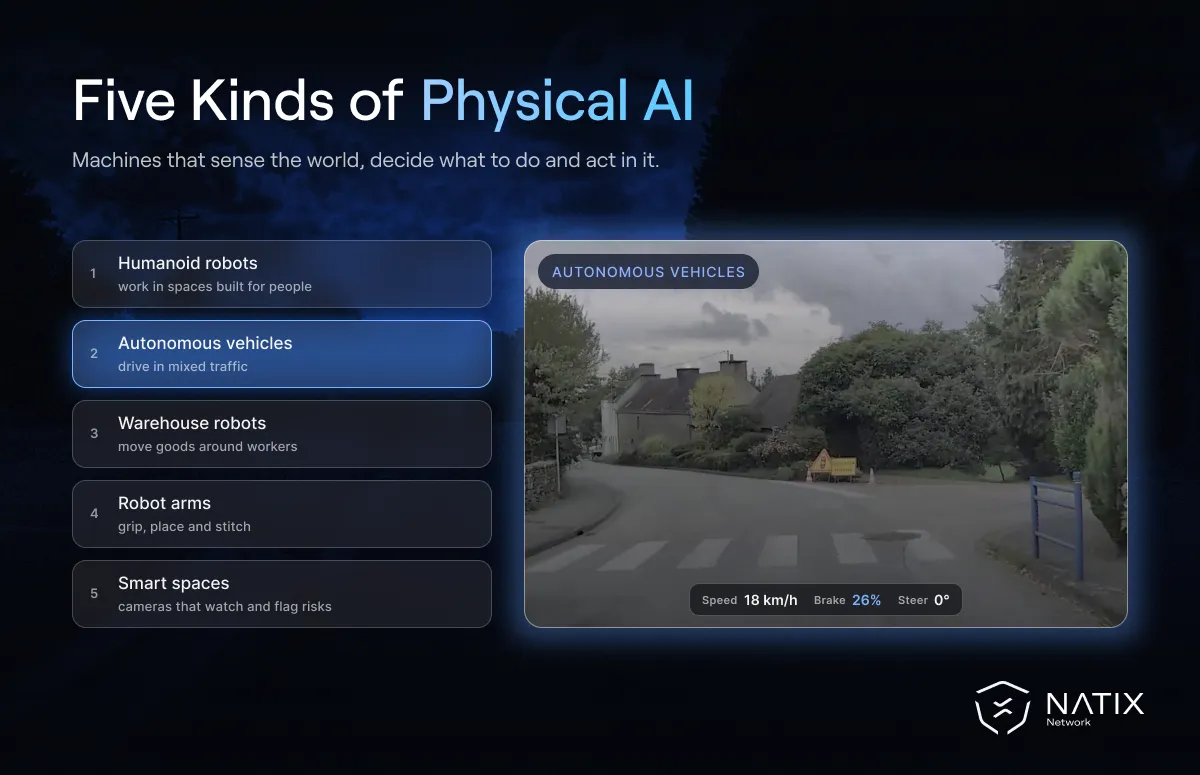
Physical AI examples are easy to spot once you know the pattern. Look for a machine that senses the real world, makes sense of it and then does something in it. A humanoid robot carrying a box, a car navigating a busy junction and a warehouse robot weaving between workers all fit that description. Each is AI that has left the screen and entered the physical world.
These systems share another trait. They learn from real experience, which is why so many of them depend on autonomous vehicle training data and other recordings of real environments. This guide gives a clear physical AI definition, walks through the main physical AI examples and shows what they have in common.
NVIDIA uses the term widely and offers a clear physical AI definition in its Physical AI glossary. It describes AI that lets autonomous systems such as cameras, robots and self-driving cars perceive, understand, reason and perform or orchestrate complex actions in the physical world.
In simpler words, Physical AI is the step after computer vision. Computer vision helps a machine understand what it sees. Physical AI uses that understanding to act, safely and in real time, in places that are messy and unpredictable. Our guide to machine vision, computer vision and Physical AI explains how the three terms connect.
Humanoid robots aim to work in spaces built for people. They need both gross and fine motor skills, and they must perceive, understand and interact with the physical world whatever the task. That makes them one of the hardest physical AI examples to get right.
Self-driving cars are among the most mature physical AI examples. They process camera and sensor data in real time to understand their surroundings, then act on it. Every second, the vehicle must interpret the scene and choose a safe action.
Autonomous mobile robots move goods through warehouses and factories. They navigate busy aisles and avoid obstacles, including people, using feedback from onboard sensors.
Robot arms that adjust their grip to the position of an object on a conveyor belt are an everyday example. At the delicate end of the scale, surgical robots are learning tasks that demand very fine control.
Factories and warehouses with networks of fixed cameras form a quieter kind of Physical AI. The system watches the flow of people, vehicles and robots, then helps plan routes and flag safety risks.
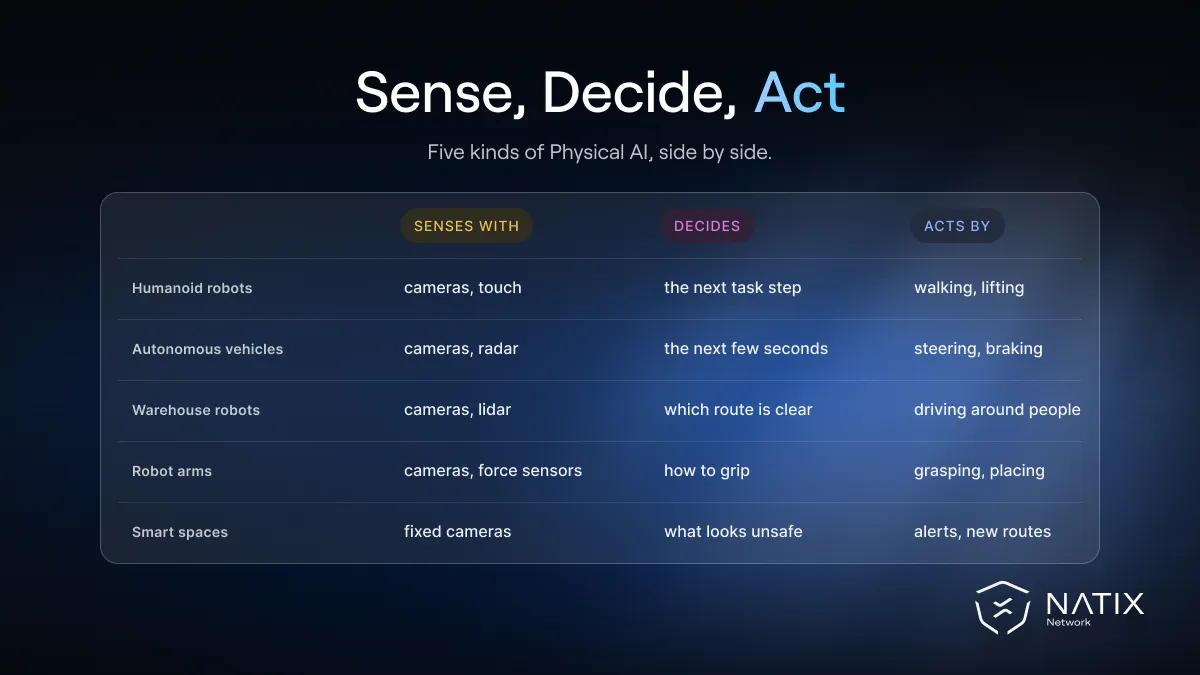
Different as they look, the physical AI examples above share four traits:
Every example runs that same loop: sense, understand, decide and act, then sense again. That loop is the heart of embodied intelligence, the idea that intelligence grows through a body interacting with its surroundings.
They also share a data problem. Each one must learn how the real world behaves, including rare situations that are hard to stage. NVIDIA's glossary stresses that training physical AI models requires large, diverse and physically accurate data about spatial relationships and the physical rules of the real world. Simulation helps, but real recordings anchor the models in what actually happens.
World foundation models are one response. NATIX and Valeo are building one of the largest open-source multi-camera world foundation models, as described in our announcement of the NATIX and Valeo collaboration. Models like these learn how scenes evolve so that physical AI systems can be trained and tested on realistic experience.
Testing a physical AI system is harder than testing software that runs on a screen. A mistake in the real world can damage equipment or hurt people, so most testing starts in simulation. Physics-based simulation gives autonomous machines a safe, controlled place to practice. Reinforcement learning then lets them repeat tasks many times before trying them for real.
Simulation has limits, though. It only contains what its designers modeled, and real environments keep producing situations nobody planned for. That is why the strongest physical AI programs combine three layers. They use simulated practice, testing on recorded real-world data, and carefully supervised trials in the real world. Each layer catches problems the others miss.
The more an example has to act on its own, the more this testing matters. A robot arm in a fenced-off cell can be tested thoroughly in a narrow setting. A car on public roads or a humanoid robot in a home faces an almost endless range of situations. Its testing has to draw on a correspondingly wide range of real experience.
Collecting enough real-world data is expensive for any single company. One response is to crowdsource it. NATIX calls this approach DePAI, decentralized physical AI, where everyday contributors supply the real-world data that physical AI systems learn from.
Driving is a natural starting point, because cars already move through the busy, shared environments that robots and autonomous systems need to understand. As physical AI examples spread from factories to streets and homes, that kind of distributed, real-world collection is likely to matter more and more.


