

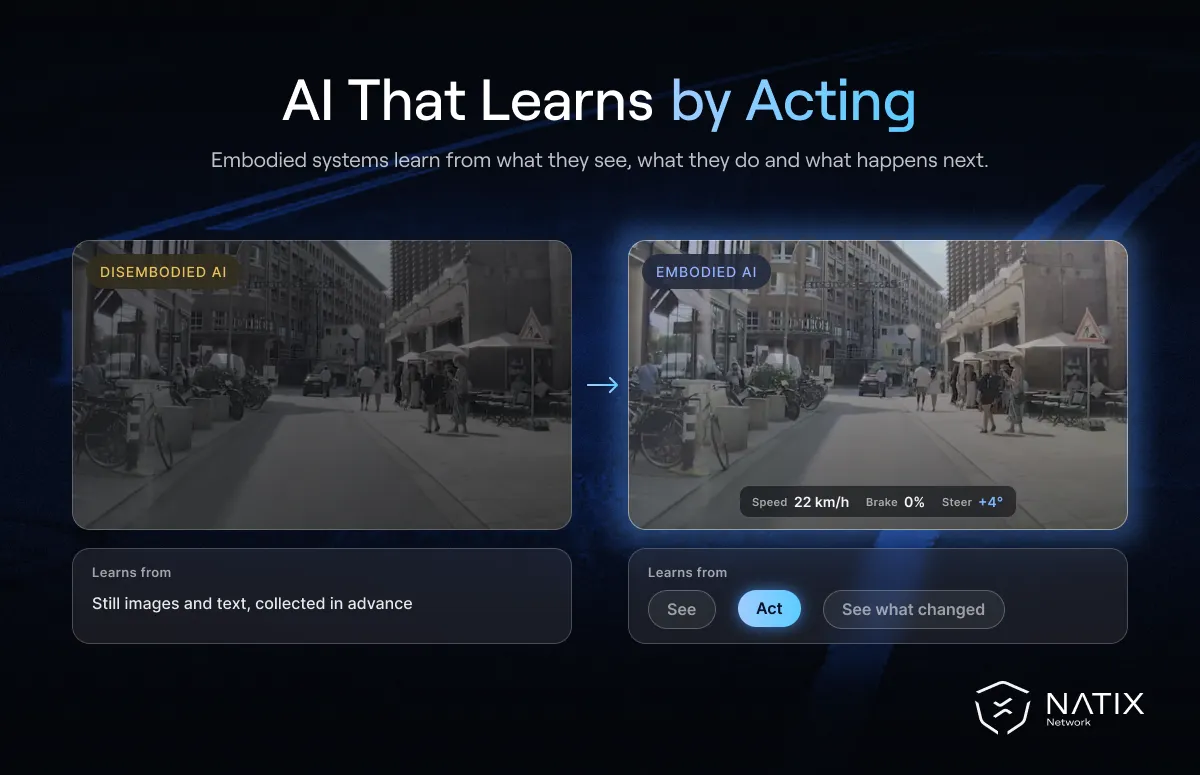
Embodied intelligence is the idea that intelligence develops through a body that senses and acts in the world, not only through a mind that reads and reasons. A chatbot learns from text. An embodied system learns from the consequences of its own movements: what it sees, what it does, and what happens next. As AI moves from recognizing images to operating robots and vehicles, that difference is becoming one of the most important ideas in the field.
It is also a practical idea. Systems that act in the physical world need training data that captures action and consequence. A good example is long stretches of real-world driving data where every camera frame is tied to what the vehicle did next. This guide explains what embodied intelligence means, how it differs from other AI, and why the data behind it looks so different.
In plain terms, the idea means that a system's understanding is shaped by having a body and interacting with its surroundings. A Towards Data Science explainer on Physical AI puts the distinction clearly. Physical AI is about acting in the world, while embodied AI is about intelligence being shaped by a body and its interaction with the environment. NVIDIA uses similar language, describing robots and autonomous vehicles as "physical-AI-embodied systems" in its Physical AI glossary.
The idea has roots in robotics and cognitive science. Researchers noticed that many skills humans find easy, such as catching a ball or walking across uneven ground, are hard to learn from descriptions alone. They depend on constant feedback between perception and movement. An embodied system learns those skills the same way: by trying, observing the result and adjusting.
Most of the AI people use every day is disembodied. Language models, image classifiers and recommendation systems process data that has already been collected. They never move, never touch anything and never see the effect of their own actions on the world.
Embodied AI is different in three ways:
That makes embodied intelligence a close cousin of Physical AI. The two terms overlap heavily. Physical AI usually describes the overall system that perceives, reasons and acts. Embodied intelligence describes how the intelligence inside that system is formed.
The central mechanism is the perception–action loop. The system observes its surroundings, chooses an action, observes the result and updates its understanding. Over many repetitions, it learns which actions lead to which outcomes.
Modern driving systems show this loop clearly. In end-to-end autonomous driving, a single model maps camera input directly to driving behavior. Instead of hand-written rules for every situation, the model learns from many examples of what skilled drivers actually did in each scene. The driving itself becomes the teacher.
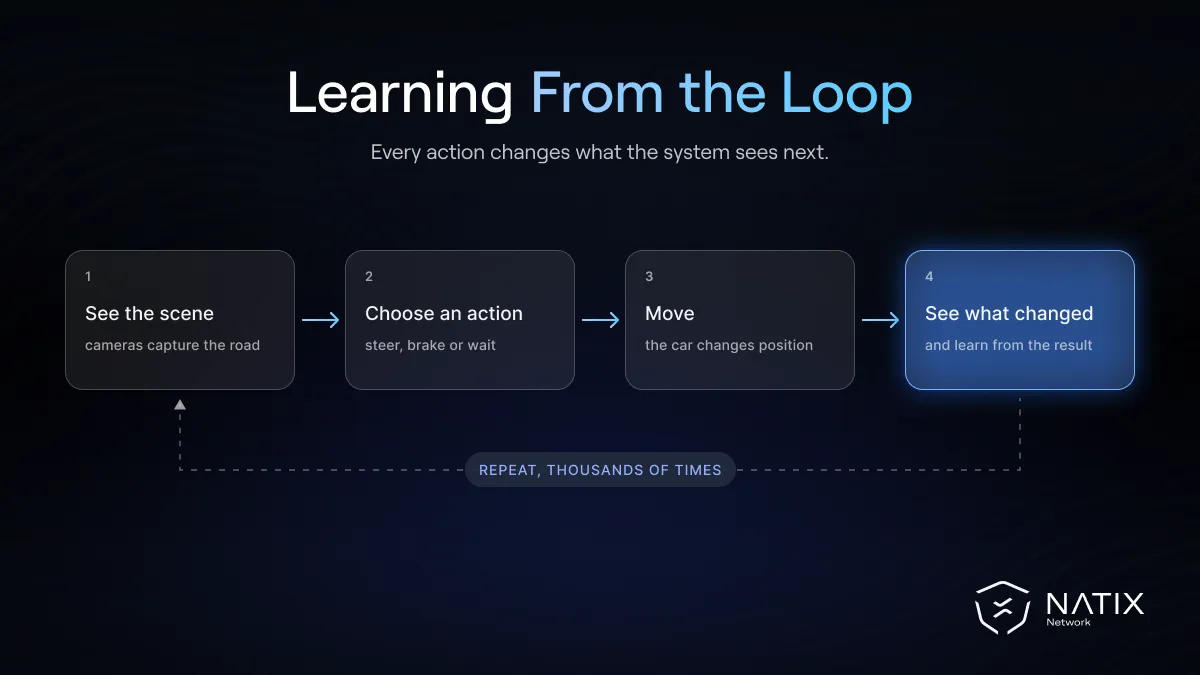
People often picture humanoid robots when they hear embodied AI. Cars are a less obvious but very important example. A self-driving car has a body, sensors and actuators. It moves through a shared, unpredictable world, and every decision it makes changes the situation around it.
That is why autonomous driving has become one of the main proving grounds for embodied AI. Lessons learned from cars, such as how to predict other road users or how to act safely under uncertainty, are increasingly carried over to robots. Our guide to robotic vision looks at how robots perceive the world they act in. Our comparison of machine vision, computer vision and Physical AI places embodied intelligence in the wider picture.
World models give embodied systems a way to learn without risking a real body for every lesson. A world model learns how a scene is likely to evolve, so an embodied system can imagine the outcome of an action before taking it. We explain the wider interest in this approach in our article on why world models matter.
World models still need real experience to learn from. Orbis 2, a driving world model from the University of Freiburg with NATIX as its largest single data source, is one example. As described in our announcement of Orbis 2, NATIX data made up more than 40 percent of its training mix, and the model held up better than comparable models on Waymo data it had never seen. Real multi-camera footage keeps its predictions tied to how real roads and real road users behave.
Embodied intelligence changes what good training data looks like. Still images with labels are not enough, because they show what a scene contains but not what happens next. Embodied systems need:
This is why real-world driving footage has become valuable well beyond cars. It is one of the largest sources of recorded experience from an agent acting in a busy, shared environment. Embodied intelligence turns that experience into the foundation for machines that do not just see the world, but learn to move through it.


