

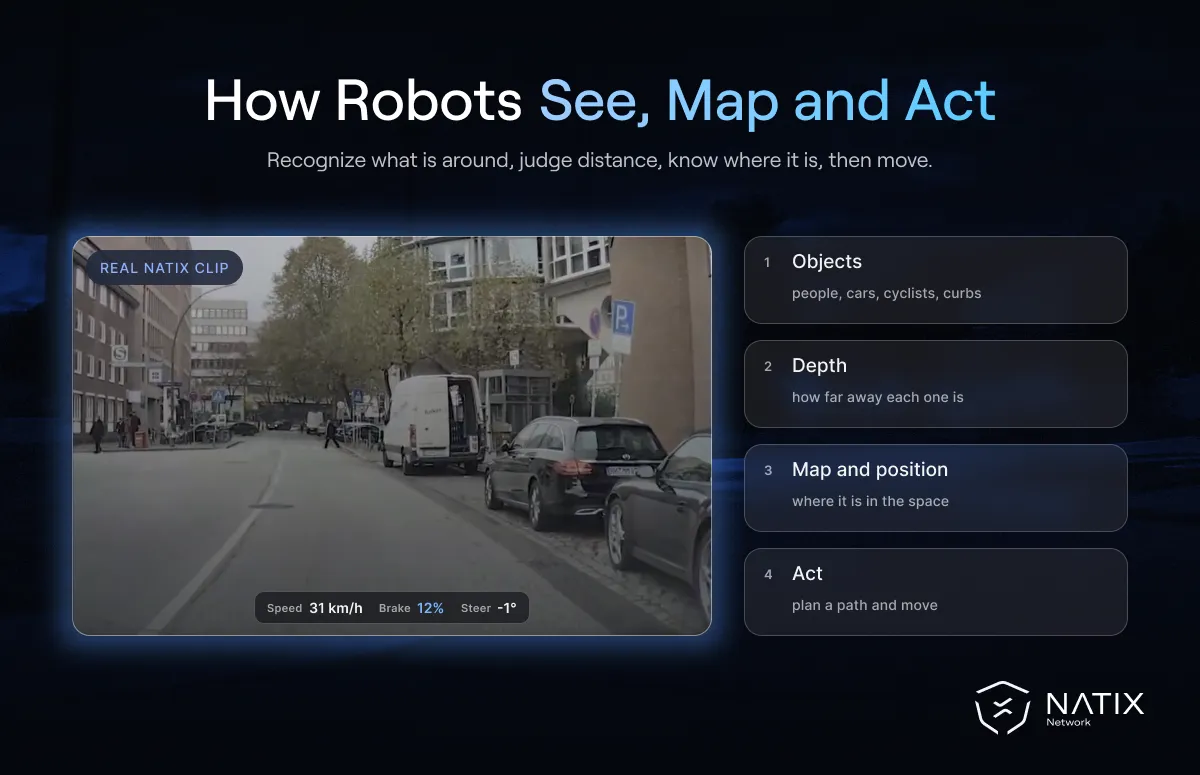
Robotic vision is the ability of a robot to turn camera input into movement. It covers everything from recognizing objects and judging distance to building a map of the surroundings and deciding where to go next. Unlike a camera that only records, a robot with vision has to act on what it sees. It often does so in places that change from one moment to the next.
That requirement shapes how robotic vision is built and trained. A model that will steer, grasp or navigate needs to learn from video of real environments. Some of the richest examples come from an unexpected source: a large camera dataset recorded from vehicles on public roads. This guide explains how robots see, where robotic vision differs from machine vision, and what data it needs.
At its core, this kind of vision combines three abilities. The robot must recognize what is around it, understand where those things are in three-dimensional space, and use that understanding to plan a movement. Remove any one of the three and the robot either sees without acting or acts without understanding.
This is why robotic vision sits between classic computer vision and Physical AI. It uses the same image models as computer vision, but its purpose is always tied to a body that moves.
Robot perception usually breaks down into a few core tasks:
These tasks together give a robot what researchers call spatial intelligence: an understanding of what is where and how things relate in space. NVIDIA's Physical AI glossary gives two everyday examples. Autonomous mobile robots in warehouses navigate complex spaces and avoid obstacles, including people, using direct feedback from onboard sensors. Robot arms adjust their grasping strength and position based on how an object sits on a conveyor belt.
Machine vision and robotic vision are often confused. The industrial vision company Mech-Mind notes that machine vision often implies robotic vision as well, in its comparison of machine vision and computer vision. Machine vision typically sits in a fixed position, inspects items in a controlled setting and triggers a defined action, such as rejecting a faulty part. A robot arm that picks parts from a tray in the same spot every time is still close to that world.
The picture changes when the robot must handle variety. Objects sit in random positions, light changes, people move nearby, or the robot drives itself through a building. At that point the robot needs perception that generalizes, not a rule that works under one set of conditions. That shift is what moves robotics toward embodied intelligence, where a system learns by acting rather than by following fixed instructions.
Robotic vision's history follows the same path as the wider field. Early industrial robots used simple vision to find parts in known locations. Later systems added better cameras and learned models, which let them pick mixed items from bins and work in less structured spaces.
Today's frontier is mobile and general-purpose robots: delivery robots on sidewalks, autonomous vehicles in traffic and humanoid robots in homes and factories. All of them share a hard problem. They must move safely through spaces full of people and objects that do not follow a script.
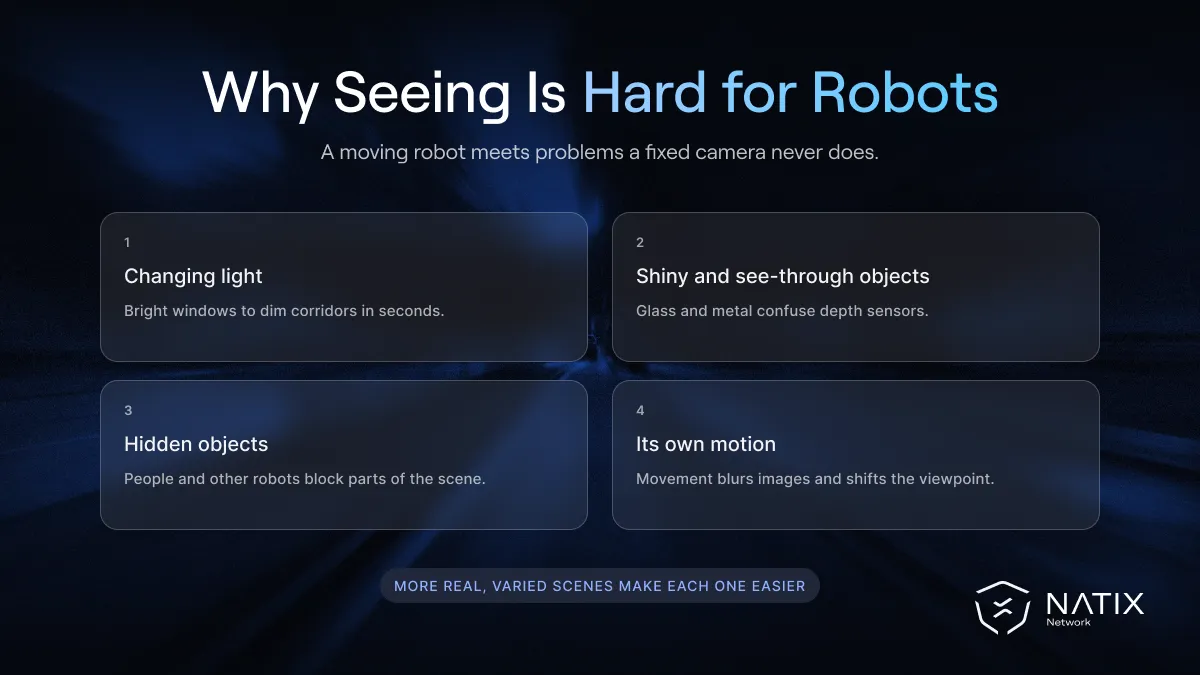
Several problems make perception harder for a robot than for a fixed camera. Lighting changes as the robot moves, from bright windows to dim corridors. Transparent and shiny objects confuse depth sensors. People and other robots block parts of the scene, so the system must reason about what it cannot see. And the robot's own motion blurs images and shifts its viewpoint every moment.
Each of these problems is easier to solve when the model has already seen many similar situations. That is why the breadth of training data matters as much as the model design. A robot trained only in one tidy test room will often stumble the first time it meets a crowded, changing space.
Robots learn to see from data, and the right data depends on the task. A factory inspection robot can learn from a carefully controlled image set. A robot that moves through public spaces needs far more. It needs video of real environments, many viewpoints, varied lighting and weather, and the behavior of people and vehicles over time.
Collecting that data with robots alone is slow and expensive. Driving footage offers a shortcut. Vehicles already record streets, crossings, pedestrians and cyclists every day, in exactly the kind of shared, changing environments that mobile robots must handle. We explore that transfer in our article on how driving data is training the next generation of robots.
Spatial context matters as well. Our partnership with MaprGo, described in the announcement of spatial AI intelligence for Physical AI, turns real driving footage into structured road intelligence and simulation-ready maps. For robots that operate outdoors, that kind of spatial understanding is part of seeing the world correctly.
Robotic vision is where seeing becomes doing. The better the real-world data behind it, the more confidently robots can move through the places people live and work.


