

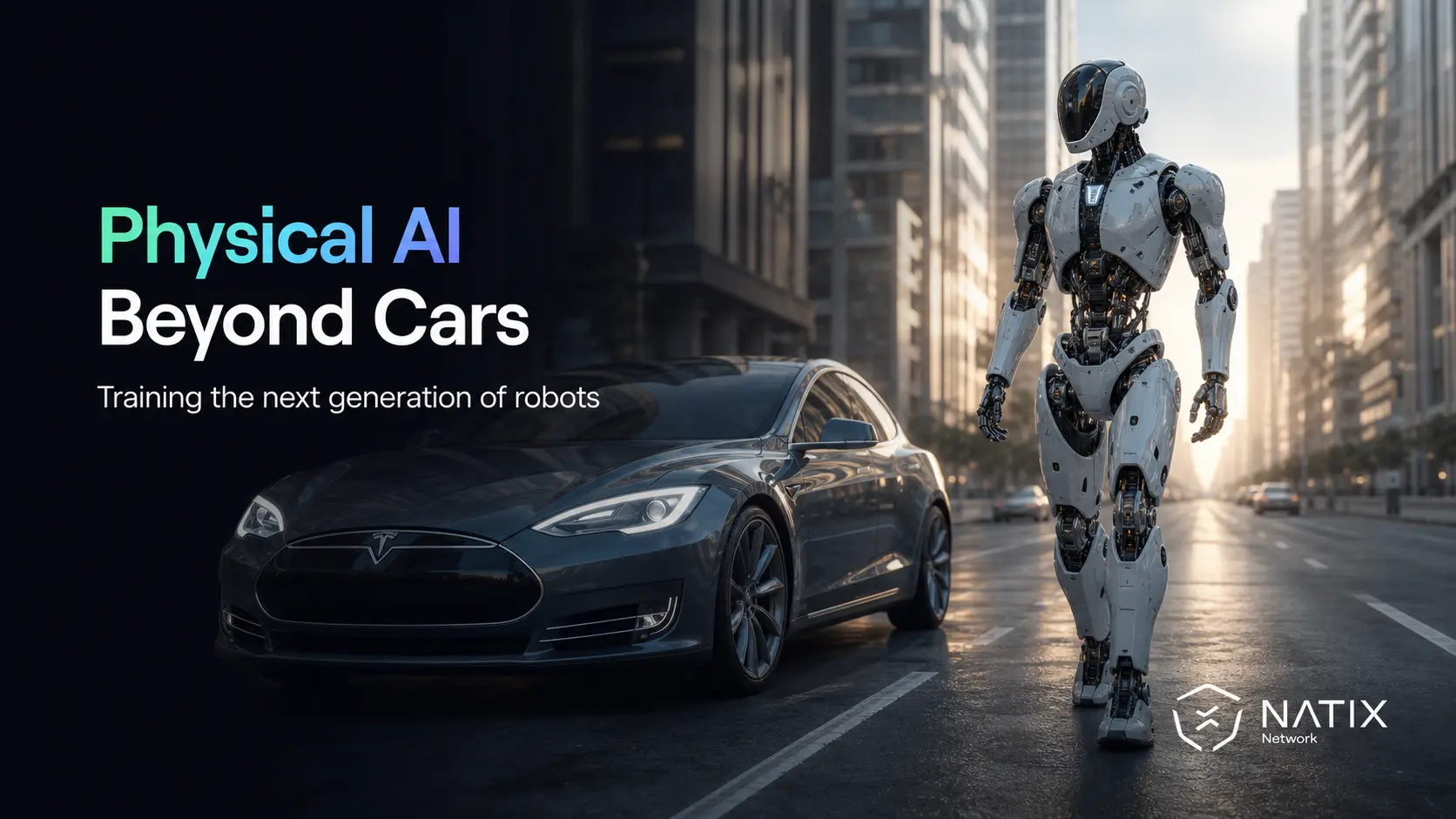
For years, robotics lived inside controlled environments. Factory floors, warehouse aisles, surgical suites, all places where the world could be measured, fenced in, and made predictable. The robots that worked in those spaces worked because the world cooperated.
That phase is ending. Humanoid platforms are stepping out of demos and into homes, hospitals, and unstructured workspaces. Delivery robots are crossing public streets. General-purpose agents are being trained to manipulate objects they have never seen and navigate environments no engineer designed for them. The promise is enormous. So is the problem underneath it.
The bottleneck for the next generation of robots is the same one that autonomous driving hit first. It is not actuators. It is not compute. It is the data needed to teach a machine how the physical world behaves.
This matters because Physical AI, as a category, is no longer a single industry. It is becoming a shared training problem, and the field with the largest, most diverse, most action-rich dataset of the real world is the field that has already spent a decade solving it. That field is autonomous driving.
Physical AI is shorthand for any system that perceives, reasons about, and acts in the physical world. A self-driving car is Physical AI. So is a humanoid sorting groceries, a quadruped inspecting a power plant, and a robot arm working alongside a human technician.
Each of these systems looks different on the outside. On the inside, they depend on the same set of capabilities.
A robot has to understand motion. It has to know that a person walking toward a door will keep walking. It has to predict that a cup near the edge of a counter will fall if nudged. It has to interpret a cluttered room the same way a human does, by separating objects from background, predicting intent, and reasoning about cause and effect.
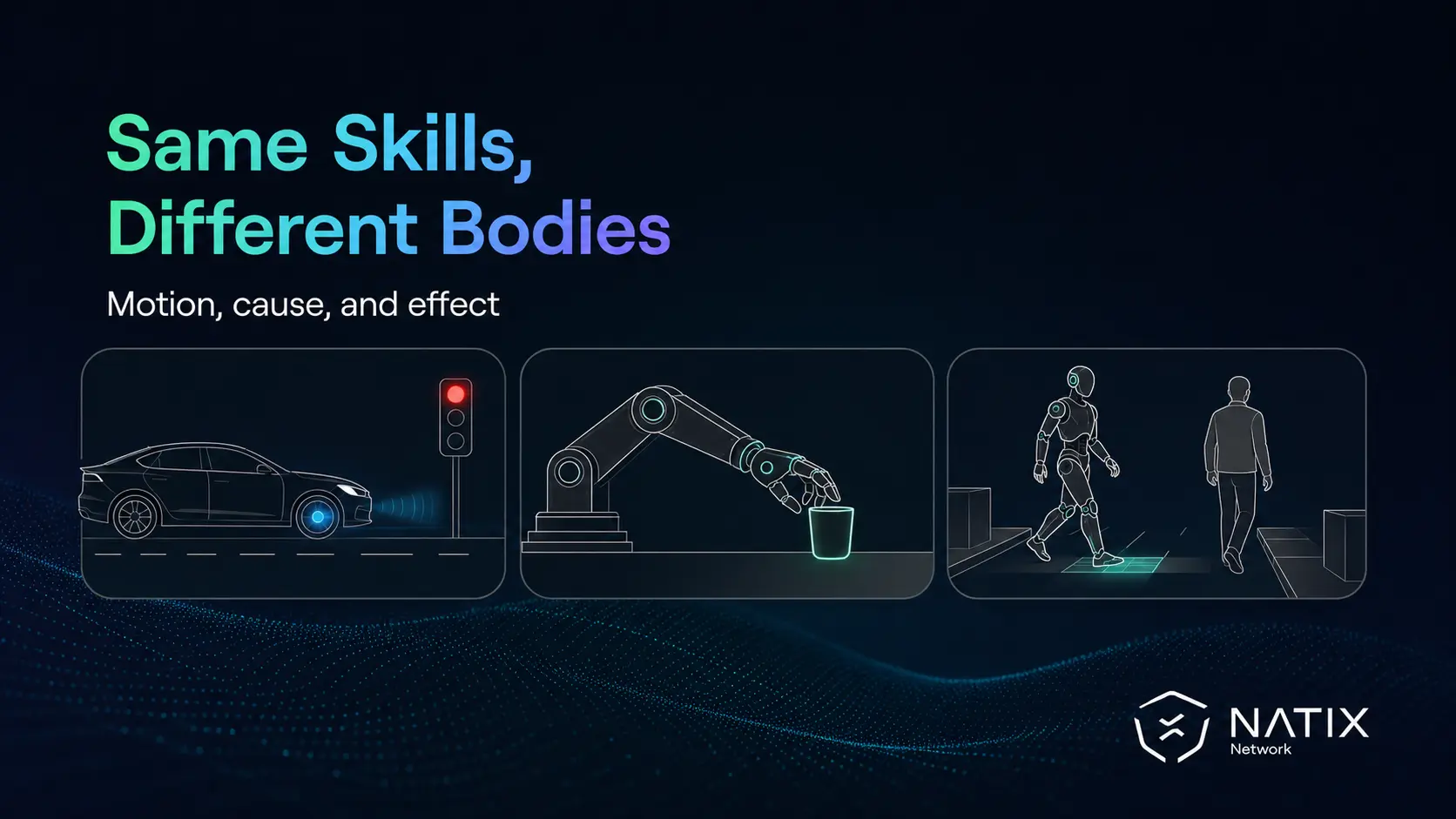
Humans do not acquire these abilities by memorizing rules. We arrive with years of physical intuition before we ever pick up a glass or walk through a crowd. Machines do not. They have to learn it from data.
This is what makes Physical AI hard. The hardest part is not building the body. It is teaching the mind. And the mind cannot be taught without exposure to a world that does not cooperate.
The autonomous driving industry has, almost by accident, built the largest training corpus of human physical behavior ever assembled.
Driving fleets generate enormous volumes of structured, time-aligned, multi-camera video. Every clip is paired with vehicle motion, steering input, acceleration, and braking. Every scene contains pedestrians, cyclists, weather, lighting changes, traffic interactions, near-misses, and ordinary moments of human behavior in public space. Driving data is not just footage of cars. It is footage of how people move, how objects interact, and how cause and effect plays out in a real environment.
No other Physical AI domain has produced anything close.
Industrial robotics datasets are narrow by design. Manipulation datasets are small. Lab footage of humanoid robots is heavily curated. Driving, by contrast, has been collecting at planetary scale for years. It has cities, suburbs, deserts, mountains, monsoons, blizzards, weddings, protests, construction zones, and every variety of human improvisation. It is the closest thing the field has to a foundation dataset of the physical world.
The more you look at what robotic foundation models need to learn, the more driving data starts to look like the obvious place to learn it. Object permanence, multi-agent prediction, social navigation, physics under uncertainty, all of these emerge naturally from a large enough driving corpus.
This is why companies that started in autonomous driving are now training models for general robotics. The data was always going to transfer. The industry just had to catch up to the idea.
If driving data is the corpus, World Foundation Models are the engine that turns it into general-purpose training material.
A world model is not a simulator in the traditional sense. Traditional simulators are like movie sets. They are expensive to build, hard to scale, and limited by what the designer thought to include. A world model is different. It learns how scenes evolve from real video and can generate physically coherent variations of what it has seen. A rare event captured once in the real world can become hundreds of slightly different versions of that event, each one grounded in physics rather than imagination.
This is the moment driving data crosses the species line.
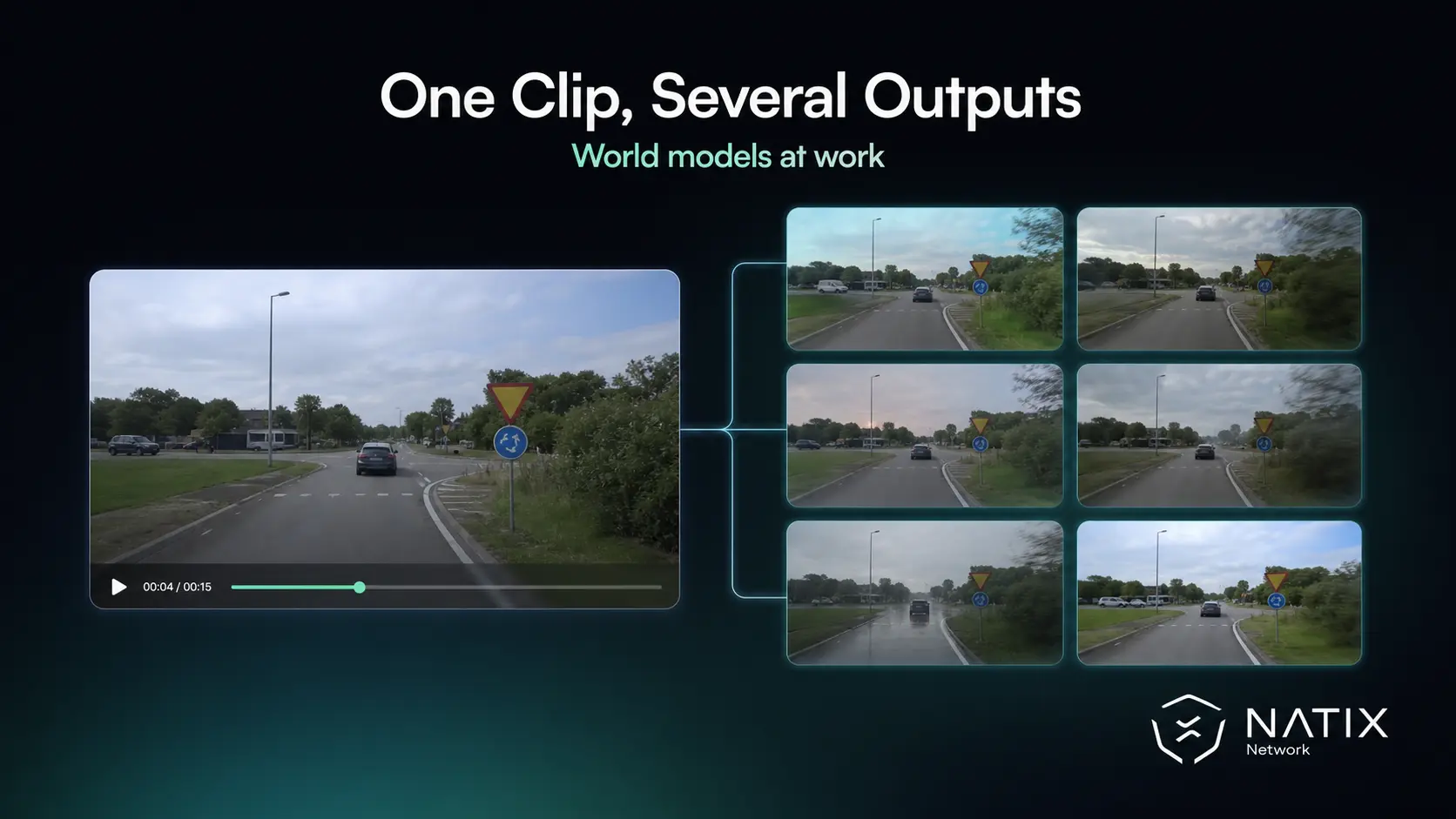
If a model learns from billions of frames of real driving, it does not just learn how to drive. It learns how the physical world behaves. It learns lighting, momentum, occlusion, human movement, and the rhythm of public space. That knowledge is not exclusive to cars. A humanoid that needs to walk through a crowded train station benefits from the same understanding of how people move and react. A delivery robot navigating a sidewalk benefits from the same intuition about timing, distance, and intent.
This is why NVIDIA built Cosmos as a platform aimed at both autonomy and robotics. It is why Wayve frames its vision-language-action research as a foundation for embodied agents, not just for cars. The current World Foundation Model landscape shows the same pattern across the leading labs. Driving is the entry point. Physical AI is the destination.
Raw driving footage is not useful by default. Without structure, that footage is just storage cost.
This is where Vision-Language Models come in. A VLM turns unstructured video into something searchable and machine-readable. It lets a researcher ask for pedestrians stepping off the curb at dusk and receive a curated set of clips. It lets a robotics team mine the same archive for an object falling from a shelf or a person reaching across a table. The same archive that supplies edge cases for autonomous driving can supply training material for a manipulation policy.
VLMs are the bridge between a giant video archive and a useful dataset. Without them, you have a warehouse. With them, you have a library.
This is why the line between driving data and robotics data is blurring. Once footage is structured by a VLM, the question is no longer what was this collected for. It becomes what scenes does it contain, and which model needs them. A clip of a near-miss can train a driving policy on Monday and a humanoid avoidance model on Tuesday. That is what searchable multi-camera video enables in practice.
Synthetic data is excellent for coverage. Real-world data is essential for grounding.
This distinction matters more in robotics than people often realize. A foundation model that has only been trained in simulation will inherit the assumptions of its designers. It will learn the physics that the simulator chose to model, the lighting the simulator chose to render, and the human behavior the simulator chose to include. The first time it meets the real world, those assumptions break. The sim-to-real gap is not a small adjustment. It is a structural problem.
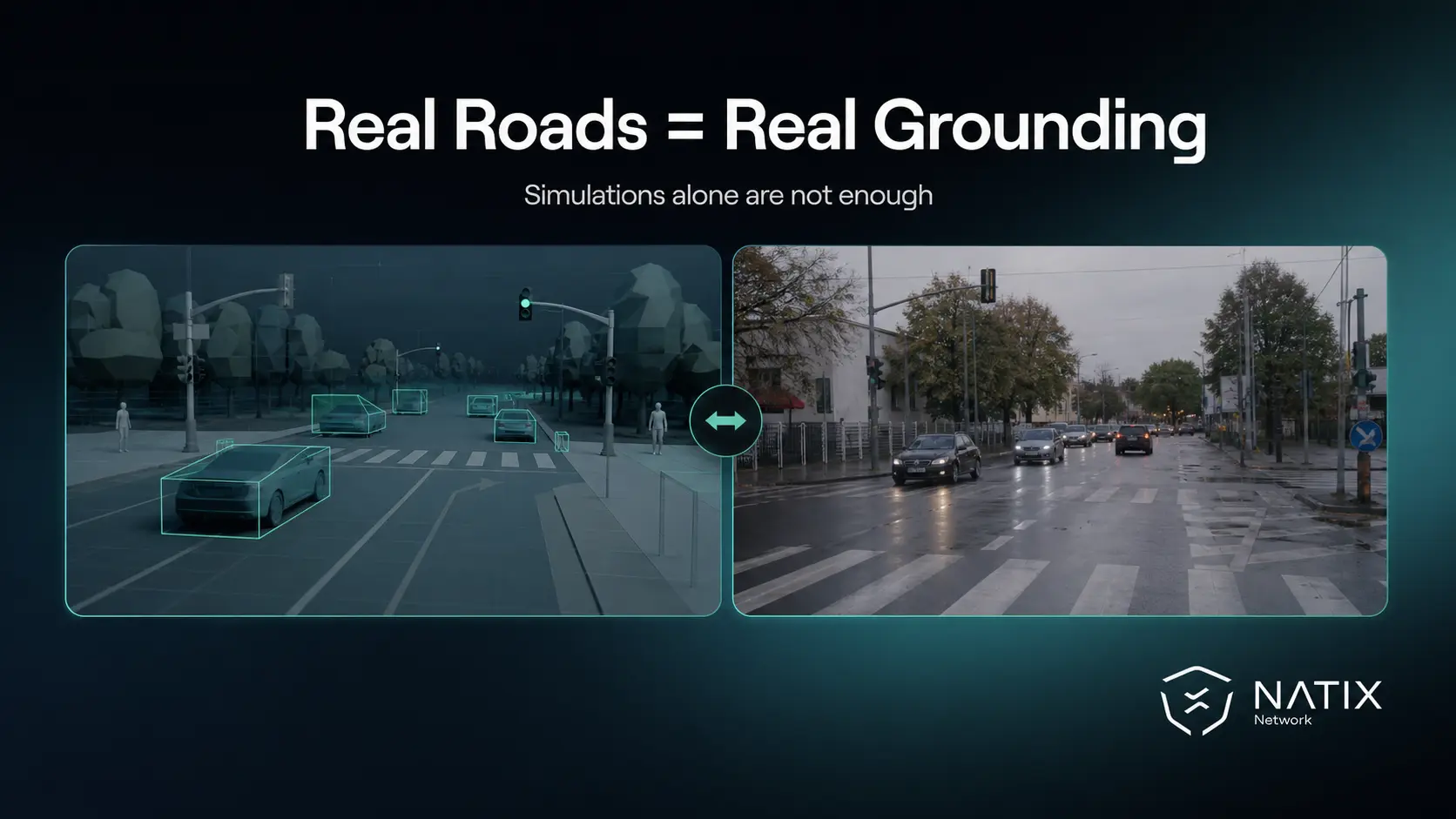
Autonomous driving learned this lesson the hard way. The field spent years assuming that more simulation would close the gap. It did not. What closed the gap was scaled, diverse, real-world data captured across geographies, weather, and edge cases that no designer had imagined.
Robotics is on the same path. Synthetic environments will continue to be useful for volume and control. They will not, on their own, produce models that perform reliably in the real world. The systems that succeed will be the ones trained on a foundation of actual physical experience, then expanded with synthetic variation. Driving data is the most credible source of that foundation that currently exists at scale.
This is where the data layer becomes the constraint. Most autonomous driving companies have data, but that data is narrow. It is front-facing, geographically limited, and tied to a single product roadmap. For Physical AI to generalize, the underlying corpus has to look different. It has to be multi-camera, geographically diverse, and structured for use across many models.
That is what NATIX is building.
VX360 is a low-cost, surround-view capture system designed to ride inside ordinary vehicles around the world. It captures the scene from every angle, not just the road ahead, because the world does not happen only in front of a car. Rare events unfold across angles, and the most valuable training data is often in the periphery. By distributing capture across thousands of contributors, the dataset scales geographically in a way that single-fleet operators cannot match.
That data then feeds the layer above it. Together with Valeo, NATIX is building one of the largest open-source multi-camera World Foundation Models, aimed at training, testing, and validation for autonomy. With MaprGo, the same footage is turned into machine-readable spatial intelligence, including signs, lanes, and OpenSCENARIO-ready data for simulation. With Nomadic ML, the archive becomes searchable for case mining and validation. These are not separate products. They are layers of the same Physical AI stack.
The point is not the individual tools. The point is that the same real-world data, captured once, can train a driving model, a world model, a robotics policy, and a spatial intelligence layer. That is what makes decentralized Physical AI infrastructure different from a traditional data pipeline. It is built to serve many models at once, across many domains, including ones that do not exist yet.
Robotics will not be rebuilt from scratch. The next generation of robots will be trained on the same foundation that autonomous driving has spent the last decade assembling. The data, the world models, the validation workflows, the searchable archives, all of it carries over.
This is good news for the field. It means the long, expensive work of teaching machines how the world behaves does not have to be repeated for every domain. A robot that learns motion from driving data does not need to relearn motion in a warehouse. A humanoid that inherits a world model trained on real public spaces starts with intuition that no synthetic environment can match.
It is also a strategic reality. The companies that own the real-world data layer will shape what the next generation of robots can do. Not because they control the models, but because they control the training material that makes those models possible.
In the end, Physical AI is not about who builds the smartest robot. It is about who has seen the most of the world the robot will live in.


