

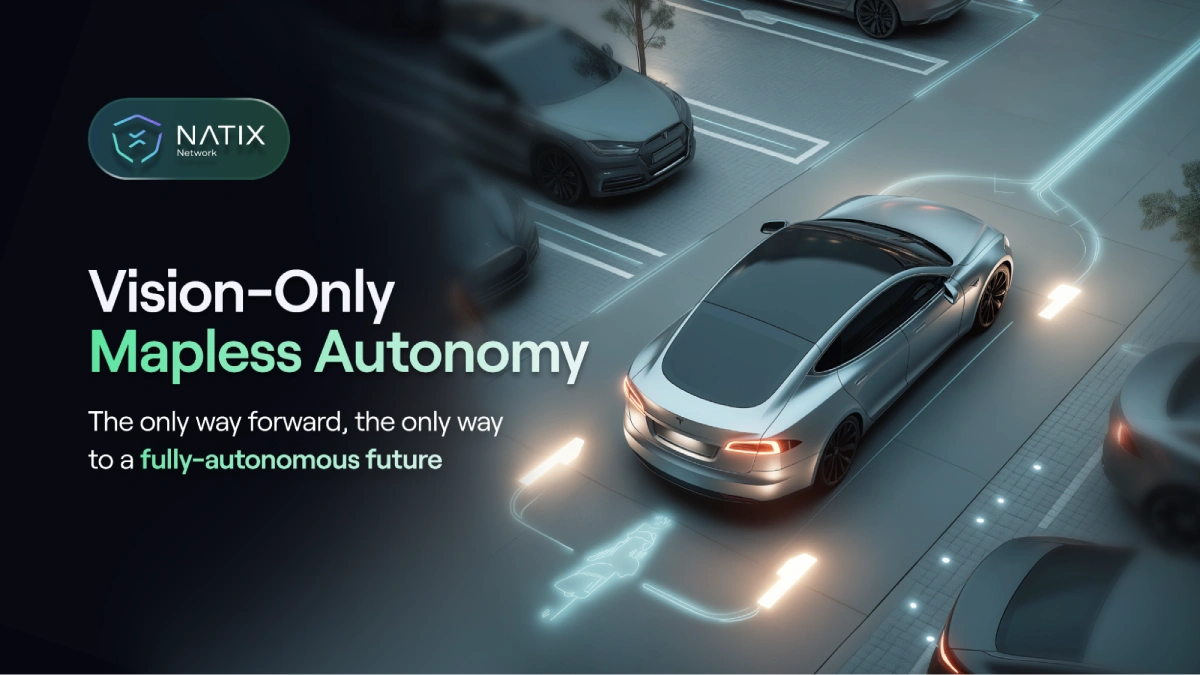
Imagine two autonomous vehicles entering the same intersection for the first time. One depends on a long list of sensors and pre-built HD maps. The other uses only cameras and real-time understanding of its surroundings. When something unexpected appears, the first vehicle hesitates. The second simply sees it and reacts.
For years, the industry believed the first approach was the only path to autonomy: add more sensors, build heavier HD maps, and fuse everything together. But this strategy is now revealing its limits. The rise of vision-only perception and mapless driving is showing that a simpler architecture is not only more elegant — it is more practical, more adaptable, and far more scalable.
The shift is happening because reality is forcing it.
Developing an autonomous vehicle with a full sensor stack is extremely expensive. A typical robotaxi configuration with multiple LiDARs, radars, and high-resolution cameras can cost as much as $100,000 per vehicle. For companies operating fleets of hundreds or thousands of vehicles, this becomes a massive financial burden.
The cost is only part of the problem. Each additional sensor layer introduces more complexity: more calibration, potential points of failure, power consumption, and maintenance. A multi-sensor system is slower and works well in controlled pilot zones, but doesn’t perform as well in high-speed environments and becomes impractical to deploy at scale in normal consumer vehicles. It is one of the reasons robotaxi programs relying on a full sensor stack have remained geographically limited despite years of investment.
By contrast, a vision-first system dramatically reduces hardware cost and simplifies scaling. Cameras are cheap, small, reliable, and already built into every modern vehicle. As AI improves, the economic advantage of vision-only becomes too significant to ignore.
For years, the industry assumed autonomous driving required expensive LiDAR and radar arrays. That changed when Tesla publicly shifted its system to a vision-only approach, removing radar from all new vehicles and relying on its eight-camera setup. Over time, Tesla demonstrated that with the right neural network architecture and enough diverse real-world data, cameras alone can learn depth, motion, and 3D structure well enough to navigate complex roads.
In 2024, Xpeng, a leading Chinese developer of autonomous driving technology, followed the same path, announcing a move away from LiDAR-heavy designs toward a camera-only system. Their reasoning was straightforward:
These examples make something clear. The bottleneck is no longer the camera hardware. It is the quality, diversity, and global coverage of the data you train on. The companies that solve that problem will be the ones that scale autonomous driving worldwide.
Perception alone isn’t the full story. Most autonomous systems still rely on HD maps, which are highly detailed digital maps that store precise information, enabling autonomous vehicles to localize themselves on the road and identify where lanes, intersections, and traffic signs are located. But the world changes faster than maps can be updated. When a lane is repainted overnight or a sign is moved, a map-dependent system struggles.
A mapless system doesn’t need to rely on a pre-recorded blueprint of reality. It simply understands the road based on what the cameras see in the moment. It identifies lanes, drivable space, signs, traffic flow, and obstacles without external help.
This approach reacts faster, adapts better, and eliminates the brittleness that comes from outdated maps. It also removes the need for constant connectivity and reduces security risks associated with transmitting and storing huge map databases.
Most importantly, a mapless system can be deployed anywhere without waiting for detailed maps to be built first.

Vision-only systems and mapless planning both require vast amounts of real-world data, especially 360° camera data. A single front-facing camera cannot teach an AI how traffic behaves behind, beside, or around a vehicle. It cannot reveal global driving culture, unpredictable human behavior, or rare edge cases. For the autonomous driving stack to learn how the world works best, it needs to know how objects act, from all angles.
This is where traditional datasets fall short, as data scarcity remains a key bottleneck of Physical AI innovation, along with insufficient computing resources.
NATIX fills this gap by collecting synchronized multi-camera footage from Tesla vehicles equipped with the VX360 device across multiple continents. This includes highways, residential streets, complex intersections, rural roads, bad weather, night scenes, and the countless exceptions that never appear in scripted tests.
Such diversity is essential. World models, simulation engines, and autonomous driving systems all require a rich foundation of real-world, multi-view data to learn how the world actually behaves. Without it, the system cannot generalize beyond a small set of conditions.
When vision-only perception, mapless driving, and globally diverse 360° data come together, they form a system that can scale across cities, countries, and driving cultures without massive overhead.
A vision-only, mapless stack can adapt instantly to road changes. It can be deployed without waiting for maps to be created. It works with simpler, more affordable hardware. It behaves consistently across different regions. Most importantly, it mirrors the way humans drive: by seeing, understanding, and reacting.
Expensive LiDAR rigs, fragile HD maps, and complex fusion architectures work only in controlled environments. They do not scale to millions of real drivers, real roads, and real conditions. The simpler architecture does. It is now becoming clear that this approach is not just viable. It is necessary.
Autonomy is undergoing a major reset. The old belief that more sensors and heavier maps would unlock full autonomy is fading. In its place, a new architecture is rising, one that is more efficient, more adaptable, and far more scalable.
Vision-only systems can now perceive the world with remarkable accuracy.
Mapless planning removes the bottleneck of outdated or incomplete maps.
Large, globally diverse 360-degree datasets make true generalization possible.
This combination points to a future where autonomous systems can operate anywhere, not just in carefully mapped zones. Vision-only, mapless autonomy is no longer an experiment. It is becoming the clear path toward globally scalable, real-world AI.


