

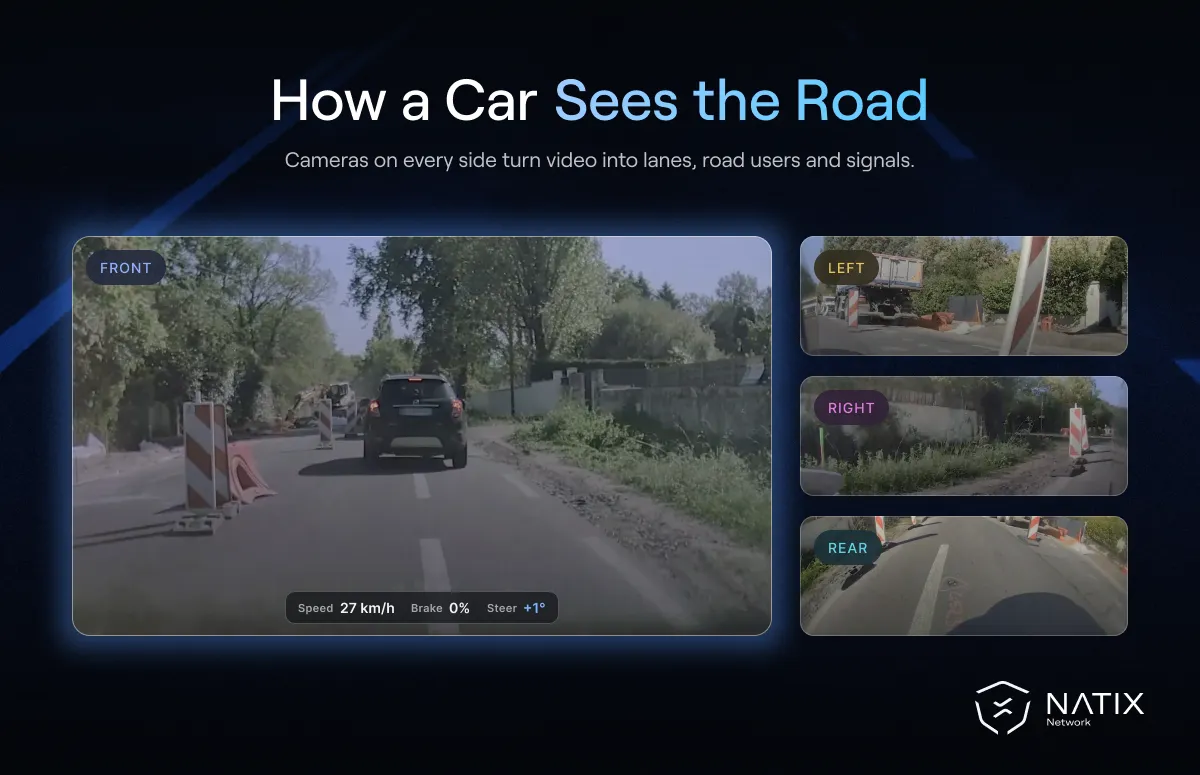
Computer vision in autonomous vehicles is the technology that turns camera video into an understanding of the road. It finds lanes, reads signs, spots pedestrians and estimates how far away every vehicle is. Everything a self-driving car decides depends on how well it sees. That makes perception one of the hardest and most important parts of the whole system.
It is also the part that depends most on data. A vision system learns from enormous amounts of recorded driving, and the more varied that recording is, the better it handles the unexpected. That is why teams invest so heavily in a large real-world driving dataset before they trust a car to see for itself. This guide explains how computer vision in autonomous vehicles works, where it struggles and what data it needs.
A vehicle's cameras capture video many times per second. Neural networks then process each frame, and often several frames together, to describe the scene. NVIDIA's Physical AI glossary describes the goal in simple terms: autonomous vehicles process sensor data in real time to perceive and understand their surroundings.
The output is a structured picture of the world around the car. It shows where the drivable road is, where other road users are, how they are moving and what the traffic rules require at that moment. That picture feeds the planning system, which decides what the car should do next. In industry language, this whole step is perception.
Computer vision in self-driving cars handles several tasks at once:
Each task needs examples in training. Classic approaches rely on labeled frames, which is why careful data annotation for autonomous vehicles remains so important. Newer end-to-end models also learn from what human drivers did in each scene.
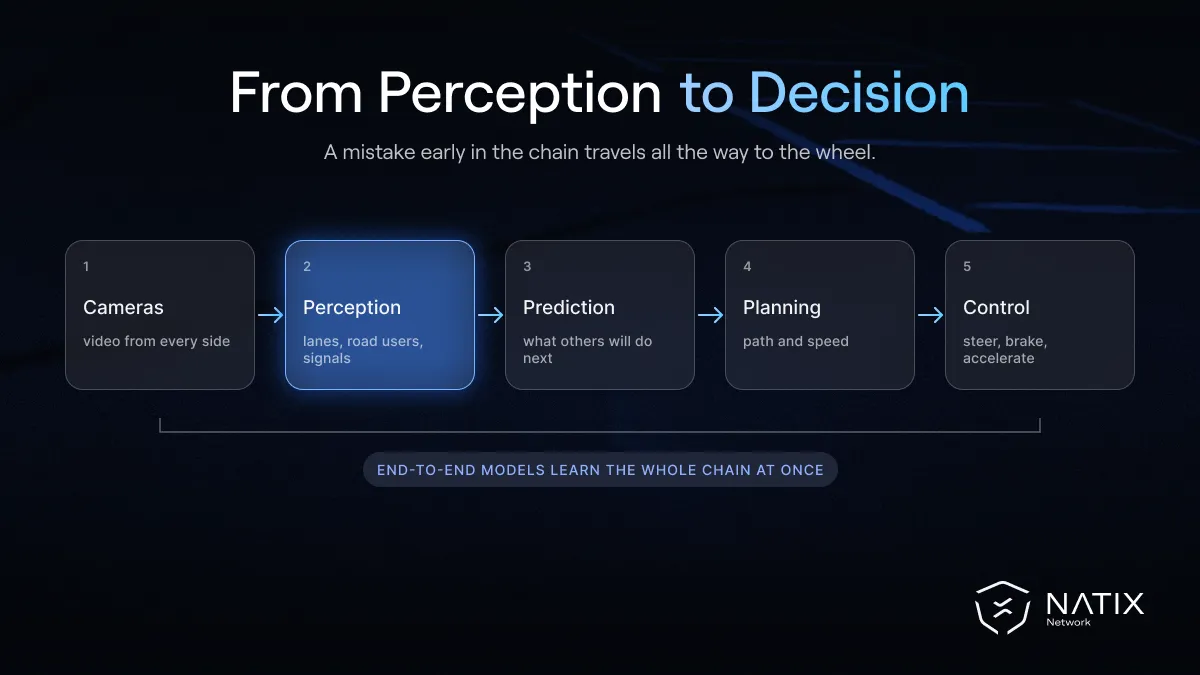
Perception is only useful if the rest of the system can act on it. After the vision system describes the scene, a prediction step estimates what other road users will do next. A planning step then chooses a path and speed, and a control step turns that plan into steering, braking and acceleration.
Errors in perception travel down that chain. A pedestrian detected too late can lead to a poor decision, even if the planner is excellent. The same is true of a lane line misread in the rain. That is why teams measure perception carefully on its own before testing the whole system. They also keep adding difficult examples to their training and test sets.
End-to-end models blur these steps by learning the whole chain at once, from camera input to driving behavior. They still depend on the same foundation: seeing the road correctly in every condition the car will meet.
Not every autonomous vehicle relies on cameras alone. Many programs combine cameras with lidar and radar, a design known as sensor fusion, so each sensor covers the others' weaknesses. Others pursue camera-only autonomous driving. They argue that cameras capture the same visual information human drivers use and scale more cheaply across millions of vehicles.
Either way, cameras do much of the work of understanding the scene. Only they capture color, text and the fine visual cues of traffic. Our pillar on machine vision, computer vision and Physical AI explains why that visual understanding is only the first step toward a car that acts on its own.
Computer vision in autonomous vehicles is strongest on situations it has seen many times. It struggles with what is rare. Think of a mattress on the highway, a police officer directing traffic, glare at sunset, heavy rain at night or an unusual vehicle. These moments are uncommon in any dataset, yet they are exactly where safety is decided.
Different levels of automation feel this differently. Driver assistance can rely on a human to catch mistakes. Higher levels of automation cannot. Their perception must be trained on far more variety, a point we explain in our guide to the SAE levels of autonomous driving.
The best way to make computer vision in autonomous vehicles more reliable is to show it more of the real world. That means many regions, road types, weather conditions and times of day, recorded from cameras similar to the ones the car will use. Views from every side of the vehicle matter too. Many hazards appear beside or behind the car before they appear in front of it.
Open data helps researchers get started. NATIX released an open sample of real multi-camera driving footage, described in our announcement of the NATIX open multi-camera driving dataset. Teams can use it to test their perception models on everyday driving recorded by real drivers. Our broader guide to computer vision examples shows how driving fits among other uses of the same technology.
Computer vision in autonomous vehicles is the car's sense of sight. The richer and more varied the driving it learns from, the better it sees when it matters most.


