

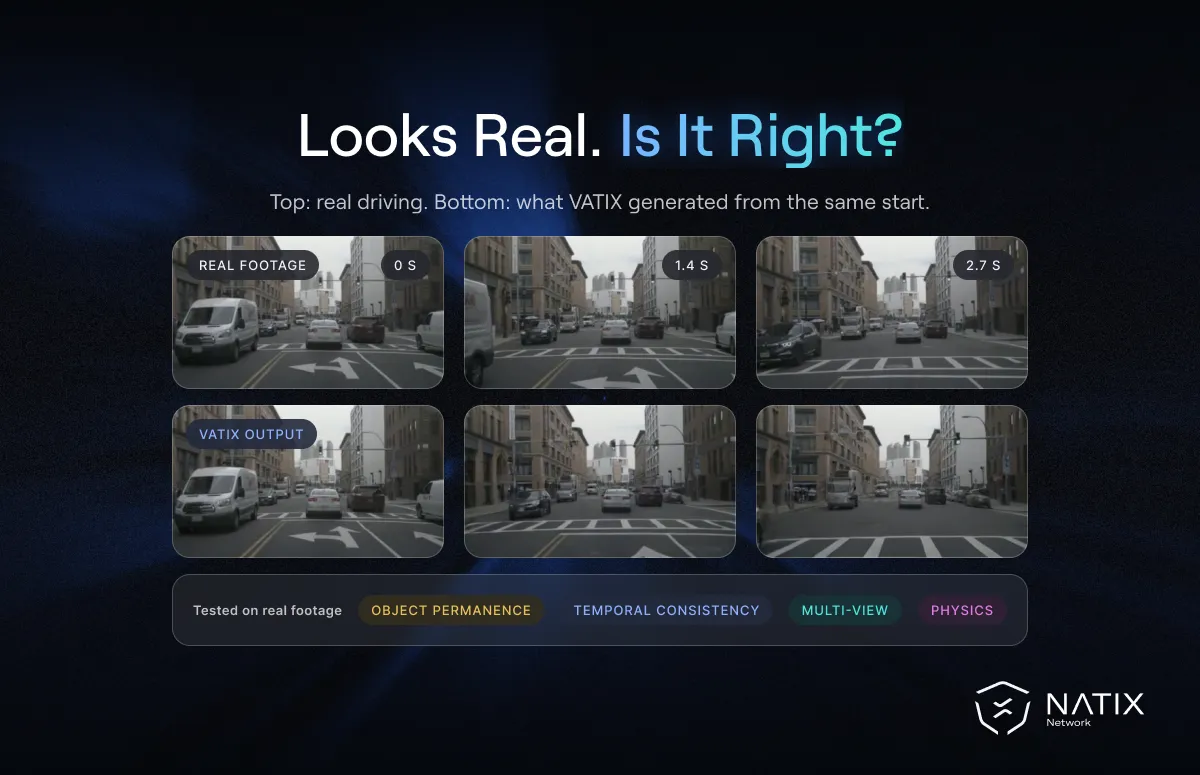
A video world model can generate driving footage sharp enough to fool a human reviewer and still get the physics wrong. A car slips behind a truck and never comes out the other side. A lane marking bends one way in the front camera and another way in the side camera. A pedestrian quietly changes jacket color halfway across the street. None of these errors ruin a single frame, but each one breaks the thing a video world model exists to do: predict how the world actually behaves.
A video world model is a generative model that predicts future video frames. It works from past observations and, in most driving setups, from the actions of the vehicle. If large language models predict the next word in a sentence, world models predict the next moment in a scene. Teams use them to create training scenarios and to replay rare events with small variations. Increasingly, they also use them to test driving policies before a car leaves the lot. The largest are world foundation models, trained on thousands of hours of video to cover many places and conditions at once.
All of this rests on one question the field has been slow to answer: how do you know a video world model is right? Visual quality is easy to measure. Physical consistency is not. The answer depends on what you compare the model against. The real-world driving dataset used for evaluation matters as much as the model itself.
Most driving world models are scored with Fréchet Video Distance (FVD). It compares the statistics of generated clips with real clips inside the feature space of a pretrained video network. A low FVD means the footage resembles real footage on average. It says nothing about whether objects persist or a braking car slows at a believable rate. It also ignores whether two cameras agree on where a cyclist stands. The authors of the WorldLens driving benchmark make the same point. Perceptual metrics such as FVD and LPIPS show how real a video looks. They say very little about physical causality or multi-view geometry.
Researchers at Google DeepMind tested that gap directly. Their Physics-IQ benchmark gives video models the start of real recordings across 66 physical scenarios, from solid mechanics to magnetism. The models then have to continue each scene. The strongest model reached a Physics-IQ score of 24.1%. Visual realism turned out to be unrelated to physical understanding: the most convincing models were not the ones that predicted what would happen next.
A second study helps explain why. A ByteDance team trained video generation models on simple simulated scenes of objects moving and colliding. They then scaled the data and the model size to see what changed. The models became nearly perfect on situations close to their training data. Their errors on unfamiliar situations, however, did not shrink with more data or more parameters. Instead of learning the laws, the models recalled the most similar training example. They matched on color first, then size, then velocity and only then shape.
For anyone building autonomous systems, this is the real issue with simulation fidelity. A model that generalizes by lookalike handles the common case well. It fails in exactly the rare, unfamiliar situations a test is supposed to catch. A hand-coded simulator is limited by its rules, but at least those rules are written down and can be inspected. A video world model learns its rules from data. The only way to know what it learned is to test its output against the real world.
Physical world modeling asks more of a model than good pixels. In driving, four properties do most of the work, and each one fails in its own recognizable way. Checking them separately turns a vague sense that "the video looks off" into an evaluation a team can track over time.
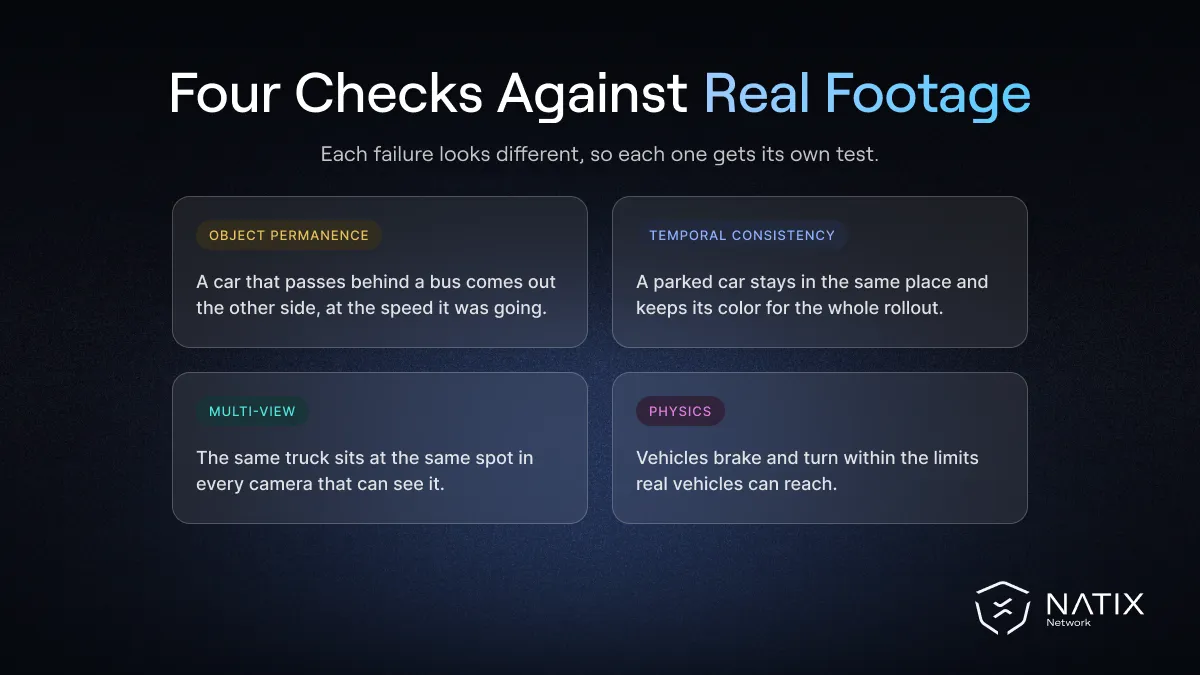
Object permanence is the expectation that things keep existing when you cannot see them. A van that disappears behind a bus should reappear on the far side, at about the speed it was traveling. Physics plausibility covers the rest of everyday mechanics. Objects do not pass through each other or change shape for no reason. Vehicles accelerate and brake within limits that real vehicles can reach.
Cognitive scientists call this bundle of expectations intuitive physics, and infants start building it in their first year. Machines remain far behind. On Meta's IntPhys 2 benchmark, which tests permanence, immutability, continuity and solidity, most models perform at chance level, around 50%. Human accuracy is close to perfect.
Temporal consistency is the same requirement stretched across time. Short clips can look flawless while long rollouts slowly drift. A parked car shifts a meter, a building gains a floor, or the sky turns from overcast to clear between frames. Because a world model generates each step from its own previous output, small errors compound as the rollout gets longer.
This failure is easy to miss if you only watch the video. The University of Freiburg team behind the original Orbis world model measured the vehicle trajectories implied by generated footage instead. Every public driving world model they tested showed substantial limitations in capturing state transitions, even though the videos looked excellent at first. A model that cannot keep track of where things are cannot be trusted to simulate what happens next. Its successor, Orbis 2, was built and judged with that problem in mind.
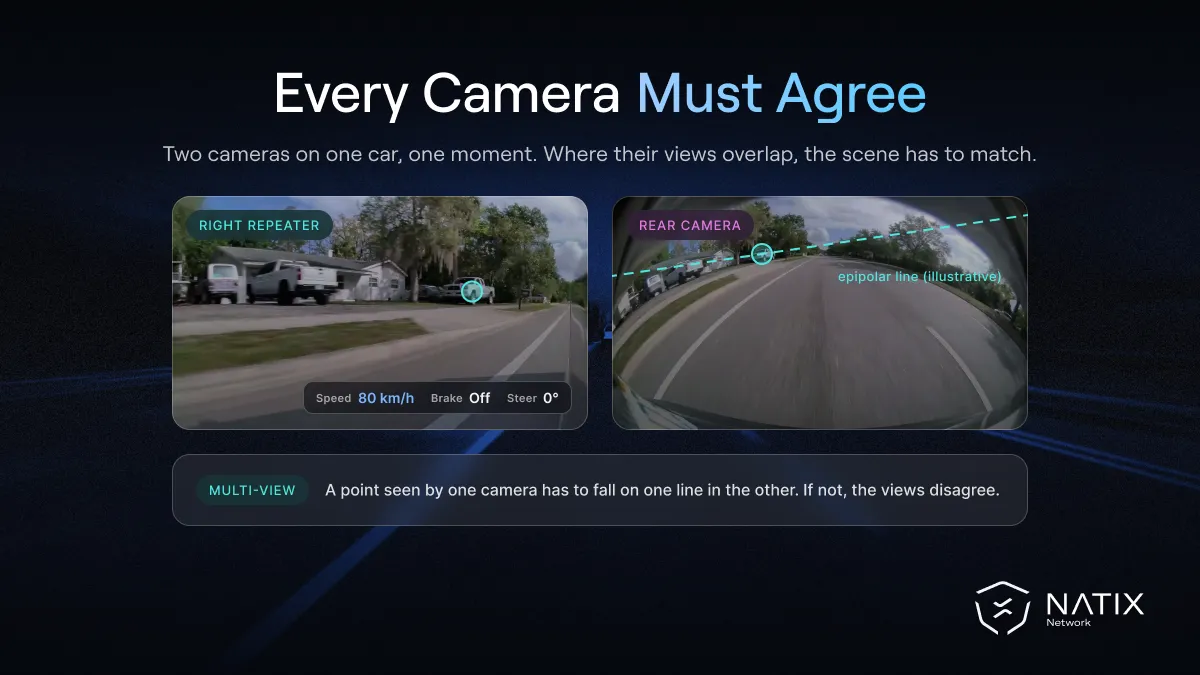
Self-driving systems rarely see the world through one camera. A typical vehicle combines several overlapping views, and a world model that generates multi-camera video has to keep them in agreement. The same truck must appear at the same place, scale and color in every camera that can see it.
The cameras' mounting positions and lens properties are fixed and known, so this can be checked with epipolar geometry. A point seen in one camera must fall on a specific line in the neighboring camera. Recent driving benchmarks now score cross-view consistency on its own, by measuring how well overlapping regions of adjacent cameras line up. A scene can look right in each camera separately and still fail this test, which is why it needs its own metric.
It is tempting to treat these failures as cosmetic. They are not, because of how a video world model gets used. When a team trains a driving policy on generated scenarios, the policy learns whatever the world model teaches it. If vehicles that pass behind a bus sometimes vanish, the policy learns that occluded vehicles can be ignored. If braking distances are slightly too short, it learns to follow too closely. Errors a human viewer would never notice become habits in the model trained on them.
The same problem shows up in testing, only in reverse. When a world model scores a driving policy, a physically wrong world can pass a bad policy or fail a good one. A planner that brakes correctly for a cyclist who then disappears may be marked as overcautious. A planner that drifts out of its lane may never be caught if the generated lane markings drift with it. Either way, the score looks precise while measuring the wrong thing.
The industry now separates two questions that used to be treated as one. The first is whether a video world model is useful for generating varied training material. The second is whether it is accurate enough to stand in for the real world during validation. The first question tolerates some error, because training data is mixed and averaged. The second does not, because one wrong verdict on a safety-critical scenario can send a flawed policy to the road.
In practice, world model evaluation has become a stack of tests, each catching errors the layer below misses. The first layer is perceptual. FVD and similar scores are cheap to run and catch blur, artifacts and obvious distribution shifts. The second layer is consistency: identity tracking across time, depth agreement and cross-camera alignment. The third is downstream use, where frozen perception models trained on real data run on generated footage. If a 3D detector cannot find the cars in a generated scene, the world is wrong in a way that matters for driving.
The fourth layer asks whether the generated world reacts correctly to the vehicle. A full-spectrum benchmark such as WorldLens combines all four and reaches an uncomfortable conclusion: no current driving world model leads on every axis. Some produce strong textures but violate physics. Others keep geometry stable but fail when a planner has to act inside them.
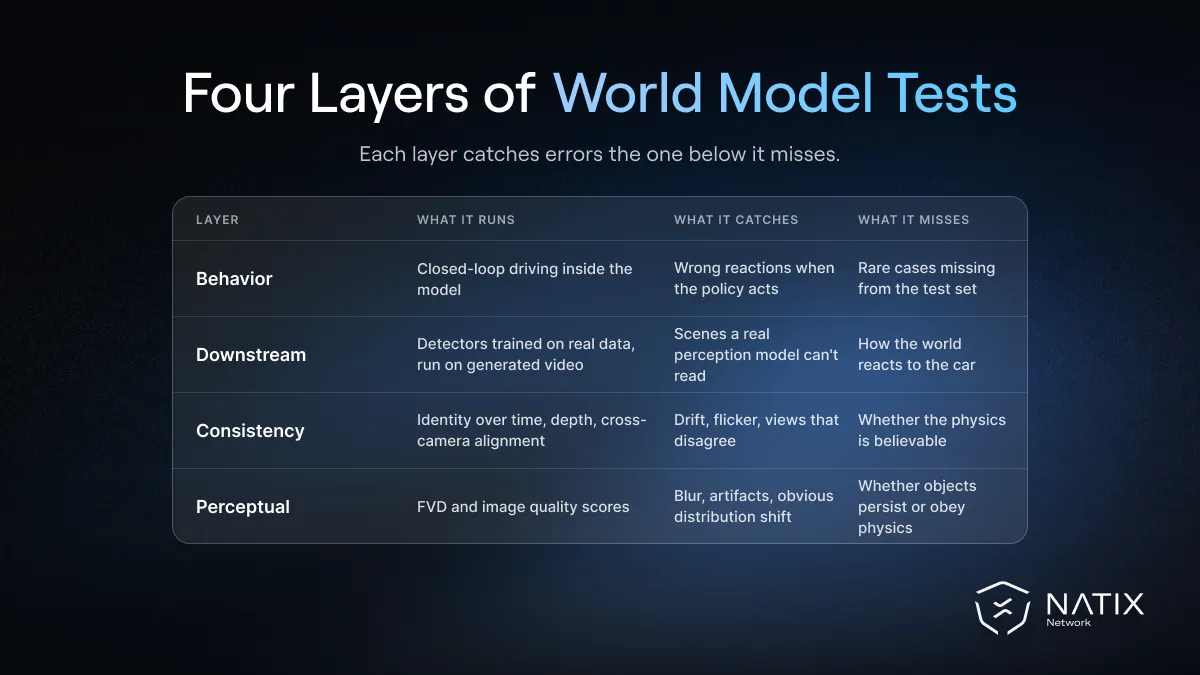
That last layer is the hardest and the most important. An open-loop test replays recorded logs and checks predictions against what happened. A closed loop simulation lets the driving policy act and the world respond. Mistakes then compound the way they would on a real road. The two can disagree sharply. On the nuPlan planning benchmark, Dauner and colleagues found a negative correlation between open-loop and closed-loop scores. A rule-based planner from more than twenty years earlier beat every learned method in closed-loop driving.
For a video world model used as a simulator, action-following is part of physical consistency. When the policy steers left, the generated scene has to shift right in every camera at the correct rate. Other road users have to respond plausibly. The test set matters as much as the metric, too. Rare, safety-relevant situations have to be found in real footage and included on purpose, which is the job of scenario mining. A model that only faces average traffic in its test set will look better than it is.
NATIX data already sits inside several driving world models. Their results say as much about evaluation as about training.
Orbis 2 is the University of Freiburg's hierarchical driving world model. NATIX data made up more than 40% of its training mix, making NATIX its largest single data source. What stands out is how it was judged. Beyond visual quality, the team measured long-horizon stability, the quality of the model's internal representations and steering responsiveness on counterfactual scenarios. The model also stayed robust on Waymo data it had never seen. It is exactly the kind of out-of-distribution check the ByteDance study shows scale alone cannot pass.
Valeo's VATIX work tested scale from the other direction. Valeo trained a family of video diffusion models from scratch on NATIX footage, the largest with 9 billion parameters. It used the results to derive scaling laws for driving video generation, showing how model size and training time should grow together. The synthetic driving videos these models produce show why evaluation keeps getting harder. As generated footage becomes more realistic, a reviewer can catch less by eye. A team then depends more on real footage to compare against.
NATIX and Valeo are also building one of the largest open-source multi-camera world foundation models, extending Valeo's front-camera models to multi-camera input. An open model is also an open evaluation target. Anyone can test it for permanence, temporal drift and cross-view agreement against real recordings. The principle behind all three projects is the one that runs through every debate about synthetic and real data. Training benefits from amplification, while validation depends on fidelity. A video world model can multiply rare events into thousands of variations. Each variation is only as trustworthy as the evaluation behind it.
Every test above compares a model against something. For physical consistency, that something has to be real footage, because a simulator can only confirm the assumptions it was built on. Ground truth data for world model evaluation needs four qualities. Most existing datasets have only one or two.
The first is synchronized, calibrated multi-camera recording. Cross-view checks only work when every camera's position and lens model are known. Only then can a generated view be compared with what the real rig would have captured. The second is long continuous clips. Object permanence and temporal drift show up over tens of seconds and minutes, not in the short snippets most benchmarks were built around.
The third is breadth across regions, weather, road types and driving cultures. A world model checked only on familiar roads has only been checked on its training distribution. Most public benchmarks were recorded in a handful of cities. The fourth is rare and safety-critical events such as hard braking, sudden cut-ins and blocked views. Physics errors are most dangerous exactly where real data is thinnest.
This is where NATIX fits. NATIX holds more than 200,000 hours of multi-camera world model data, recorded through factory Tesla cameras by everyday drivers, with faces and license plates blurred. The footage is camera-only, so it does not replace LiDAR-based ground truth or a team's own fleet logs. What it adds is the scale, variety and long tail a validation set needs. With it, a video world model trained on one slice of the world can be checked against many others.
A useful evaluation does not need every benchmark at once. It needs to cover each kind of failure at least once, with real footage as the reference.
Occlusion tests for permanence. Collect real clips where vehicles and pedestrians pass behind larger objects. Check that the model brings them back at the right place and speed.
Long rollouts for temporal drift. Generate sequences of tens of seconds or more. Track the identity, position and appearance of static objects across the whole rollout.
Cross-camera agreement. Use the real rig's calibration to check that overlapping views show the same scene, at the same scale and position.
Downstream perception on generated video. Run detectors and trackers trained on real data on the generated footage. Compare their scores with the same models on real footage.
Closed-loop action following. Put a driving policy inside the model and vary its actions. Check that the world responds consistently, including in rare scenarios drawn from real data.
Want to run these checks on roads beyond your own fleet? Request a sample of real-world driving data and start with the scenarios your test set lacks.
A video world model is a generative AI model that predicts future video frames. It works from past frames and, often, from the actions of a vehicle or robot. In autonomous driving, it acts as a learned simulator that can create training scenarios and test driving policies.
Evaluate it in layers. Start with perceptual metrics such as FVD, then check temporal and multi-view consistency. Next, run perception models on the generated footage. Finally, test it in closed loop with a driving policy. Every layer above the first needs real footage as the reference.
FVD measures how closely generated video resembles real video on average. It does not check whether objects persist, whether motion follows physics, or whether cameras agree with each other. A video world model can score well on FVD and still be physically wrong.
A world model earns trust the way a driver does: by behaving correctly when it matters. Realistic video is the starting point. Physical consistency is what makes a video world model useful for training and testing the systems that will share the road with us. Only real multi-camera footage from many places and conditions can confirm it.


