

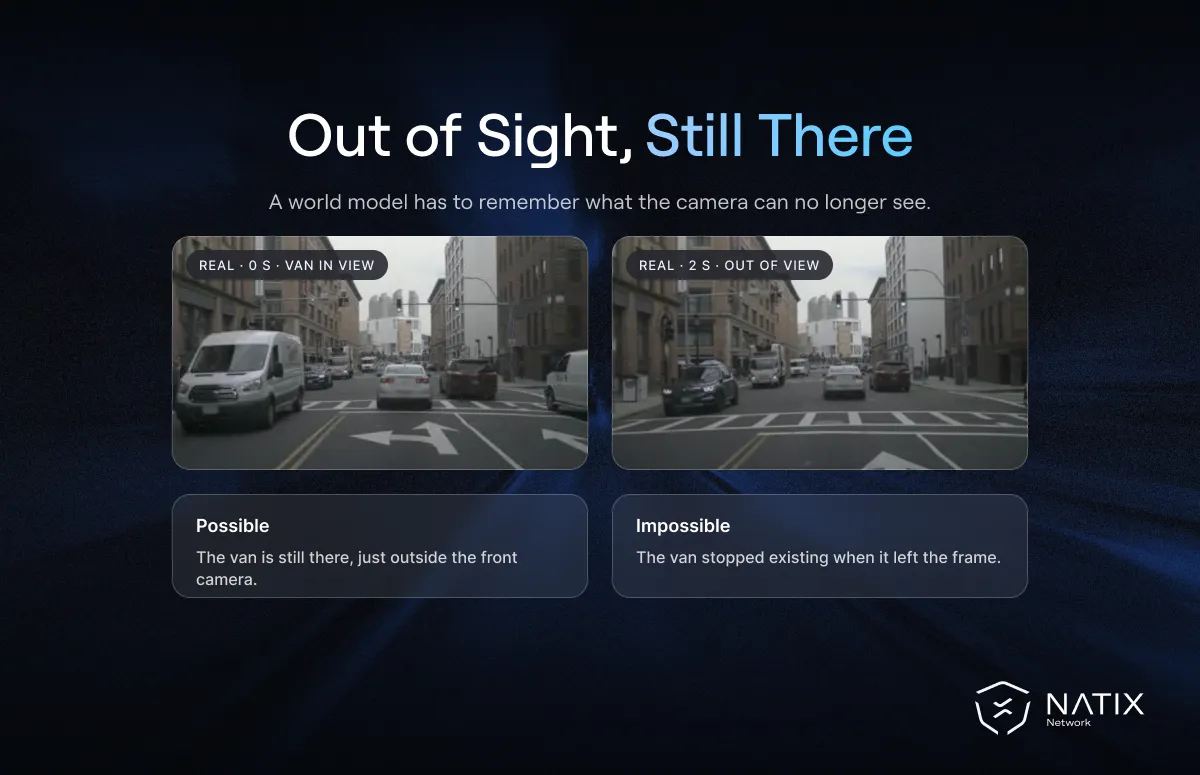
Intuitive physics is the everyday understanding that objects keep existing when hidden, keep their shape and cannot pass through each other. Humans build it long before they learn a single formula, and it quietly guides every decision a driver makes. AI models have to learn it from data. A video world model that generates driving scenes can only be trusted if it has learned it well. Checking that takes real-world data for world models that shows how objects actually behave on the road.
Cognitive scientists use the term for the expectations people hold about how ordinary objects behave. AI benchmarks usually break it into four principles:
Object permanence: things keep existing when they are out of sight.
Immutability: objects keep their shape and properties.
Spatio-temporal continuity: objects move along connected paths instead of jumping from place to place.
Solidity: two objects cannot occupy the same space.
Physics plausibility adds one more layer: speed, braking and turning stay within believable limits. Together, these describe the physics a driver relies on without thinking.
None of this is exotic. A toddler who watches a ball roll behind a sofa expects it to come out the other side. What makes these principles hard for machines is that data rarely states them. A video never says "this car still exists". The model has to infer it from thousands of examples where hidden objects reappear. Then it has to hold on to that inference, even when the data offers an easier shortcut.
For Physical AI, this is the difference between seeing and understanding. A perception model only describes what is visible right now. A world model predicts what happens next, so it has to keep track of what it cannot currently see.
Most tests borrow a method from infant research called violation of expectation. The model watches pairs of videos that are identical except for one detail. In one, the world behaves normally. In the other, a physical rule is broken. A model with good intuitive physics should be measurably more "surprised" by the impossible version.
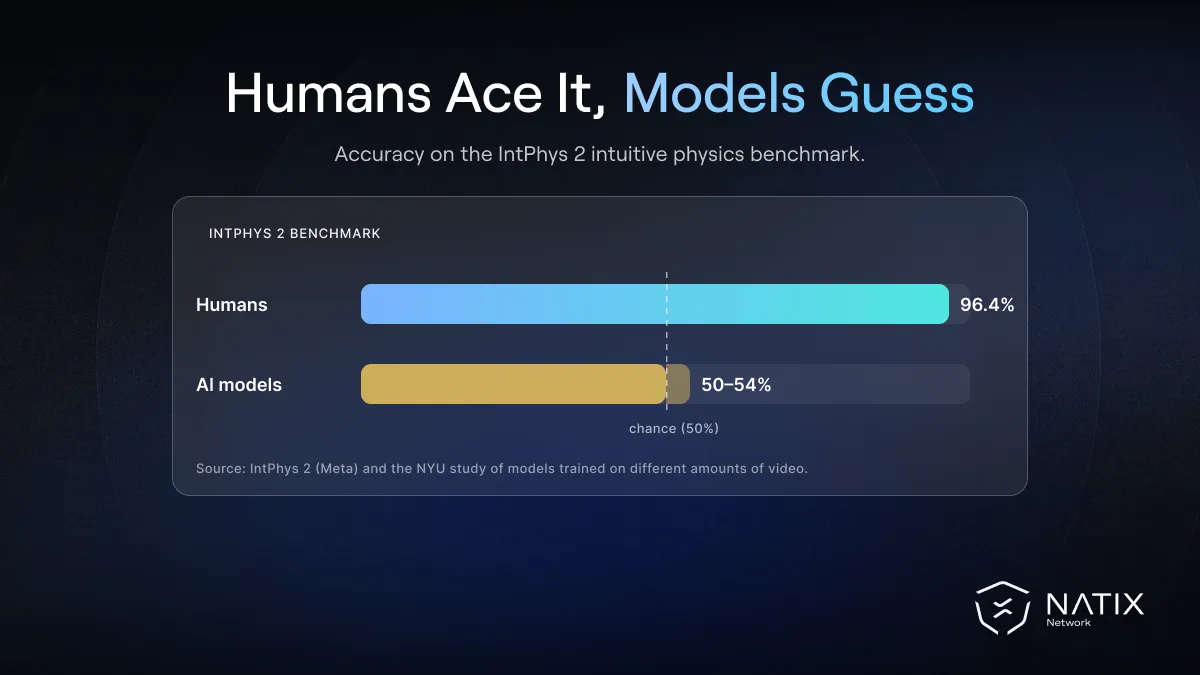
The most demanding recent example is Meta's IntPhys 2 benchmark. It tests all four principles in photorealistic scenes, with moving cameras and longer occlusions. Its finding is blunt. Most models, including large multimodal and predictive video models, perform at chance level, around 50%. Human accuracy is close to perfect.
A New York University study of models trained on very different amounts of video found accuracies between 50% and 54% on IntPhys 2, against a human score of 96.4%. That held even for a model trained on 3,600 times more video than a dataset filmed from a child's point of view. More video, on its own, did not produce intuitive physics.
Generation tells a similar story. On the Physics-IQ benchmark, video models continue real recordings of physical events. The most visually convincing models were not the ones that got the physics right. The lesson for anyone evaluating a world model is clear. A beautiful rollout says little about whether the model understands what it draws.
Driving is full of situations that only make sense with this kind of physical common sense. A cyclist disappears behind a parked van and should emerge a moment later. A truck turning across two lanes hides oncoming traffic that is still there. A car braking hard on a wet road needs more distance than the same car on dry asphalt. Human drivers handle all of this because they never stop believing in the things they cannot see.
A world model without this understanding teaches the wrong lessons. If it lets occluded road users vanish, a policy trained inside it learns that hidden hazards can be ignored. If its vehicles stop too quickly, the policy learns to follow too closely. These errors are hard to spot in a single frame and they compound over time. That is why these expectations are tied so closely to temporal consistency. An object allowed to drift or flicker is also an object allowed to vanish.
These moments sit in the long tail of driving events, the rare situations that matter most for safety and appear least often in data. As we covered in edge cases and the long tail, average driving data underrepresents them. A model can look competent on typical footage and still fail where it counts.
Synthetic benchmarks like IntPhys 2 are valuable because they control every variable. Driving evaluation also needs real footage. The goal is to check a model against the physics of real roads, vehicles and occlusions. Two kinds of clips are especially useful:
Occlusion events, where a vehicle or pedestrian passes behind something larger and then reappears.
Dynamic events such as hard braking and sharp turns, which test a model's sense of mass, speed and friction.
NATIX's open safety-critical driving events dataset was built for the second kind. It contains 45 events detected from g-force telemetry, each paired with multi-camera video. They include 20 harsh accelerations, 9 harsh braking events, 9 harsh turns and 7 cases of aggressive driving. The telemetry records how hard the vehicle actually braked or turned. That gives evaluators a measured reference for checking the physics plausibility of a world model's predicted motion.
For the first kind, NATIX's Edge Case Driving Dataset on Hugging Face includes scenes where large vehicles block the view. That makes it a natural test of object permanence. Both are free to explore for research, which makes them a practical starting point for this kind of test set.
The same principle reaches beyond cars. As we described in embodied intelligence, any system that acts in the physical world has to learn how that world pushes back. Intuitive physics is where that learning starts, and real recordings are the only reliable way to check whether it has happened.
Intuitive physics in AI is a model's ability to expect what ordinary objects will do. They stay in existence when hidden, keep their shape, move continuously and do not pass through each other. It is usually tested by showing models possible and impossible videos and measuring their surprise.
Not reliably yet. On demanding benchmarks such as IntPhys 2, most models perform close to chance on object permanence. Humans are close to perfect. Evaluating a world model therefore needs explicit occlusion tests against real footage.
A world model earns trust on the road the same way a driver does: by believing in what it cannot see. Intuitive physics is the test that shows whether it does, and occlusion and hard-braking clips from real driving are the fairest way to run it. A model that passes can be trusted to simulate the moments that matter most; one that fails will teach its mistakes to every policy trained inside it.


