

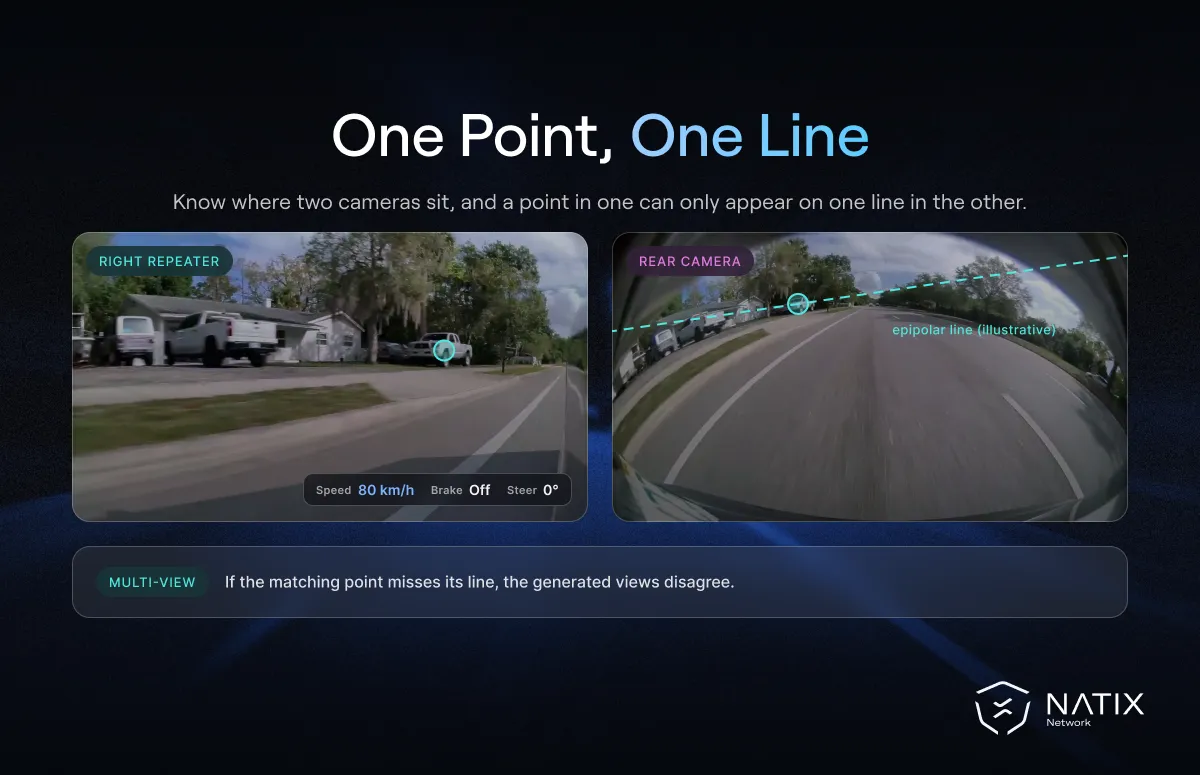
Epipolar geometry describes how two cameras that look at the same scene constrain each other. Know where the cameras sit and how their lenses work, and a point seen by one camera can only appear along a single line in the other. That rule is taught in every computer vision course. Today it is also one of the most practical ways to check whether a multi-camera world model is telling the truth. It explains why a calibrated multi-camera driving dataset is worth more for evaluation than uncalibrated footage.
Picture the front wheel of a cyclist, seen by two cameras mounted at different spots on a car. The first camera tells you the direction of the wheel, but not how far away it is. Every possible distance along that direction maps to a line in the second camera's image. That line is the epipolar line. Wherever the wheel really is, it has to appear somewhere on it.
Two sets of numbers make this work. A camera's intrinsics describe its lens, such as focal length and image center. Its extrinsics describe where it sits on the vehicle and which way it points. When both are known for a pair of cameras, the epipolar geometry of that pair can be computed directly. From then on, any matching pair of points can be tested. If a point in one image does not land on its epipolar line in the other, something is wrong.
Classic computer vision uses this for stereo depth, 3D reconstruction and camera calibration, the same tools behind computer vision in autonomous vehicles. World model evaluation uses it the other way around. The geometry of the real camera rig is known, so it can be used to test whether generated views obey it.
A self-driving system rarely relies on a single camera. Its views overlap at the edges, and those overlaps are where a world model has to be most careful. A truck that sits between the front and front-left cameras must appear at a consistent position in both.
If the model draws it slightly too far left in one view, each image still looks fine on its own. A perception system that fuses the views, however, now receives two contradictory positions for one truck. Multi-view consistency is broken, and the error is invisible to anyone checking the cameras one at a time.
This is one of the core checks for physical consistency in world models, alongside object permanence and stability over time. It is also an unusually objective one. Many properties of generated video are judged by learned scores or human reviewers. An epipolar check is measured against the real geometry of the camera rig. It rests on the known geometry of the camera rig, not on another model's opinion.
Recent driving world models report cross-view consistency as its own metric. The HelloWorld project measures it with cross-camera Sampson error, a standard score for how far matched points fall from their epipolar lines. It is computed from each clip's real intrinsics and extrinsics. Post-training improved the model's score, but every generated setting stayed above the real-video reference of 1.730. Generated multi-camera video still falls short of real footage on this test.
Earlier work took a related approach. The Drive-WM world model introduced a key point matching score. It uses a pretrained matching model to count how many points can be matched between neighboring generated views. More consistent views produce more reliable matches.
Both methods share a limit that the HelloWorld authors state themselves. Epipolar agreement is necessary but not sufficient. A point can sit on the correct line and still be at the wrong depth. A model can pass the check while getting distances wrong. Cross-view checks are therefore combined with depth comparisons and with temporal consistency checks that follow the same objects across time.
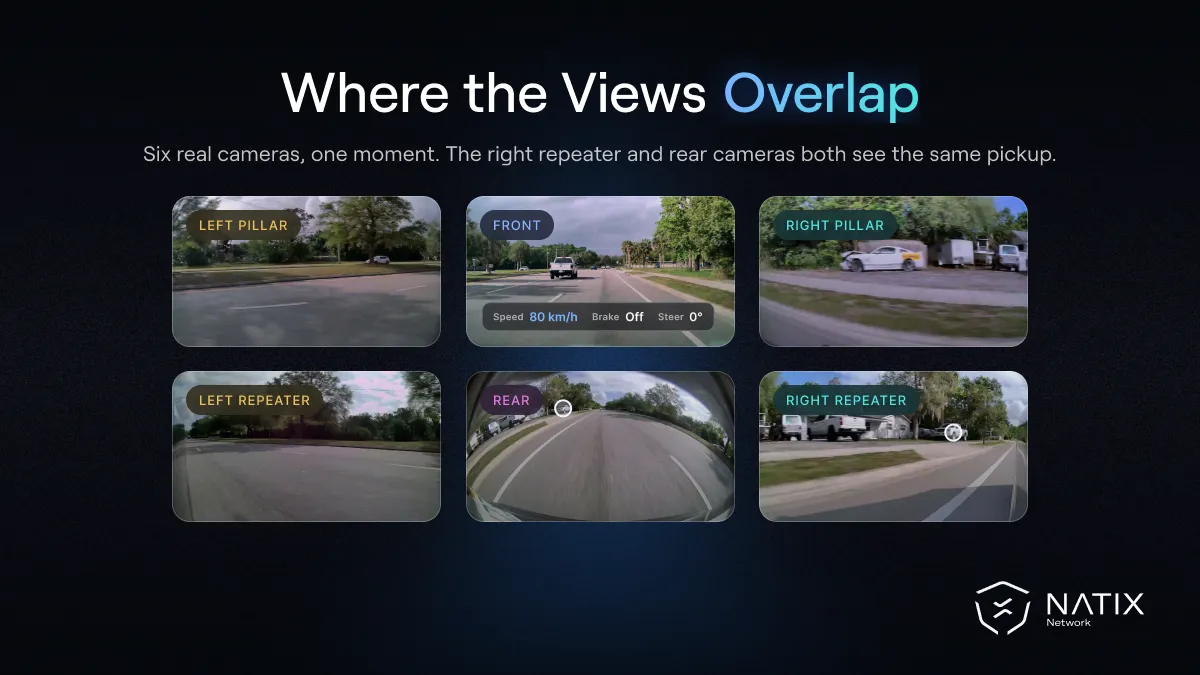
None of these checks works without accurate calibration. To compute epipolar lines, an evaluator needs each camera's intrinsics and its position on the vehicle. Footage without that information can still be watched, but it cannot be used to verify geometry.
That practical requirement shapes which data is useful for evaluation. NATIX's open multi-camera dataset includes 100 hours of footage from factory Tesla cameras in 4-camera and 6-camera setups. It is published on Hugging Face with camera intrinsics and extrinsics for each trip. That means epipolar geometry can be computed for every overlapping pair of views.
It is worth being clear about what this data is and is not. It is camera-only, without LiDAR, so depth has to be estimated rather than measured. What it offers is the geometry of real production camera rigs across many trips, which is exactly what multi-view checks need. The views a model trains and tests on shape what it understands about space, as we explored in our piece on the multi-camera data engine.
Perception teams know the idea well: calibrated cameras turn pixels into positions. For world model teams, epipolar geometry turns that calibration into a test. The open sample is the fastest way to try this on real rigs. Teams that need more calibrated trips can request them through the form on the NATIX autonomous driving data page.
Epipolar geometry is the rule that links two cameras viewing the same scene. A point seen in one camera can only appear along one specific line, the epipolar line, in the other camera. If you know both cameras' calibration, you can compute that line exactly.
It gives a measurable test for multi-camera output. Using the real rig's calibration, evaluators check whether matching points in generated neighboring views fall on their epipolar lines. Points that miss their lines reveal views that disagree about where objects are.
A generated world that does not respect the camera rig's geometry is not the world the car would see. Epipolar geometry gives every multi-camera world model a test it cannot fake, as long as the evaluation footage comes with real calibration.


