

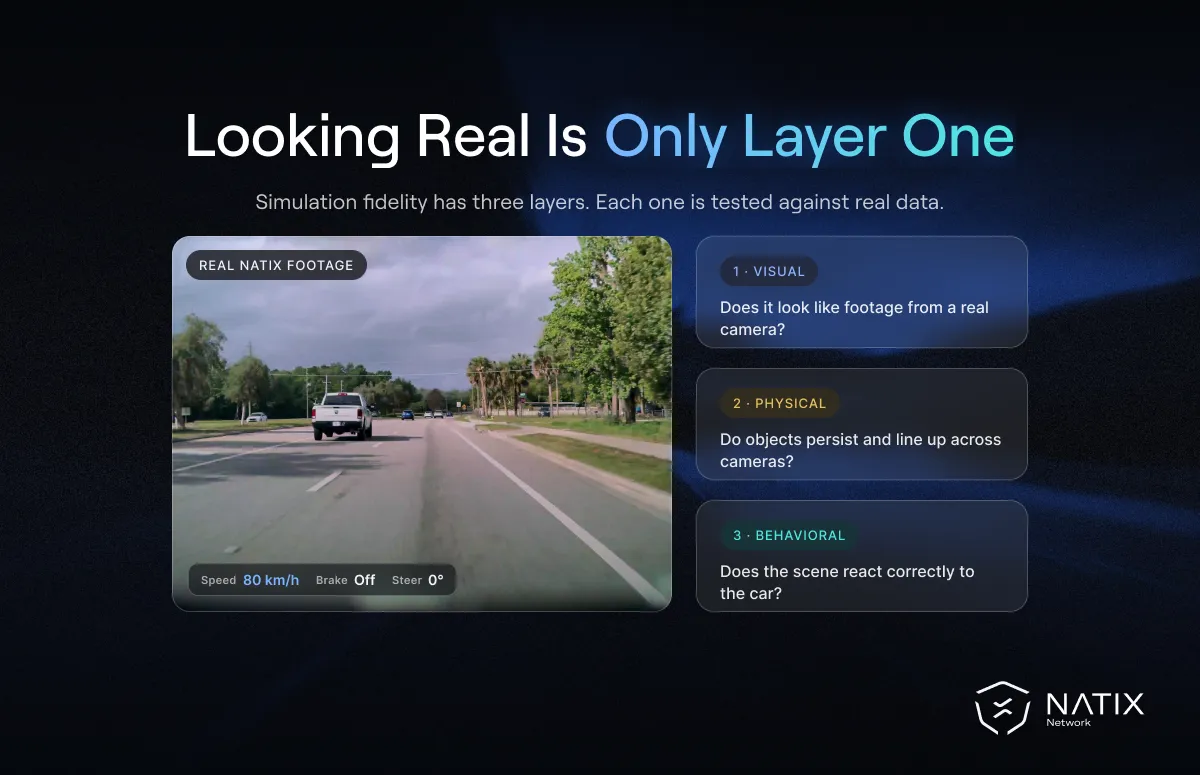
Simulation fidelity is how closely a simulator's output matches what the real world would have done in the same situation. For years, fidelity in autonomous driving mostly meant graphics: sharper textures, better lighting, more convincing rain. Generative world models have made that kind of fidelity almost easy. The harder question now is whether those scenes behave correctly. Only a comparison with a real-world driving dataset can answer it.
It helps to split fidelity into layers, because each one fails differently and needs its own test.
Visual fidelity is about appearance. Do the roads, vehicles, weather and lighting look like footage from a real camera? Most people judge this layer by eye, and it is where modern video world models have improved fastest.
Physical fidelity is about how things move and persist. Do hidden cars reappear? Do braking vehicles slow at believable rates? Do several cameras agree about where an object is? This layer covers object permanence, intuitive physics and geometric consistency, and it is invisible in any single frame.
Behavioral fidelity is about reactions. When the simulated vehicle changes lanes or brakes, does the rest of the scene respond the way real traffic would? This layer only appears when a driving policy acts inside the simulator.
A simulator can excel at one layer and struggle with the next, so a single simulation fidelity score hides more than it reveals. Traditional simulation environments were often strong on physics, because engineers wrote the rules by hand, but weak visually. Generative world models tend to have the opposite profile.
The standard metric for generated video, Fréchet Video Distance (FVD), compares the overall statistics of generated clips with real ones. It is fast and useful for spotting broken models. But it was designed to measure resemblance, not correctness.
The gap shows up clearly in research. On Google DeepMind's Physics-IQ benchmark, video models had to continue real recordings of physical events. Visual realism turned out to be unrelated to how well the models predicted the physics. The most convincing video was not the most correct.
Driving benchmarks reach the same conclusion from another direction. The WorldLens benchmark evaluates driving world models on generation quality, geometry, action-following and downstream perception at once. It finds that no model wins on every axis. Some generate strong textures while violating physics. Others keep geometry stable but fail when a planner has to act inside them. Visual fidelity, in other words, is a poor proxy for the other two layers.
This distinction matters because world models do two very different jobs. For training, a world model multiplies rare situations into many variations, giving a policy more practice than real driving could supply. Some imperfection is acceptable there, because generated material is mixed with real data and averaged across many examples. This is where synthetic data earns its place. For coverage, synthetic driving data is hard to beat.
Validation is different. When a world model decides whether a driving policy is safe, every scenario becomes a verdict. A physically wrong world can pass a bad policy. Training benefits from amplification, while validation depends on fidelity. Teams now treat a generative simulator as a candidate that must be checked against real footage before its results are trusted. We described this shift in our piece on replacing hand-coded driving simulators.
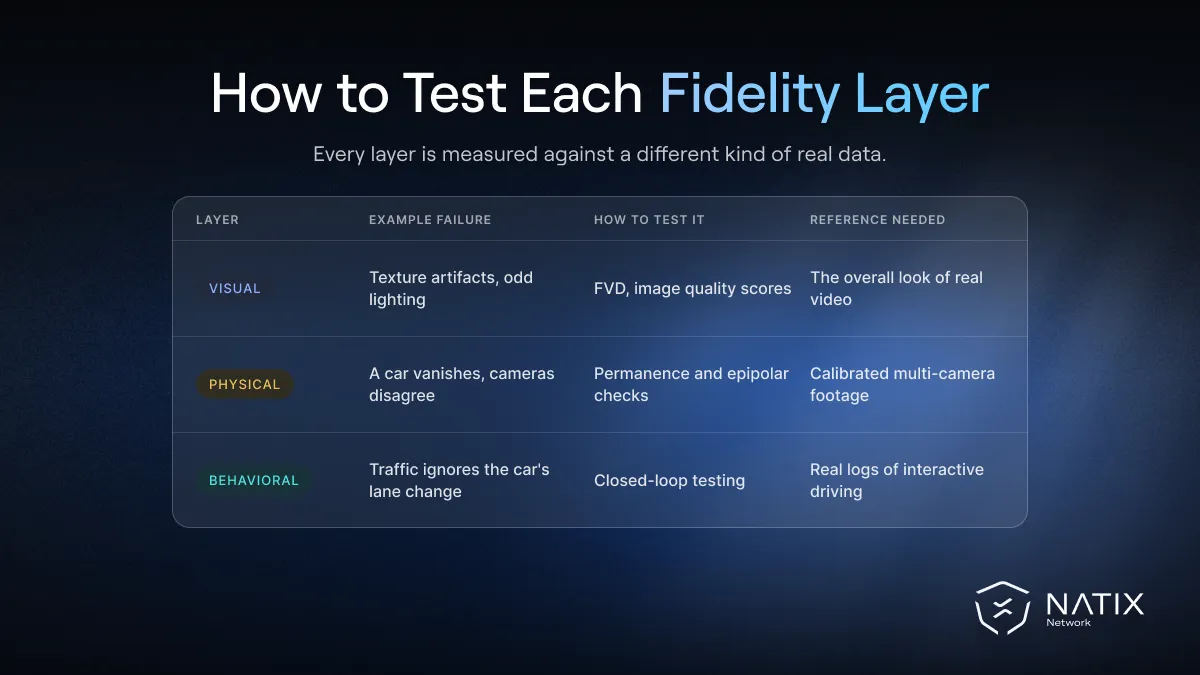
In practice, each layer needs its own reference:
Visual: measure against the overall distribution of real footage, which is what FVD and image quality scores do.
Physical: start a generated rollout from a real clip. Compare it with the real continuation, object by object and camera by camera.
Behavioral: run a closed loop simulation with a driving policy inside the simulator, and check that other road users respond the way recorded traffic does.
The common thread is real data at every step. A team that only checks the first layer will consistently overrate its simulator. Simulation fidelity that holds up for validation is measured against real-world data from the roads, weather and traffic the driving system will actually face.
Higher visual quality makes this anchoring more important, not less. Valeo's VATIX models are a clear example. Valeo trained a family of video diffusion models from scratch on NATIX driving footage, up to 9 billion parameters. The largest scored better than earlier open models such as Vista and Epona on the nuScenes benchmark. The work also produced scaling laws that show how model size and training should grow together for driving video.
Models like these generate synthetic driving video that is increasingly hard to tell apart from real footage by eye. That is progress, and it is also a warning. When a generated clip and a real clip look alike, judge simulation fidelity by what happens in them. Check where objects go, how fast vehicles stop and whether every camera agrees.
Need a real reference to test against? Start with NATIX's Multi-Camera Driving Dataset on Hugging Face, which pairs multi-camera trips with calibration and metadata.
Simulation fidelity is how closely a simulator's output matches what would happen in the real world. For driving, it has three layers. Visual fidelity asks whether it looks real, physical fidelity whether it moves correctly, and behavioral fidelity whether it reacts correctly to the vehicle.
Not necessarily. Realistic video only shows high visual fidelity. A world model can look photorealistic and still lose objects, break physics or react wrongly to the car. Physical and behavioral fidelity have to be tested separately against real driving footage.
A simulator that looks perfect has passed the easiest test. Simulation fidelity in the sense that matters for safety is earned on the other two layers, and it is earned against real data.


