


Imagine an AI that can watch the road for a few seconds and predict what will happen next. Not just identify what it sees, but understand how an entire scene is likely to unfold. Will traffic slow down? Will a car merge into the lane? Will a pedestrian step into the crosswalk?
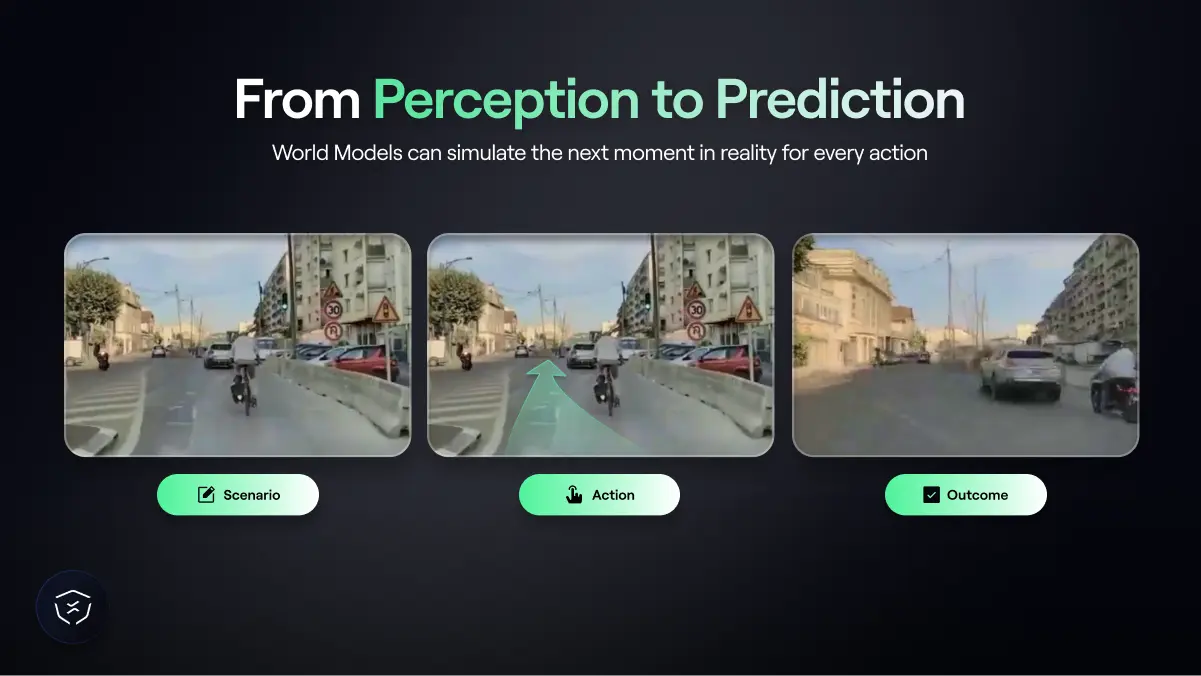
That is the promise of World Models: AI systems that learn how real-world environments evolve over time. In simple terms, a world model learns the relationship between the current state of the world, a possible action, and what happens next.
For Physical AI, this is a major step forward. Once an AI system can simulate and reason about what may happen after different actions, it can start comparing possible futures. What happens if the car slows down? What happens if it changes lanes? What happens if it waits?
At that point, choosing the best action becomes less of a data problem and more of a compute problem: simulate many possible outcomes, compare them, and choose the safest or most useful path. This is why world models matter. They move AI from simply recognizing the world to simulating how it responds.
Researchers at the University of Freiburg have taken a significant step in that direction with Orbis 2, the first hierarchical driving world model trained on thousands of hours of real-world driving footage, and NATIX data was not just included in that training mix. It was the largest single data contributor, providing more than 2,000 hours of driving video, over 40% of the full training mix. That is more than any other available datasets, including NVIDIA PhysicalAI-AV, OpenDV, and BDD100K.
Orbis 2 was developed by the University of Freiburg, a pioneer in building world models for autonomous driving, and a core member of nxtAIM, a major German AI consortium backed by leading automotive and technology players, including Mercedes-Benz, ZF, Aptiv, Aumovio, Valeo, and more. The project brings together some of Germany's most advanced research efforts in autonomous driving and Physical AI.
The Orbis team is also behind the original Orbis World Model, the first German driving World Model, published at NeurIPS 2025, one of the world’s biggest computer vision conferences. With only 469M parameters trained on 280 hours of video, Orbis is a state-of-the-art model demonstrating 10x more data and compute efficiency than competing public models. Where every other model breaks down, Orbis dominates difficult scenarios such as turning maneuvers and chaotic urban traffic.
For NATIX, it is the second World Model being built using NATIX data, after the announcement that we are building one of the largest multi-camera World Models in the world, together with Valeo. NATIX data is becoming a benchmark for world model teams, giving us a glimpse of the future where researchers can access large-scale, real-world driving data to train the next generation of Physical AI. With contributors capturing road data across continents, the NATIX network provides a level of scale and diversity that would be difficult for any single institution to collect on its own.
Most AI models for driving are trained to recognize what is in front of them: cars, lanes, signs, pedestrians, and traffic lights. World models go a step further. They try to predict how the scene will change.
That is easier said than done.
The real world is constantly moving. A car may slow down unexpectedly. A cyclist may emerge from behind a parked vehicle. A turn may reveal a completely different road layout. The further into the future a model tries to predict, the harder it becomes to stay accurate.
Orbis 2 tackles this challenge through a hierarchical approach, structuring the problem into two levels:
This means neither part of the model is asked to do something it is poorly suited for. The high-level predictor is free to focus on understanding the situation, while the second predictor focuses on generating the visual details. Together, they produce predictions that remain coherent over longer periods of time.
The examples below show several possible futures generated by Orbis 2 from the same starting scene. While the visual quality is intentionally compressed, the model is still able to capture meaningful differences in how the situation might unfold.
At first glance, the generated footage may look rough. That is because the model is not trying to create a cinematic video. Its goal is to understand how a driving scene evolves and generate plausible future outcomes.
Building a world model is not just a question of model architecture. It is also a question of data.
A world model learns the relationship between the current state of the physical world, a possible action, and what may happen next. But to predict how the world changes, AI systems need to learn from real-world examples. Lots of them. And not only the clean, predictable examples.
Real roads are messy. A delivery van blocks the lane. A cyclist appears from behind a parked car. Road markings are faded. A construction site changes the usual traffic flow. A driver makes an unexpected move. These moments are not always common, but they are exactly the kinds of situations AI systems need to learn from.
This is where NATIX data becomes valuable. The NATIX network captures everyday driving across different countries, cities, road types, traffic conditions, and driving behaviors. Not only did NATIX contribute the project the largest dataset with more than 2,000 driving hours, but using advanced Visual Language Models, NATIX data includes long-tail situations that are easy to miss in smaller or more controlled datasets.
One of the most interesting findings in the paper is Orbis 2's ability to generalize to unseen Waymo data. While Epona, a model trained primarily on nuPlan and nuScenes, saw a noticeable drop in performance, Orbis 2 remained significantly more robust.
This shows that as the largest single data source used to train Orbis 2, NATIX provides exactly the kind of geographic and behavioral diversity that world models need to adapt to unfamiliar environments.
Orbis 2’s performance is impressive.
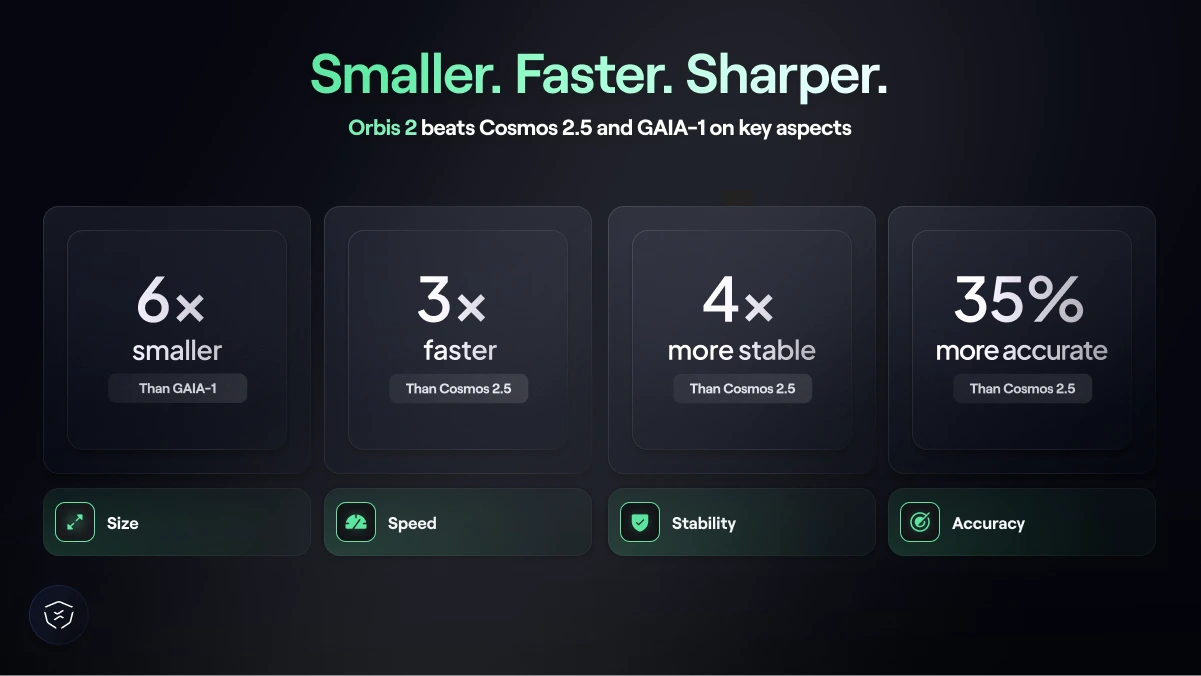
Despite being significantly smaller than some competing models and trained on a fraction of the data, Orbis 2 achieved leading performance across several important benchmarks for driving world models.
Orbis 2 even outperformed NVIDIA Cosmos-v2.5 in generalization to unseen driving data, scene understanding, and long-horizon prediction stability, despite being significantly smaller and trained on a third of the driving data. It also runs around 3x faster at inference, making it significantly more efficient.
Most importantly, Orbis 2 is especially strong at staying consistent over time. Many world models can generate a convincing future for the next second or two, but as predictions extend further, the scene can gradually drift away from reality. Roads change shape, vehicles behave strangely, and the model loses track of the situation it was trying to predict.
Orbis 2 performed best among the evaluated models on long-horizon stability. In simpler terms, its predictions held together better as the model looked further into the future. It also achieved the best results on representation quality, which measures how well the model understands the structure of a road scene. That matters because a useful world model should not only generate video that looks plausible. It should also learn where the road is, how objects relate to each other, and how the scene is likely to evolve.
The model was also trained more efficiently than Wayve's GAIA-1. The full Orbis 2 model was trained in under 3,000 H100 GPU-hours, compared with around 23,000 A100-hours for GAIA-1.
Taken together, the results suggest that Orbis 2 is not just another driving video model. It is a more stable, more efficient, and more generalizable world model for driving.
For NATIX, Orbis 2 is more than a research milestone. It is proof of what the network can make possible.
Every drive added to NATIX helps build a richer picture of the physical world. Not just the main roads. Not just the clean examples. The real world, with all its complexity, variety, and edge cases. The kind of data that is critical for the next generation of Physical AI systems.
That is exactly why we recently open-sourced two real-world driving datasets on Hugging Face: the NATIX Multi-Camera Driving Dataset and the NATIX Edge Case Driving Dataset. NATIX plans to expand the open multi-camera dataset to more than 2,000 hours and the edge-case dataset to more than 1,000 curated scenarios. The goal is to support researchers working on Physical AI, autonomous driving, world models, robotics, mapping, and simulation with real-world data that is difficult to collect independently.
World Foundation Models like Orbis 2 demonstrate something important: community-generated driving data is becoming part of the foundation on which Physical AI is built.
NATIX contributed the largest dataset used to train Orbis 2. As world models become a core building block for autonomous systems, robotics, and Physical AI, that role will only become more important.
This is not the end goal. It is an early signal of what comes next.
Read the full paper: Orbis 2: A Hierarchical World Model for Driving


