

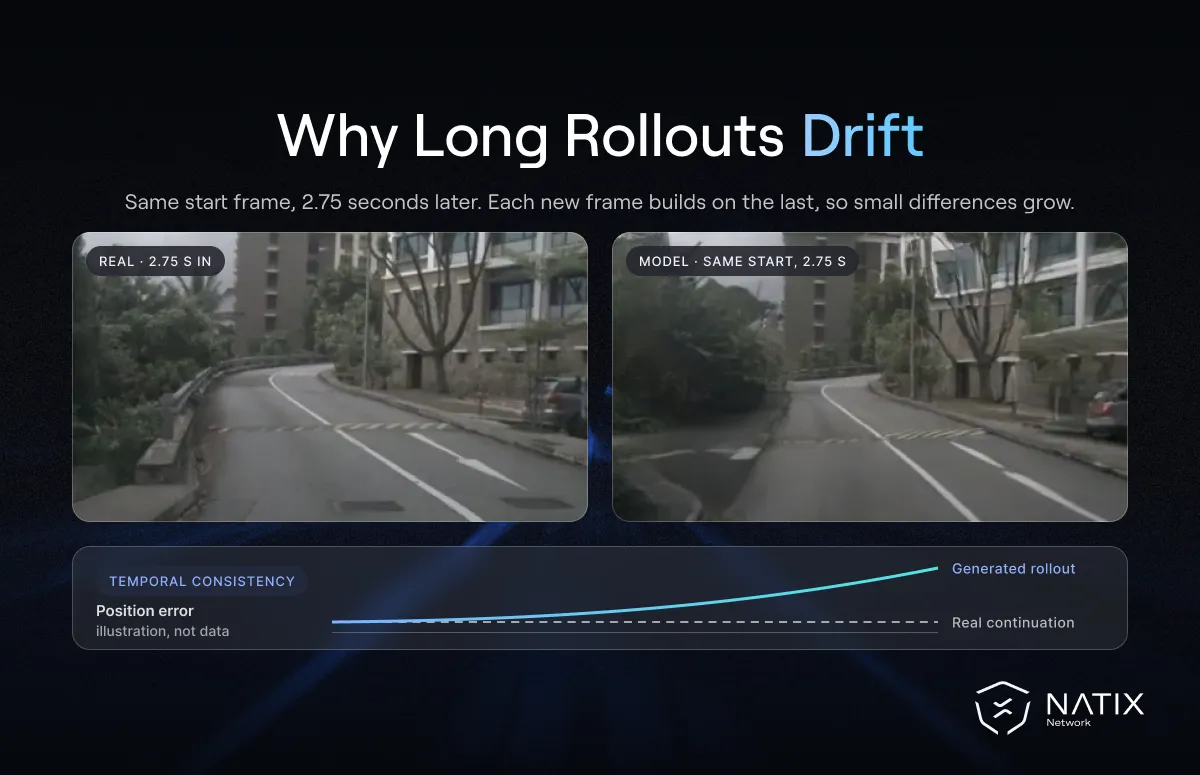
Temporal consistency is what keeps a parked car parked and a street sign the same color across every frame of a generated video. In a short clip it is easy to achieve. Over a long-horizon rollout, a world model keeps predicting the next moment from its own previous output. There, it becomes one of the hardest properties to hold. It is also one of the most important to measure against real multi-camera driving data.
In video generation, temporal consistency means a scene stays coherent as time passes. Objects keep their identity and appearance unless something in the scene changes them. The background stays stable. Motion follows smooth, connected paths instead of jumping or jittering between frames. It is one of the core checks for evaluating video world models, alongside object permanence and multi-view agreement.
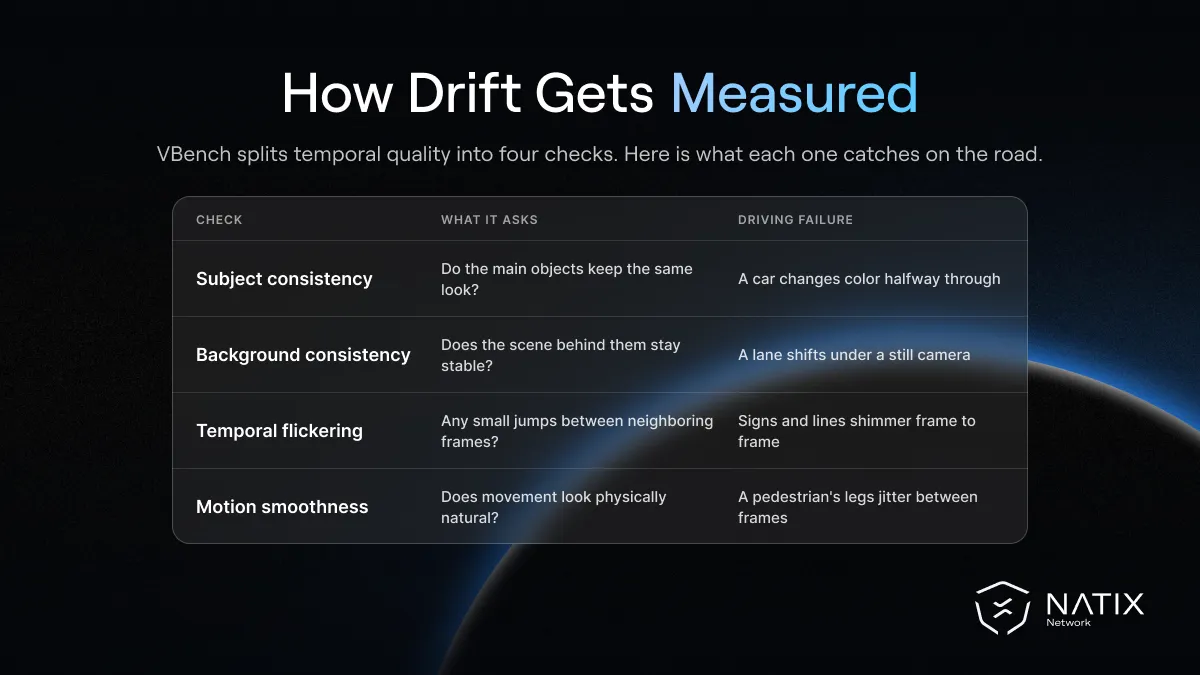
The most widely used benchmark for this is VBench, which splits temporal quality into separate checks:
Subject consistency: do the main objects keep the same appearance across the video?
Background consistency: does the scene behind them stay stable?
Temporal flickering: are there small, high-frequency changes between neighboring frames?
Motion smoothness: does movement look physically natural?
For a driving world model, each check maps onto something that matters. A car that changes color halfway through a clip is a subject consistency failure. A lane that shifts sideways under a stationary camera is a background failure. A pedestrian whose legs jitter between frames is a smoothness problem that can confuse any perception model trained on the footage.
Most video world models learn from raw video through self-supervised learning and generate the future step by step. Each new frame, or chunk of frames, is predicted from what the model has already produced. That design makes long rollouts possible. It also means every small error becomes part of the input for the next prediction.
The University of Freiburg team behind Orbis 2 describes this directly. When a predictor works frame by frame, it accumulates error over time. That limits its ability to reason about how a scene evolves over long horizons. A slightly wrong position for a parked car at second three becomes the starting point for second four. By second twenty, the car may be in a different lane.
Temporal consistency is also tied closely to intuitive physics. Object permanence is temporal consistency through an occlusion. If a model cannot keep a visible car stable for twenty seconds, it has little chance of tracking a car it cannot see.
Feature-similarity scores like those in VBench are a useful first pass. They are cheap to compute and track what human reviewers notice. They have a known weakness, though. The VBench authors point out that a completely static video can score well on the consistency metrics. The authors therefore pair them with a separate measure of how much the video actually moves. Consistency scores always have to be read alongside how dynamic the footage is.
For driving, the stronger test compares what the model generated with what actually happened:
Start from a real clip and let the model continue it.
Run the real continuation and the generated one side by side over the same horizon.
Track static objects such as signs and parked cars. Track moving road users and the ego vehicle's own path, too.
Drift then becomes a measurable distance instead of a visual impression.
Teams working with several cameras add one more dimension. A scene can stay stable within each camera and still drift apart between cameras. Temporal checks are therefore usually paired with cross-camera checks based on epipolar geometry. Together they answer two questions: does the world stay the same over time, and does it stay the same from every viewpoint?
Measuring drift against reality needs real clips long enough to show it. Many public datasets were built around snippets of a few seconds. That is enough to test perception, but not enough to expose a model that slowly loses track of the scene. Evaluation needs continuous recordings, ideally from several synchronized cameras, across many kinds of roads and traffic.
That is the role NATIX data plays in Orbis 2, the University of Freiburg's hierarchical driving world model. NATIX was the largest single source in its training mix, at more than 40%. The model was evaluated specifically on long-horizon stability, not on short-clip quality alone. It also stayed robust on Waymo data it had never seen.
Orbis 2 reflects a broader shift in video AI, from VLMs to world foundation models. These models learn directly from raw video. The quality of their world model training data, and of the footage used to test them, decides how far they can be trusted. Real-world data is what turns temporal consistency from a visual impression into a measured property.
A good way to start is with long trips rather than short clips. NATIX's Multi-Camera Driving Dataset on Hugging Face offers complete multi-camera trips with calibration. Use them to test how far a rollout can run before it drifts.
Temporal consistency means that objects, backgrounds and motion stay coherent from frame to frame. A temporally consistent video keeps a car the same color and its movement smooth. Things only change when something in the scene changes them.
Most world models generate each step from their own previous output. Small errors in one step become inputs to the next, so they accumulate as the rollout gets longer. Comparing long generated rollouts with long real recordings is the most direct way to measure this drift.
Short clips tell you whether a model can draw a scene. Long rollouts, compared with long real recordings, tell you whether it understands one. When evaluating video world models for driving, temporal consistency over long horizons is the question that matters.


