

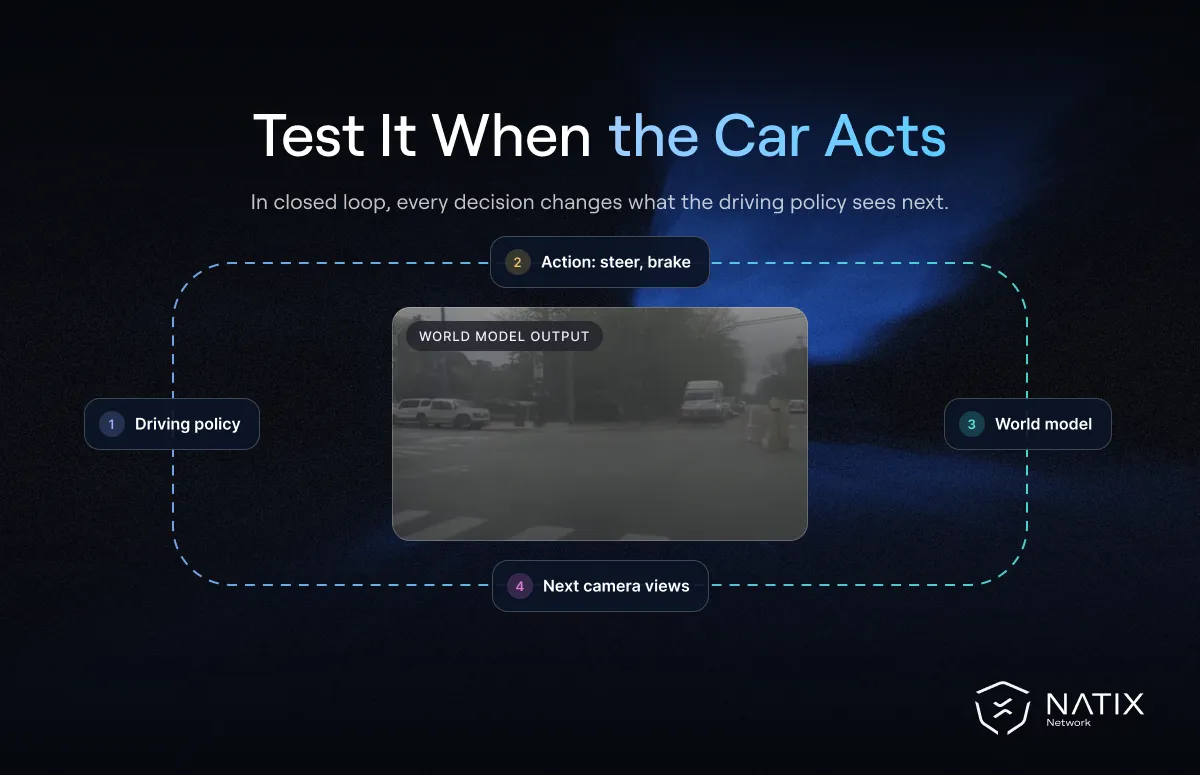
Closed loop simulation is a test in which a driving policy's actions change what happens next. The policy sees the scene and decides to brake or steer. The simulated world then responds to that decision, so the policy has to live with the consequences of its own choices. It is the closest thing to a real road test that can run safely and at scale. For world models used as simulators, closed loop simulation is also the hardest test to pass. It therefore depends on good world model validation data.
The difference is easy to state. In an open-loop test, the policy sees a recorded scene and says what it would do. Its answer is compared with what the human driver actually did. The recording then continues unchanged, whatever the policy decided.
In a closed-loop test, the scene continues from the policy's own decision. If it brakes too late, the gap to the car ahead shrinks. If it drifts toward the curb, the next frame shows the curb closer. Small mistakes can grow, recover or end in a collision, just as they would in traffic.
Open-loop testing is cheap, reproducible and easy to run on large datasets, which is why it dominates many leaderboards. Closed loop simulation is slower and needs a simulator that can produce plausible new observations. But it measures what actually matters for end-to-end autonomous driving: whether the policy drives well when its own actions shape the road ahead. It is also the final layer in how to evaluate a world model.
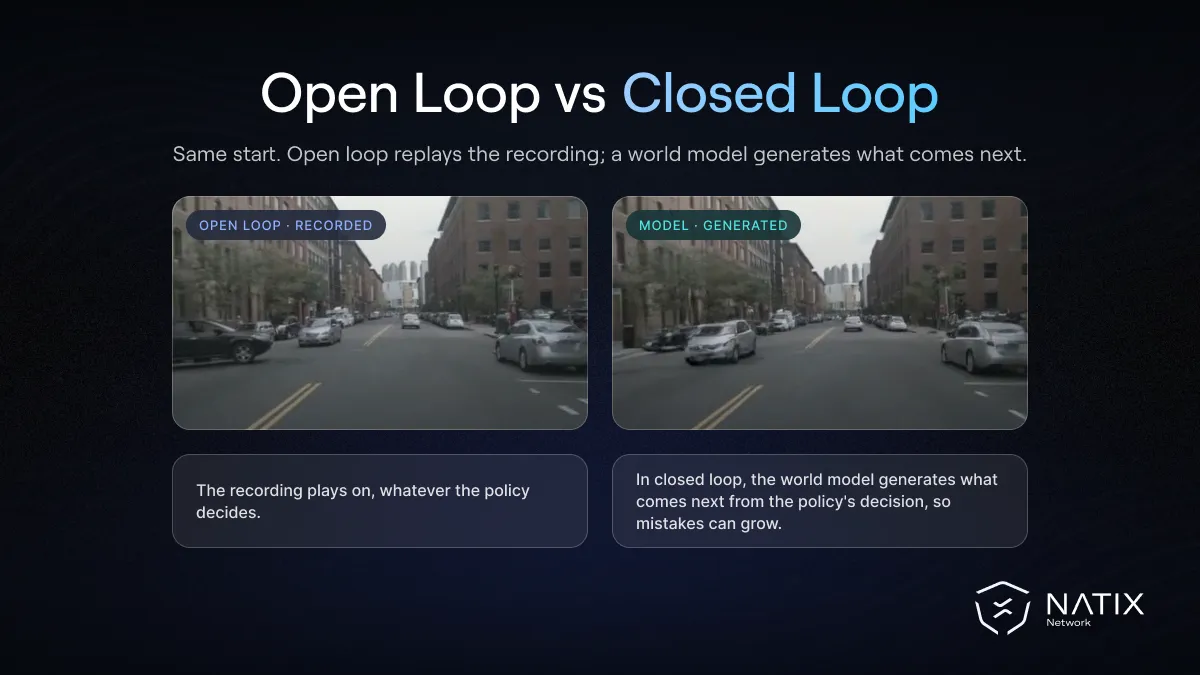
The gap between the two is not academic. On the nuPlan planning benchmark, Dauner and colleagues found a negative correlation between open-loop and closed-loop results. A rule-based planner from more than twenty years earlier beat every learned method in closed-loop driving. Meanwhile, a learned planner that scored well open-loop extrapolated its own errors and drifted off the road once it had to act.
Newer benchmarks try to close the gap. NAVSIM scores open-loop predictions with safety-aware metrics designed to mimic closed-loop outcomes. A cross-benchmark study by Bosch researchers found that NAVSIM's score correlates strongly but imperfectly with closed-loop driving on Bench2Drive. Some methods swapped places in the ranking. Some policies that looked safer open-loop performed worse in closed loop, because they drove too slowly to finish routes.
The conclusion for anyone testing driving policies is simple. Open-loop scores are useful proxy evidence, not a substitute. At some point, the policy has to act inside a world that reacts.
Traditional closed-loop simulators use hand-built 3D worlds. World models offer another route: they generate the next camera views directly from the current scene and the policy's action. That makes it possible to start a closed loop simulation from any real recording. It also opens the door to counterfactual simulation, asking what would have happened if the car had braked one second earlier. This is one of the main reasons world models attract so much interest.
It also raises the bar for evaluation. In open-loop generation, a world model only has to continue a recording plausibly. In closed loop, it has to follow actions it was never shown. When the policy steers left, every camera view has to shift right at the correct rate. When the ego car brakes, the vehicles behind it have to respond.
This action-following ability is part of physical consistency, and it depends on the layers beneath it. A world model with poor simulation fidelity in its physics will produce closed-loop results that look precise and mean little.
Closed-loop testing with world models rests on real data at three points:
Starting scenarios. Every test begins from a real recording, so the variety of those recordings sets the variety of the test.
Rare events. Safety-critical situations have to be included on purpose, which is the logic behind scenario-based testing.
Realistic reactions. The world model's responses have to match how real traffic behaves. That takes large amounts of interactive driving from many places.
Here the broader question of autonomous driving validation data comes in. Real-world validation cannot be replaced by simulation. Simulation can extend it, as long as the simulator itself has been validated against reality.
Open-source projects are starting to build that link into their stacks. NATIX joined the Autoware Foundation to provide multi-camera driving data for Autoware's first open-source end-to-end driving model, including the world model components that underpin it. When the policy and the world model both learn from real multi-camera footage, closed-loop tests become a meaningful check. Otherwise, they risk a model grading its own homework.
Teams building closed-loop test sets can explore real multi-camera trips in NATIX's Multi-Camera Driving Dataset on Hugging Face and use them as starting scenarios.
Closed loop simulation is a test where the driving policy's actions feed back into the simulated world. Each decision changes the next observation, so mistakes can compound or be corrected, as they would on a real road. It is the standard way to measure how a policy actually drives.
Open-loop testing compares a policy's predictions with recorded human driving, but the recording never reacts to the policy. Closed-loop testing lets the scene respond to every action. Open-loop scores are cheaper to compute but can rank policies very differently from closed-loop results.
Closed loop simulation is where every other form of physical consistency gets tested at once. A world model that keeps objects stable and follows real vehicle physics lets a driving policy fail safely in simulation. A world model that does not will let it pass when it should not.


