

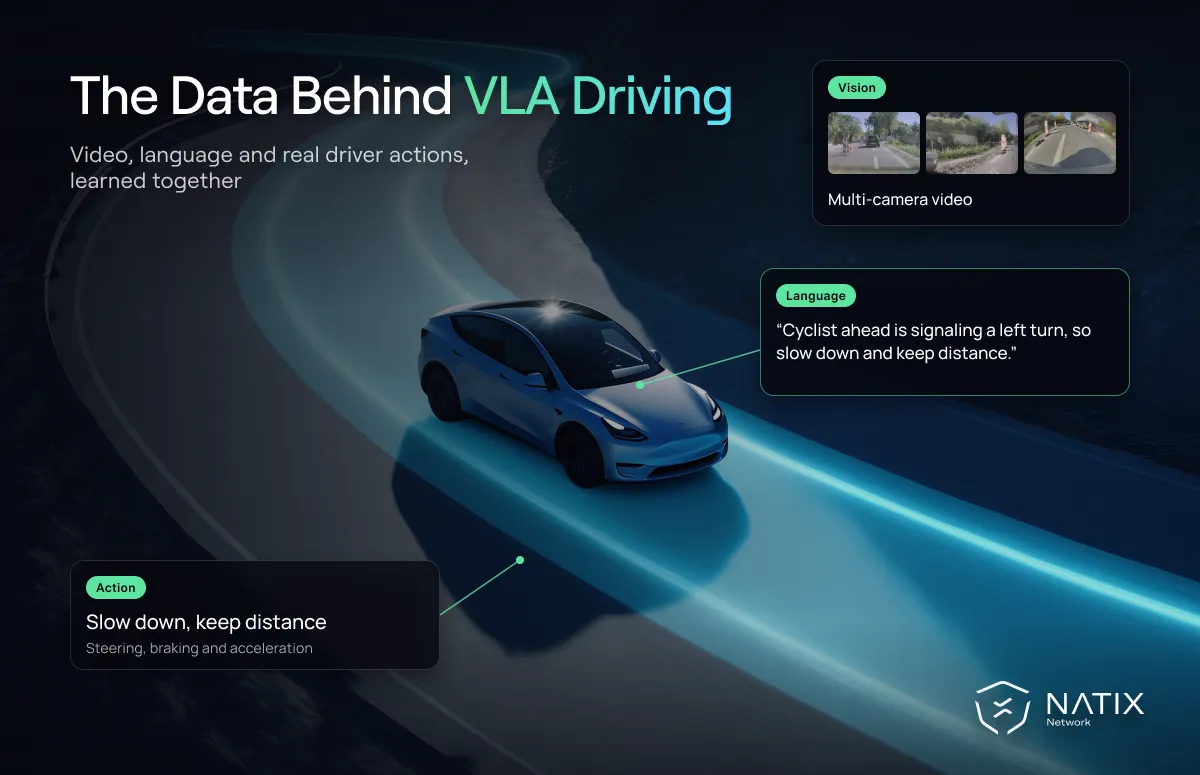
A vision language action model connects three things that driving systems used to handle separately: what the vehicle sees, how the situation can be described and reasoned about, and what the vehicle should do next. In autonomous driving, these VLA models are one of the most promising ways to make systems both more capable and easier to understand, because they can explain their decisions in plain language.
They also expose a data problem. A vision language action model learns from a combination of video, language and real driving actions, at a scale and variety that most public driving datasets were never built to provide.
A VLA model takes visual input, usually video from one or more cameras. It then produces two kinds of output: a description or chain of reasoning about the scene, and a driving action such as a trajectory, steering command or speed change. Some models also accept language instructions, such as a navigation request.
The idea grew out of robotics, where VLA models learned to follow instructions like "pick up the red cup". In driving, the same structure lets a model say what it sees, why it matters and what it will do: a pedestrian is stepping off the curb, so the car will yield.
It helps to separate three related families. A VLM, or vision-language model, describes and answers questions about images and video, but it does not produce driving actions. It is excellent for searching large video archives and tagging rare scenes.
A world model learns how a scene evolves over time and can generate plausible future frames. It is a powerful tool for simulation and for teaching a system about cause and effect.
A vision language action model goes one step further than a VLM by turning understanding into action. In practice, the three often work together: VLMs curate the data, world models expand it and VLA models learn to drive from it. We explore that progression in our article on video AI, VLMs and World Foundation Models.
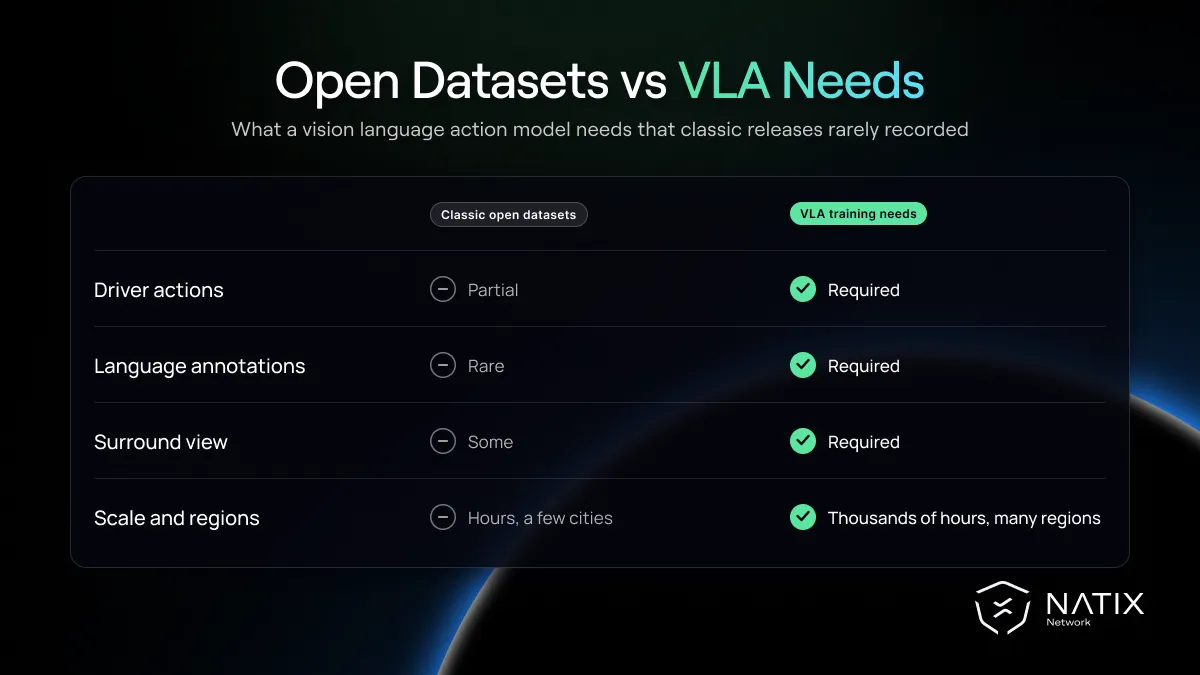
Training a vision language action model for driving puts unusual demands on data.
Video with real driver actions. The model must learn the link between a scene and a good action. That means pairing the video with what a skilled driver actually did, including steering angle, braking, acceleration and signals recorded at high frequency.
Language that explains the situation. Descriptions and reasoning traces, often generated with VLMs and checked by people, teach the model to connect what it sees with why an action makes sense.
Surround view. Driving decisions depend on what is happening on every side of the car, so multi-camera video matters more than a single forward view.
Variety and rare events. A reasoning model is most valuable in unusual situations. It needs many examples from different regions, conditions and road cultures, including the long tail of rare events.
The classic open autonomous driving datasets were designed for perception and prediction benchmarks. Most record the vehicle's trajectory, but few include detailed driver inputs, and almost none include language annotations at scale. They also come from a handful of cities and amount to hours rather than the thousands of hours VLA training benefits from.
Some newer releases are moving in this direction. NVIDIA's Alpamayo project, for example, pairs a reasoning VLA model with an open dataset of 1,727 hours of driving from 25 countries, a clear step up in scale. Even so, public data for VLA training remains limited compared with what production systems will need. Our article on reasoning in autonomous driving AI looks at why these models need broader data, and our overview of open-source reasoning driving models covers the models now being released to the community.
Evaluating a vision language action model is harder than scoring a detector. It is not enough to check whether the predicted path matches the human driver's path, because several different actions can be safe in the same situation. Teams increasingly combine three kinds of tests.
The first is open-loop comparison with recorded driving, which shows whether the model's actions resemble those of skilled drivers. The second is closed-loop testing in simulation, where the model's choices change what happens next and errors can compound. The third is checking the reasoning itself: whether the explanation the model gives matches what is actually in the scene and supports the action it took.
Each of these depends on data. Open-loop tests need large amounts of recorded driving with driver actions. Closed-loop tests need realistic, varied scenarios, often created with world models grounded in real video. Reasoning checks need scenes where the right explanation is clear, including rare situations where shortcuts fail.
The most practical way to meet these needs is to start from large, continuously collected real-world video that already includes driver behavior. Language can then be added through VLM tagging and human review. This turns a raw archive into structured training material.
NATIX supplies autonomous driving data built for that workflow. Our network records synchronized multi-camera footage from factory Tesla cameras across the USA, Europe and Japan, paired with vehicle telemetry such as wheel angle, pedal position and brake state. With VLMs, NATIX can make rare scenes searchable through WorldSeek, and our open telemetry dataset on Hugging Face shows what video paired with steering, braking and acceleration looks like. Simple, widely collected footage like BDD100K showed the value of everyday driving, and multi-camera collection with vehicle telemetry takes that idea to the level VLA models need.
A vision language action model can only reason as well as the data it learned from. Giving it rich video, real driver behavior and the variety of the real world is what turns a clever architecture into a dependable driver.


