

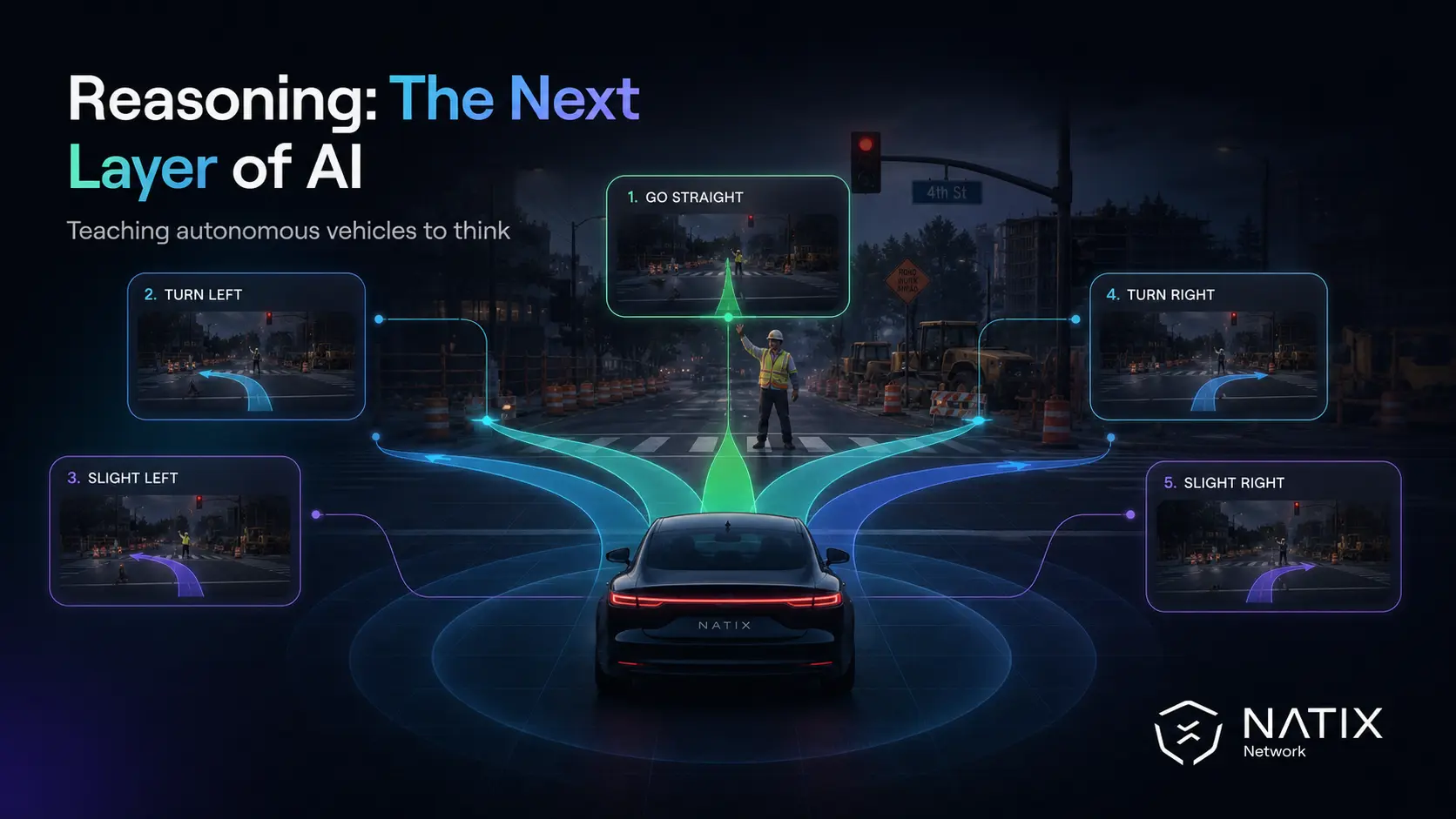
A self-driving system can spend months handling ordinary traffic without incident, then stall at an intersection where a construction worker is waving cars through a red light. The model has seen millions of red lights. It has never seen this one, because this one requires a judgment call, not a lookup. That gap is becoming one of the more interesting problems in autonomous driving, and it says something important about what these systems have been missing.
For years, autonomous driving AI has been built around two capabilities: perception, understanding what is currently in the scene, and prediction, estimating what will happen next. Both are necessary. Neither is sufficient. What is emerging now is a third layer: reasoning, the ability to work through why a situation calls for a particular action before committing to it. That shift, from systems that only perceive and predict to systems that reason step by step about cause and effect, is quietly becoming the next frontier of autonomous driving AI, and it changes what training data needs to look like.
What Reasoning Actually Means Here
Perception answers a simple question: what is out there right now. Cameras and sensors turn the physical world into objects, lanes, signals, and pedestrians. Prediction goes one step further and asks what those objects will do next, whether a pedestrian will step off the curb or a car ahead will brake. Both tasks can be learned from patterns in data without the system ever understanding why a scene unfolds the way it does.
Reasoning is different. It asks why an action is the right one, given everything the system can see and everything it can infer about intent. A human driver does not just recognize a worker waving traffic through a red light. The driver reasons through it: the light says stop, but a person with more immediate authority is saying go, and the two cars nearby are already moving, so the safe choice is to follow. That chain of if this, then that is what current driving models are only beginning to learn explicitly, through approaches often described as chain-of-thought reasoning, borrowed from how large language models work through multi-step problems.
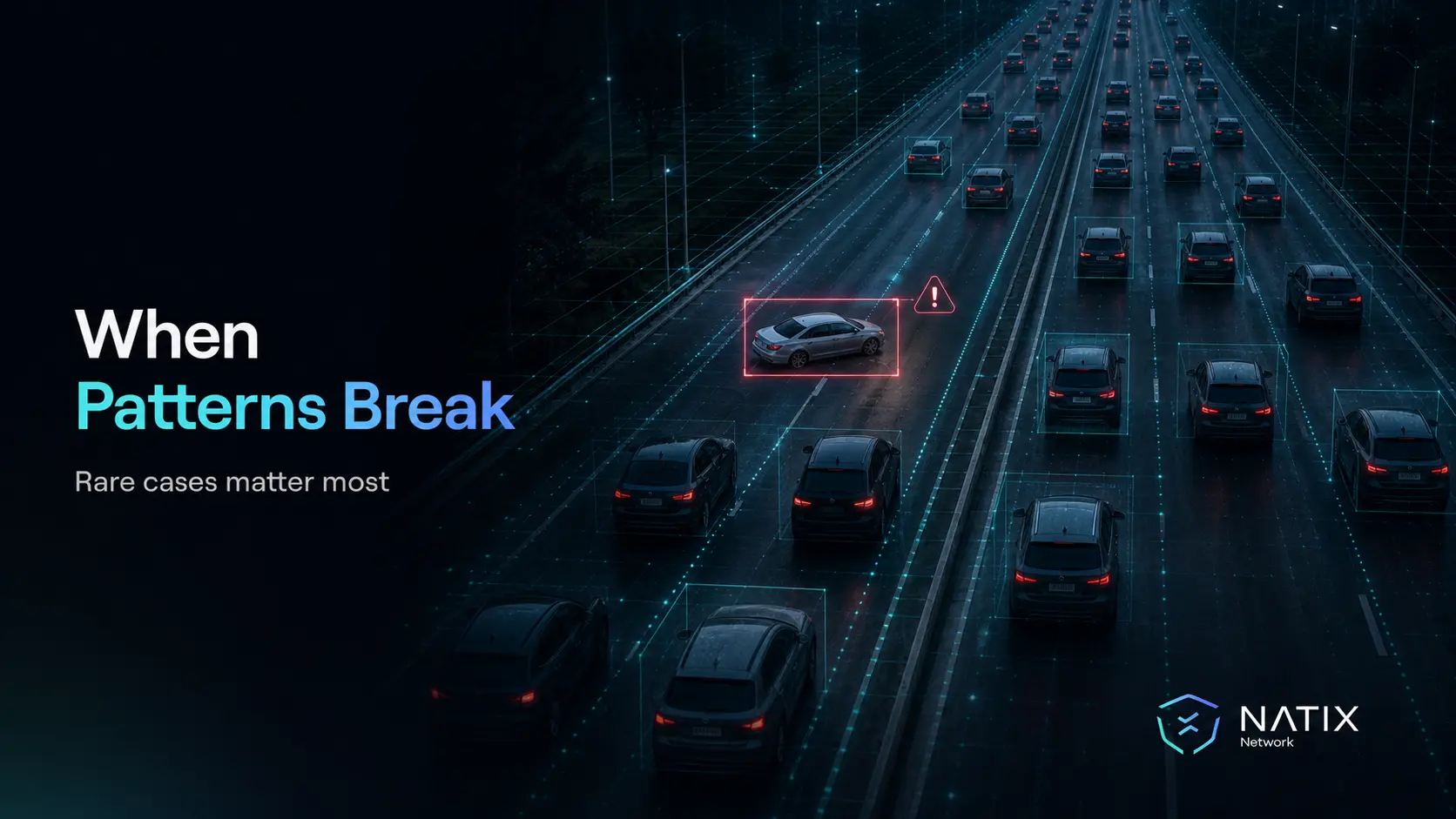
Most end-to-end autonomous driving models are trained by imitation. Show the system millions of clips of good driving, and it learns to associate a given scene with the action a human took next. This works well in common situations, because common situations repeat constantly and the correlations are strong. It works less well when a scene looks unusual, because imitation learning finds patterns, not causes.
Researchers have started calling this problem causal confusion. A model can produce the correct action in a familiar scenario for reasons that have nothing to do with what actually matters, then produce the wrong action the moment the surface pattern shifts even slightly. A recent survey of chain-of-thought reasoning in driving models points to exactly this gap: systems that work through a scenario step by step handle unusual and safety-critical situations more reliably than systems that map inputs straight to outputs, because reasoning forces the model to represent the actual logic of a decision rather than just the decision itself.
This is precisely where the long tail of driving, the rare, safety-critical situations that make up a small share of total miles but a large share of risk, becomes the real test of a system's intelligence. A model that performs well on average can still fail exactly where it matters most, and average performance was never really the goal.
A new generation of models is beginning to build reasoning in as an explicit step rather than an implicit byproduct. Waymo's research model EMMA is one example. Built on a multimodal language model, EMMA generates a chain-of-thought reasoning trace before producing a driving trajectory, and Waymo has reported that this step alone improved planning performance by close to seven percent while making the model's decisions easier to interpret. The system is not just outputting a trajectory. It is showing its work first.
NVIDIA's Alpamayo-R1 pushes the idea further. Instead of training only on trajectories, it is trained on clips that capture a few seconds of context leading up to a decision, such as an overtake or a yield at an intersection, paired with the reasoning that justifies it and the outcome that follows. The model uses a vision-language model as its reasoning backbone, generating an explicit causal explanation before predicting the action, which helps prevent the kind of confident but ungrounded output that pure pattern matching can produce. That pattern, using vision-language models to power end-to-end driving, is becoming a common thread across the field rather than a one-off experiment.
The common thread across this new wave of research, from Waymo to NVIDIA to a growing body of academic work on structured reasoning for driving, is that the reasoning step is no longer treated as a nice-to-have explanation bolted on after the fact. It is becoming part of how the model actually arrives at its decision.
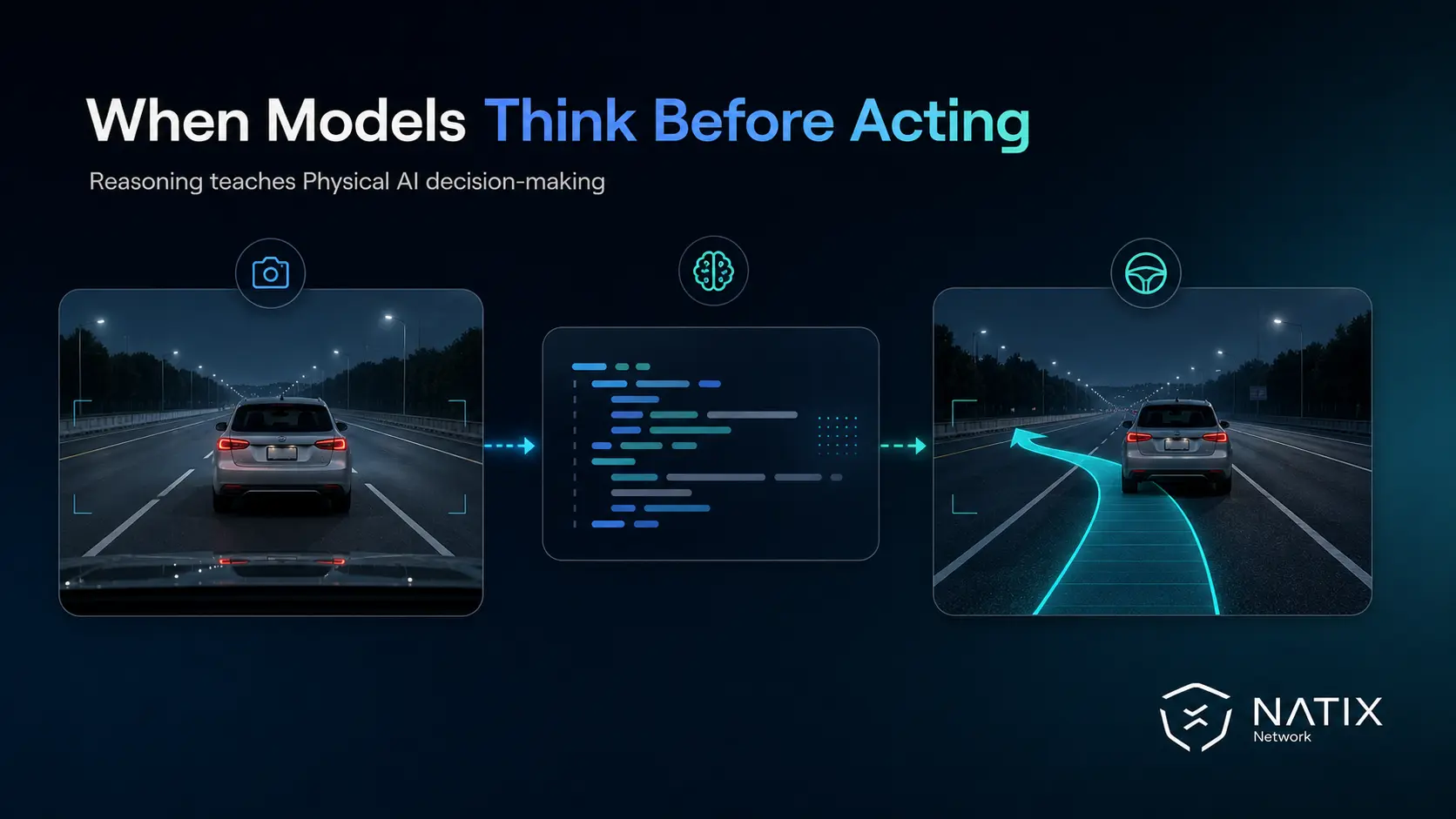
Reasoning does not operate alone. It works alongside World Foundation Models, systems trained to simulate how a scene is likely to evolve. Where a chain-of-thought reasoning step works through why an action makes sense given the current scene, a world model can play that scenario forward and show what is likely to happen if the system follows through on it.
This is where the pieces come together. Perception establishes what is currently true about the scene. Reasoning works through why a particular response fits the situation. World models let the system check that response against a plausible version of what comes next, before it ever reaches the road. None of these layers replaces the others. Each one closes a gap the others leave open.
This is also where the shift becomes a data problem, not just a modeling problem. A dataset built for perception needs labeled objects: cars, pedestrians, lane markings, signals. A dataset built for prediction needs trajectories over time. A dataset built for reasoning needs something else entirely: structured cause-and-effect chains that connect a scene, the decision a driver made, and the consequence that followed.
In practice, this means clips that capture a window of context leading into a decision, the decision itself, and enough of what happens afterward to show whether the decision held up. Alpamayo-R1's training set, for example, is built around roughly twenty-second clips: several seconds of build-up to a driving decision such as an overtake, a yield, or a pass through an intersection, followed by its outcome. Each clip is annotated with the reasoning that connects the two. NVIDIA's team found that a small share of these annotations, produced by humans, combined with a much larger share generated by other language models and checked for consistency, was enough to teach the causal structure that trajectory data alone could not.
This raises the bar on what counts as useful training data. A single front-facing camera can label what a car did. It struggles to show why, because the reasons a driver yields, brakes, or proceeds often live outside the frame, in a signal from another vehicle, a pedestrian at the edge of the intersection, a merge happening two lanes over. Reasoning-grade data depends on seeing enough of the surrounding scene, across camera angles and across the seconds before and after a decision, to make the causal chain visible in the first place. It also depends on genuinely diverse situations, since a model trained mostly on ordinary driving will reason its way to ordinary conclusions, and the moments that need reasoning the most are rarely ordinary. That is one reason scenario generation has become as important to this next phase as raw data volume ever was.
This is where NATIX's approach to data becomes relevant, not because reasoning models need more footage in the abstract, but because they need footage with the right shape. NATIX's global network of contributors, mostly everyday drivers running dashcams and 360 degree cameras, captures real driving from multiple angles at once, not just what is directly ahead of the car. That matters specifically for reasoning, because the cause of a decision is frequently visible somewhere other than the front windshield.
NATIX's work with Valeo on one of the largest open-source multi-camera World Foundation Model efforts is built on exactly this kind of real-world, surround-view data, and the same qualities that make it useful for training and validating world models: global coverage, multiple viewpoints, and a genuine long tail of unusual situations, are what reasoning-focused training sets need as well. A model cannot reason about a cause it never saw.
The same logic extends to how that footage becomes usable. NATIX's VLM-powered search tool lets teams search across real-world driving footage using plain language, which is one practical way to find the specific kinds of scenarios, such as an ambiguous right of way, a construction detour, a hand signal overriding a traffic light. That kind of reasoning models most need to learn from, and that is hardest to find by scrolling through raw video.
Perception told a system what was there. Prediction told it what was likely to happen next. Reasoning is what lets it explain, to itself and eventually to the people relying on it, why a particular response was the right one. That is a meaningful step forward, but it does not arrive for free. A model can only reason as well as the data it learned to reason from, and that means the next real bottleneck is not a smarter architecture. It is training data built to show cause and effect, not just outcomes.
In the end, the companies that solve this will not just be the ones with the most driving footage. They will be the ones whose data actually captures why the world behaves the way it does, not only how it looks in the moment before something happens.


