

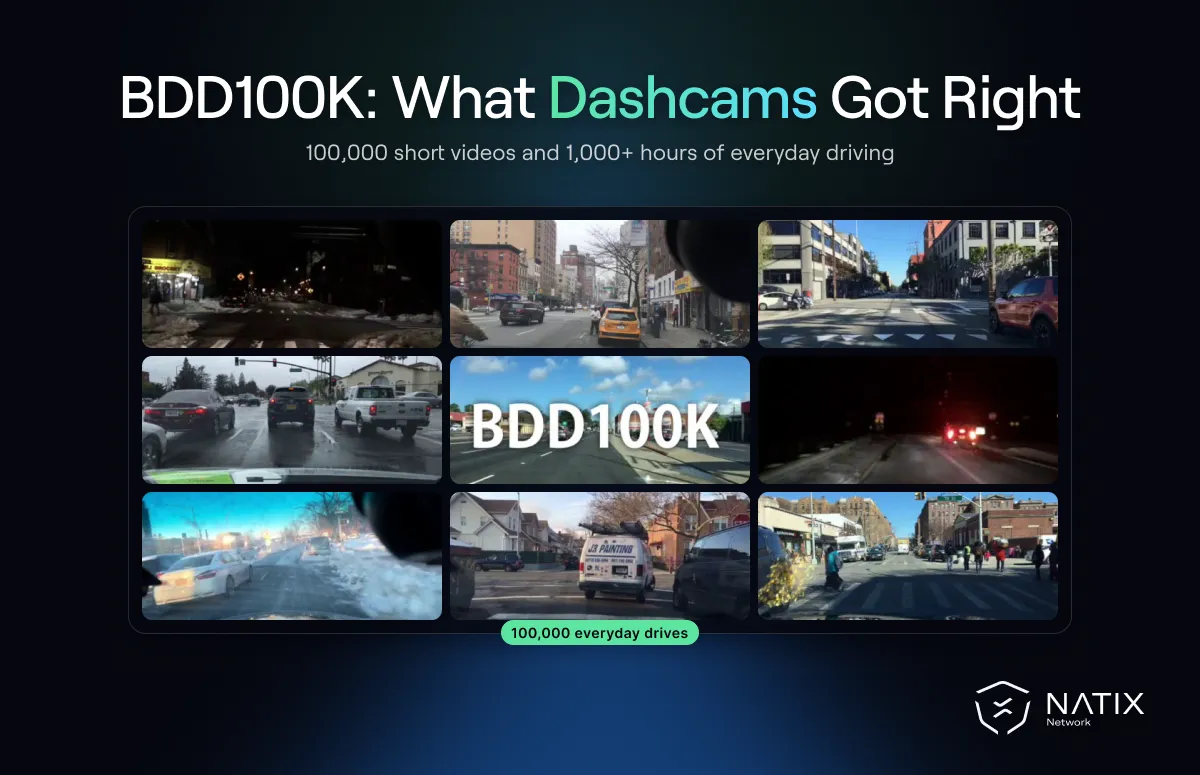
Released by Berkeley DeepDrive in 2018, BDD100K showed the autonomous driving field that variety can matter as much as sensor sophistication. Instead of a few hours of data from an expensive research vehicle, the team collected 100,000 short videos from ordinary dashcams, covering more than 1,000 hours of everyday driving. The result was one of the most diverse public driving datasets of its time.
That approach still holds lessons for anyone building driving data today. So do its limits, which explain why a single forward camera is no longer enough for modern models.
According to the project's download page, the dataset contains 100,000 videos of about 40 seconds each, recorded at 720p and 30 frames per second from roughly 50,000 trips. They were recorded mostly in US cities such as New York and around the San Francisco Bay Area. The videos come with GPS and IMU traces and cover many weather conditions, times of day and road types.
A large subset of frames is annotated for a wide range of tasks: object detection, lane markings, drivable areas, semantic and instance segmentation, multi-object tracking and image tagging for weather and scene type. That breadth made it a popular benchmark for multitask learning, where one model handles several perception problems at once.
Most research datasets of the era were recorded by small teams in a single city, often in good weather. BDD100K went the other way. By crowdsourcing dashcam footage, it captured rain, snow, night driving, glare and dense urban traffic far more often than curated research drives could.
That diversity exposed an uncomfortable truth. Models that looked strong on clean benchmark data often struggled in poor weather or at night. The dataset made those weaknesses measurable, and it pushed the field to treat domain shift as a core problem rather than an edge case.
It also proved a practical point: everyday drivers, using inexpensive cameras, can produce data that is genuinely useful for research. That idea sits at the heart of today's crowdsourced collection approaches, which we describe in our article on the dashcam-to-autonomous-driving data pipeline.
Over the years, this dashcam dataset has supported several distinct lines of research. The most common is multitask perception: because the same images carry labels for objects, lanes, drivable areas and segmentation, researchers can train one network to handle several tasks and study how those tasks help or interfere with each other.
A second use is robustness. With labels for weather and time of day, the data makes it easy to measure how a model's accuracy changes from clear daylight to rain or night. Those comparisons became a standard way to show whether a new method genuinely generalizes or simply fits the easy conditions.
A third use is domain adaptation, where a model trained on one dataset is adjusted to work on another. Pairing this dashcam dataset with lidar-heavy releases such as nuScenes or the Waymo Open Dataset gives researchers a clear test of how far a model can travel between very different recording setups.
Finally, the video format supports tracking and temporal research. Because each clip is about 40 seconds long, models can learn from motion over time rather than isolated frames, which is closer to how real driving systems operate.
One camera. Each video comes from a single forward-facing dashcam. Modern autonomy and Physical AI systems need to understand the scene in every direction, and world models increasingly learn from synchronized surround-view video.
Mostly US roads. Diversity of weather and time of day is high, but geography is still mostly American. The geography problem in autonomous driving remains: a model can handle American rain and still struggle with European road design.
Age. The data dates from the late 2010s, so vehicles, road users and camera quality reflect that period.
Limited driver behavior. BDD100K records GPS and motion traces, but not detailed driver inputs such as steering, braking and acceleration at high frequency. Those signals are exactly what end-to-end and reasoning models now learn from.
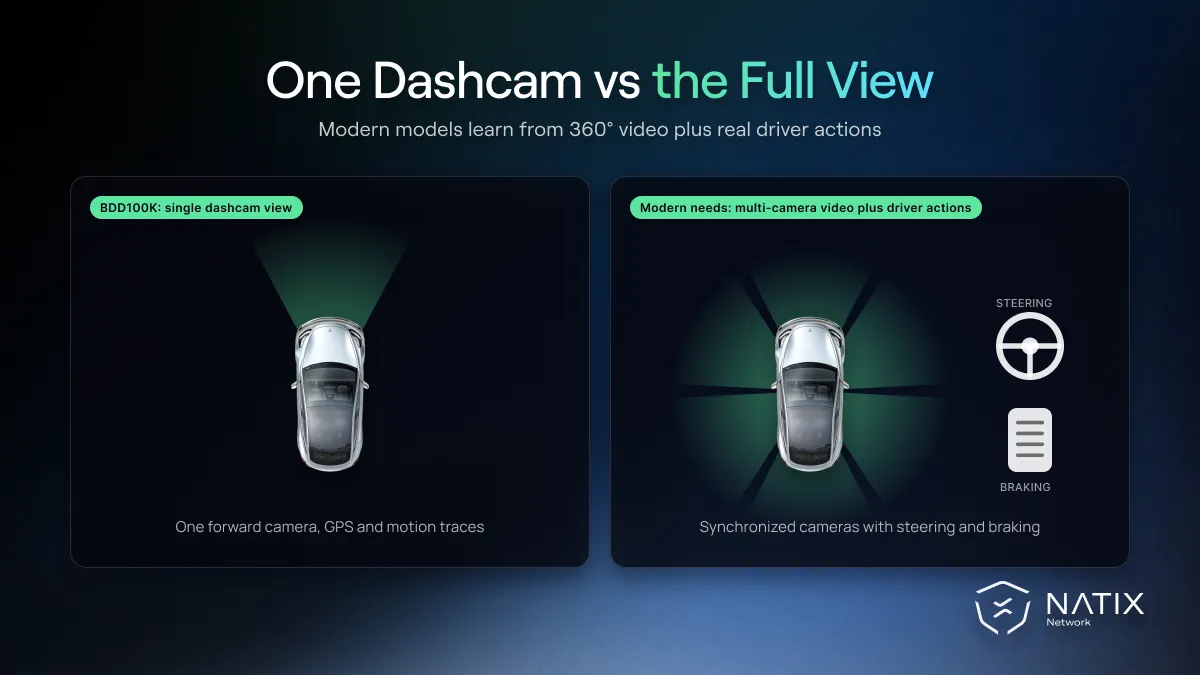
The lesson of BDD100K is that scale and variety come most naturally from everyday driving. The next step keeps that idea and upgrades the data itself: more cameras, more regions, continuous collection and driver behavior recorded alongside the video.
This is the direction NATIX has taken, and it is why NATIX was the largest single data contributor to Orbis 2, the University of Freiburg's driving world model. Our network collects synchronized multi-camera footage from factory Tesla cameras driven by everyday drivers across the USA, Europe and Japan, paired with vehicle telemetry such as wheel angle, pedal position and brake state. It is the dashcam idea, extended to multiple synchronized cameras and to a global scale.
For research benchmarks, BDD100K and the other public driving datasets remain valuable. For training models that must work across the world, a large self driving car dataset built from continuous multi-camera collection fills the gap. If you are comparing options, our breakdown of the Waymo Open Dataset shows how a lidar-heavy release differs from dashcam-style data.
BDD100K proved that ordinary drivers can teach machines about the real world's variety. Its single camera and its era are the parts that today's data has to move beyond.


