


For years, the open part of autonomous driving was the data. Companies released dashcam datasets, benchmark suites, and annotated driving clips, but the models that actually turned that data into a driving system stayed closed. That changed at CES 2026, when NVIDIA released Alpamayo, a family of open reasoning models for autonomous vehicles, alongside a simulation framework and a set of driving datasets. Alpamayo 1 is a 10-billion-parameter model that can walk through a driving scenario step by step, reason about what it sees, and explain the decision it's about to make. It is available on Hugging Face for anyone to download.
That single move reframes a question a lot of teams in this industry have been asking quietly for a while. If the model itself is now open, what is actually left to build? The honest answer is that open-sourcing a reasoning model does not hand anyone a finished autonomous vehicle. It changes where the real work starts.
Most driving systems built over the last decade worked by mapping sensor input directly to an action. A camera feed comes in, a model predicts a trajectory, the car follows it. This works well in common situations and tends to fail quietly in unusual ones, because the model was never asked to think about why it was making a choice, only to make one.
A reasoning-capable model works differently. It processes the scene the way a vision-language model does, then reasons through the situation in steps before committing to an action. Alpamayo is described by NVIDIA as a vision-language action model built on chain-of-thought reasoning, meaning it produces a visible trail of intermediate judgments, not just a final trajectory. Faced with something like a traffic light outage at a busy intersection, it can reason about right of way, uncertainty, and risk in a way that a plain perception-to-action model was never built to do.
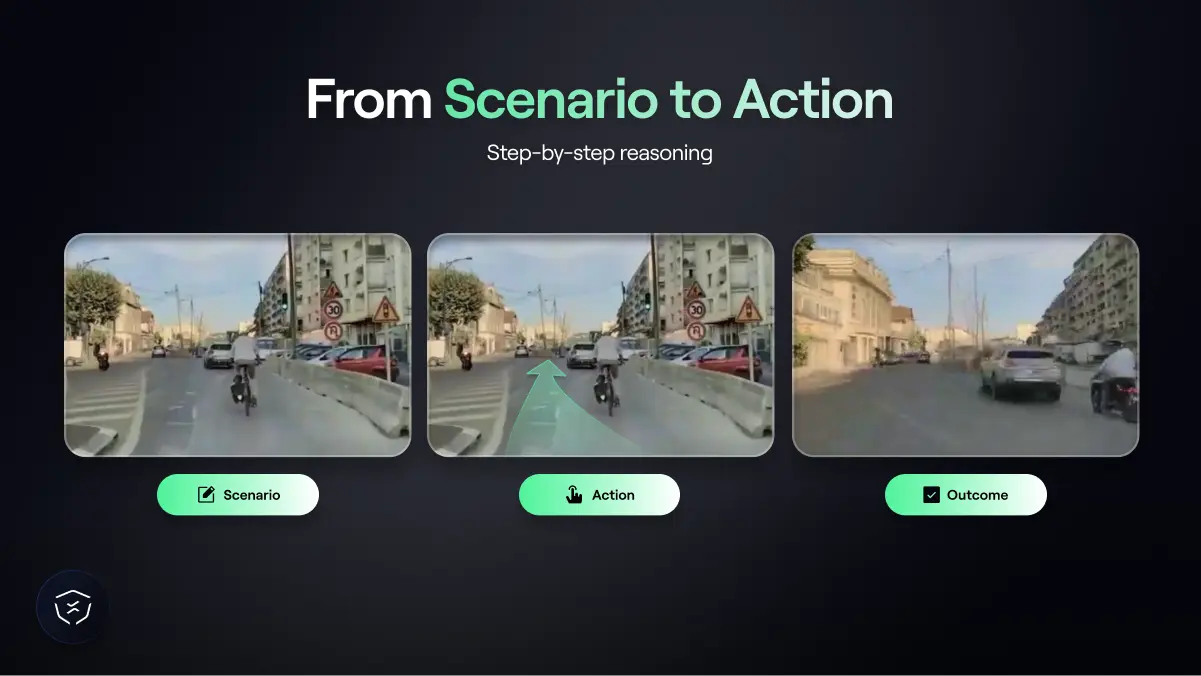
This matters because reasoning is what lets a system generalize to a situation it has never seen labeled examples of. In other words, it is the closest thing driving models have had to judgment.
Building a model like this from scratch has never been a small undertaking. It requires large amounts of driving data, enormous compute budgets, and research teams with deep experience in both vision and language modeling. That combination has been available to a small number of companies: the automakers and AV labs with the balance sheets to run frontier-scale training, and a handful of chipmakers with both the compute and the data pipelines to support it.
Everyone else built narrower. Smaller automakers, Tier 1 suppliers, and AV startups tended to assemble task-specific pipelines instead, one model for perception, another for prediction, hand-tuned rules stitched in between. It worked, but it meant that reasoning about genuinely novel situations, the kind of judgment a human driver applies without thinking, was largely out of reach unless you had the resources to train it yourself.
That imbalance is the real story behind why open data alone was never going to level the playing field. A dataset tells you what the world looks like. It does not give you a system that can reason about it.
Releasing the model itself changes the starting point. Developers working with Alpamayo do not need to train a reasoning model from zero. They can fine-tune it into smaller, faster versions suited to their own vehicle platform, use it to train simpler downstream driving systems, or build tools on top of it, like auto-labeling pipelines that tag video automatically, or evaluators that check whether a driving decision was actually a good one.
NVIDIA followed the initial release with Alpamayo 2 Super, distributed under OpenMDW-1.1, a permissive license from the Linux Foundation that explicitly covers fine-tuning, derivative models, and commercial redistribution. That licensing detail matters more than it sounds. It means an automaker, a Tier 1 supplier, or a research lab can legally adapt the model to their own driving policies and ship a product built on it, not just study it in a lab setting.
The practical effect is that the group of companies who can credibly attempt a reasoning-based driving stack just got much larger. Smaller automakers, research institutions, and AV startups that previously had no realistic path to a model like this now have one. That is a genuine shift, and it is worth taking seriously rather than dismissing as a marketing move from a company that also happens to sell the compute everyone will need to run these models.
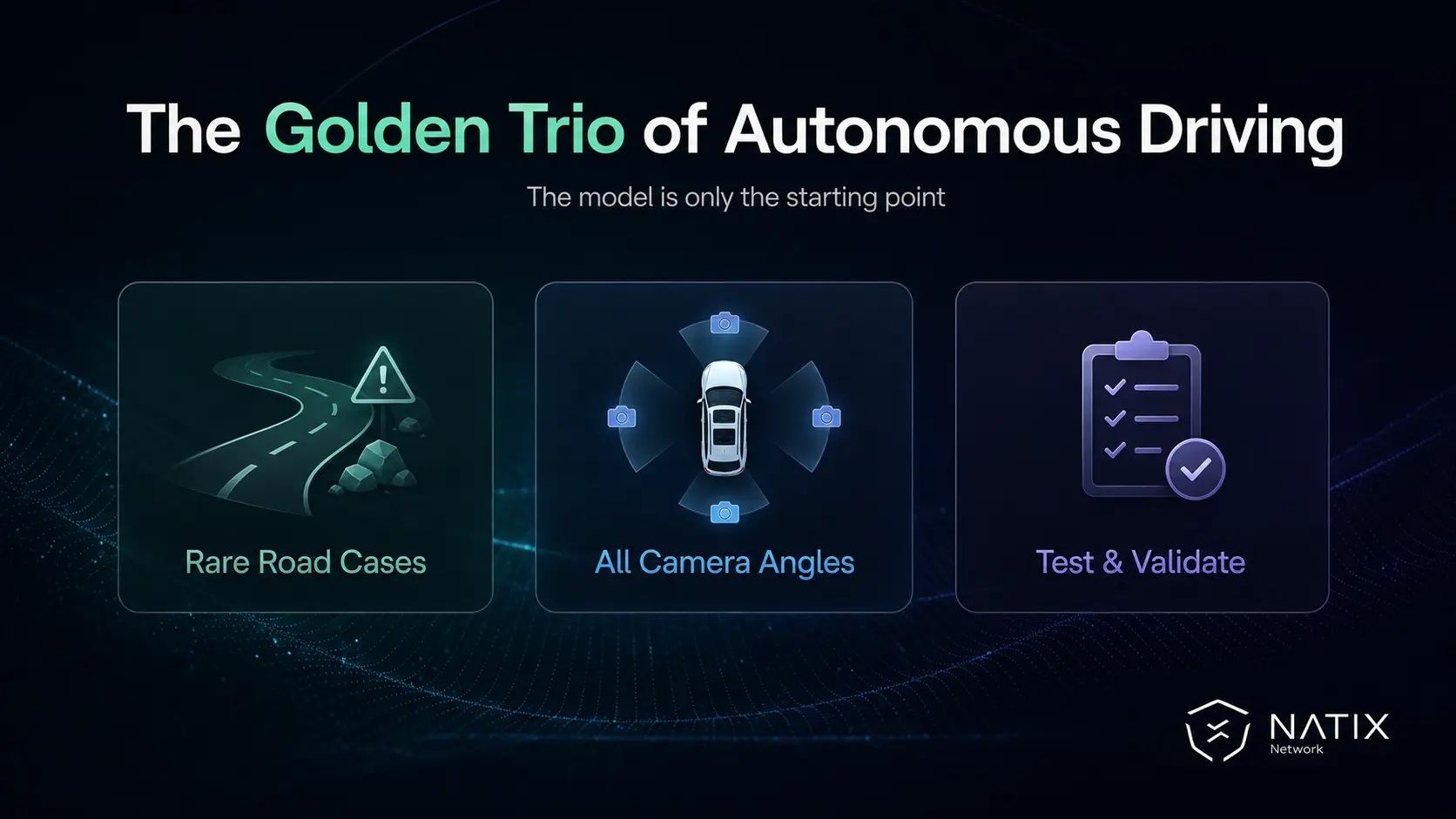
Here is where the excitement usually runs ahead of the reality. An open reasoning model is a teacher, not a finished product. To turn it into something that drives well on your roads, in your climate, with your sensor layout, you still need to fine-tune it, and fine-tuning a reasoning model is a different problem than fine-tuning a simpler perception model.
The first requirement is real-world driving data, and specifically data that covers situations the base model was not already taught. A model trained mostly on common highway driving will reason confidently and be wrong constantly the first time it meets an unusual intersection, a construction zone with conflicting signs, or a delivery truck double-parked at an odd angle. These are the long-tail cases that matter most for safety, and they are exactly the cases that generic open datasets tend to underrepresent. Fine-tuning on the average case just teaches the model to be more confidently average.
The second requirement is coverage that reflects how situations actually unfold, not just how they look from one angle. Rare events rarely happen only in front of the car. A pedestrian stepping off a curb, a vehicle merging aggressively, a cyclist appearing from a blind spot: the useful signal is often visible from the side or the rear before it ever reaches the front camera. A dataset built entirely from forward-facing footage will teach a reasoning model to reason about a narrower slice of reality than the one it actually has to operate in.
The third requirement is a way to check the results. Reasoning models that explain their decisions are easier to evaluate than black box ones, but that only helps if you can replay a scenario, vary it, and see whether the model's judgment holds up. This is where scenario generation and closed-loop simulation come in, not to replace real driving experience, but to stress test what the model learned from it before it ever reaches a vehicle.
None of this is a criticism of open-sourcing the model. It is simply the part of the work that open weights were never going to solve. The industry's real-world driving data still functions as the harder asset to build, the one that cannot be generated instantly or fully simulated, and that has not changed just because the model underneath it is now free to download.
This is the layer NATIX has been building toward. Turning raw driving footage into something a reasoning model can actually learn from and be validated against depends on real-world coverage that is broad, diverse, and captured from more than one angle. NATIX's multi-camera approach, collected through everyday drivers rather than a purpose-built survey fleet, is built around exactly that kind of coverage: a wider field of view per drive, spread across more geographies than a single company's fleet could realistically reach on its own.
The partnership between NATIX and Valeo is a useful example of what this looks like in practice. It is an effort to build one of the largest open, multi-camera World Foundation Models using exactly this kind of real-world footage, feeding both the training side and the validation side of the pipeline. Once footage exists, it also needs to be searchable. NATIX WorldSeek turns street-level video into something a team can query directly, which matters when the task is finding the handful of edge cases buried inside thousands of hours of ordinary driving.
None of this replaces the reasoning model. It supports it. NATIX is not trying to build the next open weights release. It is trying to make sure that when a team fine-tunes one, they are doing it on data that actually reflects the world their vehicles will operate in.
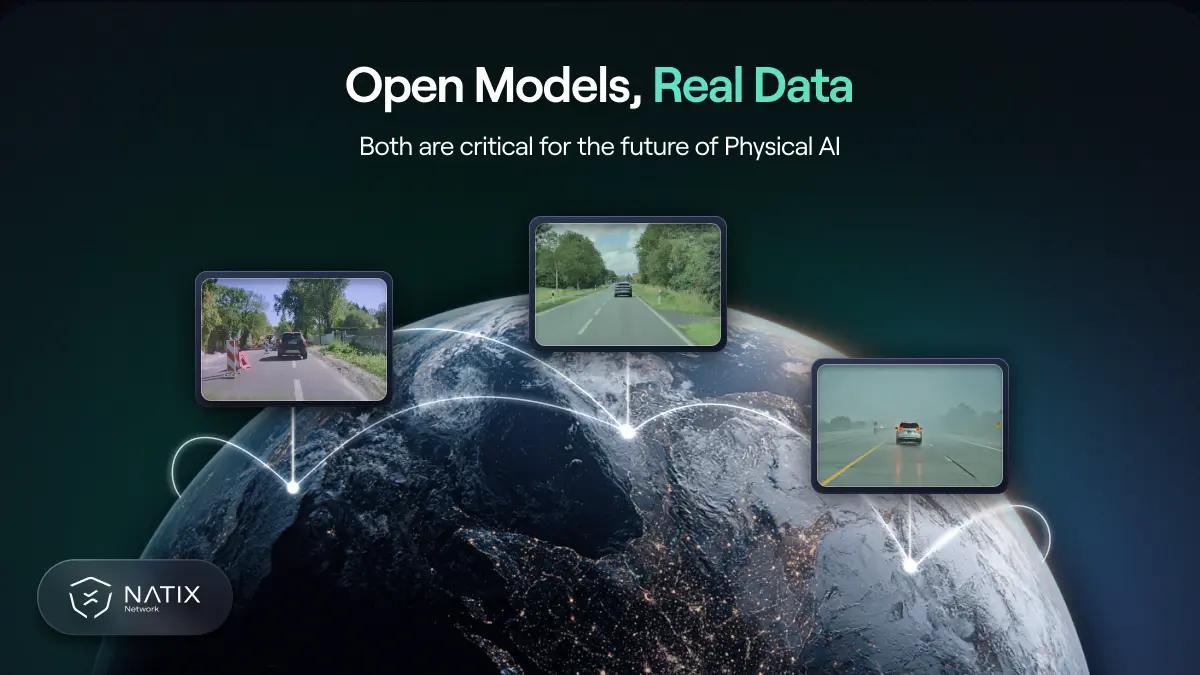
Open-sourcing a reasoning-capable driving model is a real shift, and it deserves to be treated as one. It moves the starting line for a much larger set of companies than could previously attempt this kind of work, and it means the years of research needed to build a model that reasons about driving no longer have to be repeated by every automaker and AV startup on their own.
But it does not remove the harder constraint underneath it. The model can be downloaded by anyone. The real-world experience needed to fine-tune it well, and the diverse, multi-angle coverage needed to validate that it actually reasons correctly, still has to be earned. What matters most is not who has access to the model anymore, since that question is largely settled. What matters is who can feed it, and test it against, enough of the real world to trust the judgment it produces.


