

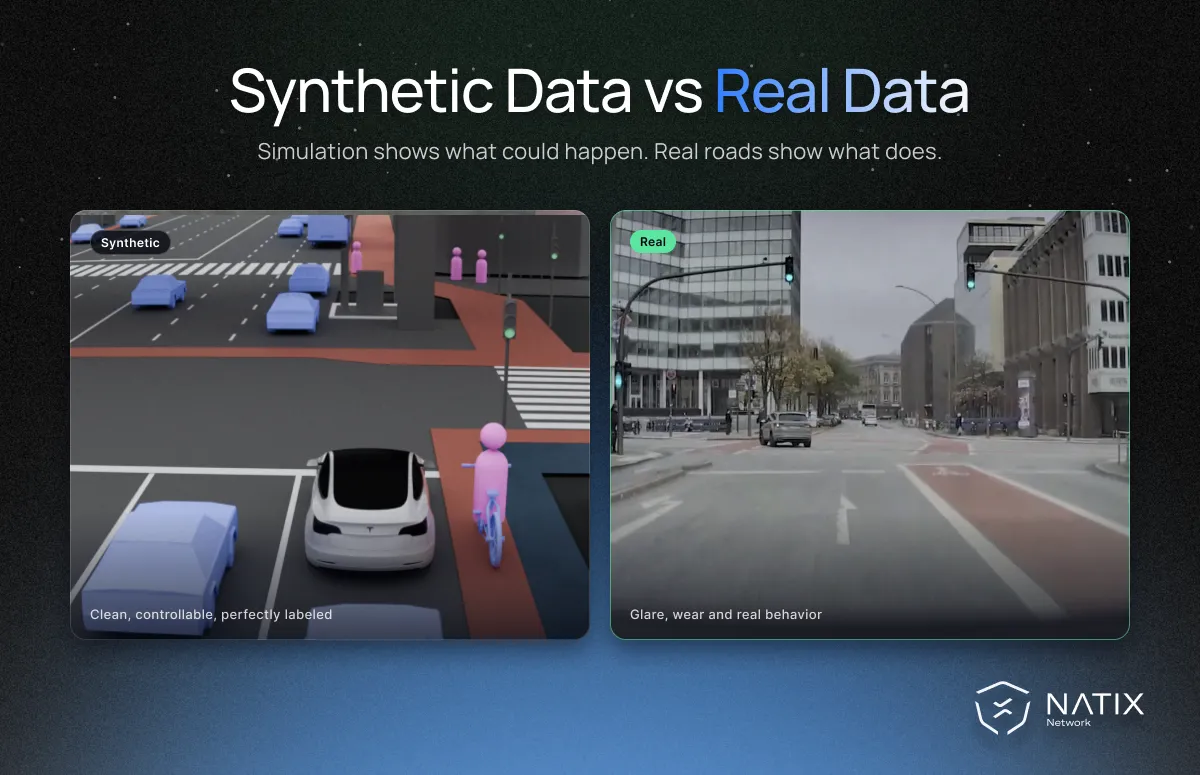
Synthetic data vs real data is one of the most common debates in autonomous driving. Simulation promises unlimited scenarios, perfect labels and no risk on public roads. Real-world driving promises the truth about how roads, weather and people actually behave. Both promises are partly right, which is why the debate never quite ends.
The useful question is not which one wins. It is what each one is good for, and how much of each a team needs for the system it is building.
Synthetic data is generated by software. A simulator renders roads, vehicles, pedestrians and weather, and produces sensor output as if a car were driving through them. Because the scene is generated, every object's position and identity is known, so labels come for free.
Real data is captured by cameras and sensors on real vehicles. It contains everything the world actually offers, including noise, glare, worn paint and unexpected behavior. It must be cleaned, organized and often labeled before it is useful.
The core difference is control versus truth: synthetic data gives control over what appears, while real data gives the true mix of what happens.
Cost also differs, though less simply than it seems. Synthetic data is cheap per scene once a simulator exists, but building realistic simulators, assets and behavior models is expensive. Real data costs money to collect and label, but every hour captures detail no designer had to model. When teams compare synthetic data vs real data on cost, they should count both sides of that equation.
Simulation shines when a team needs many variations of a specific situation. A child running between parked cars can be generated at different speeds, angles and lighting conditions. Staging that on a public road would be impossible and unethical.
It is also strong for testing, because engineers can change one parameter at a time, watch how a planner responds and replay dangerous scenarios without risk. And because labels are generated automatically, synthetic sets avoid much of the cost of data annotation.
Simulation has a built-in limit: it only contains what its designers thought to include. Real roads keep producing situations that nobody wrote into a scenario library.
There is also the gap between simulated and real performance, often called the sim-to-real gap. A model trained mostly on rendered images can struggle with the textures, lighting and sensor noise of real cameras. The gap has narrowed as simulators improve, but it has not disappeared.
Behavior is the hardest part to simulate. Physics and lighting can be modeled well. How a tired delivery driver, a hesitant pedestrian or an impatient cyclist behaves is much harder. Synthetic agents tend to be more predictable than real people, and that predictability can hide weaknesses.
Finally, real data is the basis for proving that a system works. Regulators, insurers and safety teams want evidence from real roads. We discuss this in our guide to autonomous driving validation data.
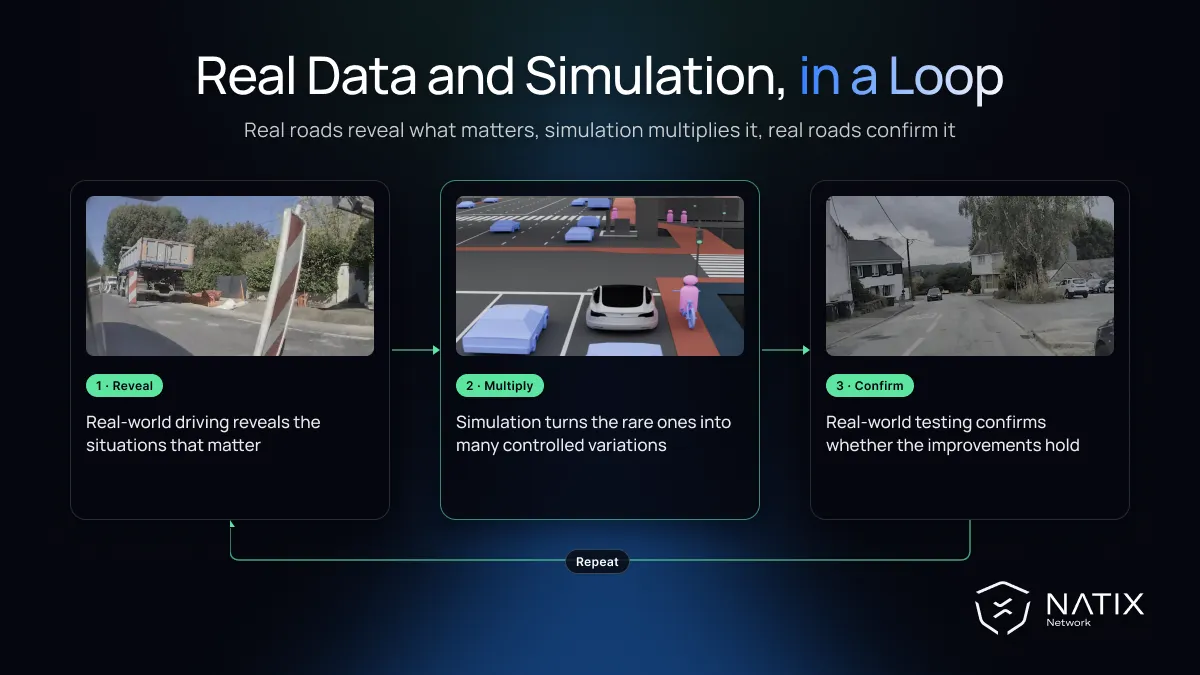
In practice, mature teams use both in a loop. Real driving reveals which situations matter and how often they occur, simulation multiplies the rare ones into many controlled variations, and real-world testing confirms whether the improvements hold.
A growing approach is to build simulations from real recordings. Instead of designing scenes from scratch, teams reconstruct real events and then vary them. Our partner MaprGo works in this space, turning real driving into simulation-ready scenarios and maps. This keeps synthetic variations grounded in what actually happens on the road.
In the synthetic data vs real data balance, driver assistance often leans toward real data. ADAS features must work across many markets and must avoid false alarms in ordinary traffic. Real footage from those markets is the most direct way to capture that variety, while simulation helps mostly with specific test scenarios.
For Level 4 autonomy, both sources carry heavy loads: simulation helps explore rare events inside the operating area, while real data anchors the distribution and supplies the evidence for safety. The higher the level of autonomy, the more weight real-world evidence must carry. We explore these differences in our guide to training data for ADAS and full autonomy.
Real-world volume is exactly what simulation cannot generate on its own. That is why many teams pair their simulators with large real-world autonomous driving datasets. NATIX supplies multi-camera footage from everyday Tesla drivers across the USA, Europe and Japan, with driver actions recorded alongside.
The synthetic data vs real data debate is best settled with a simple rule. Use simulation to explore what could happen. Use real data to learn what does happen, and to prove the system can handle it.


