

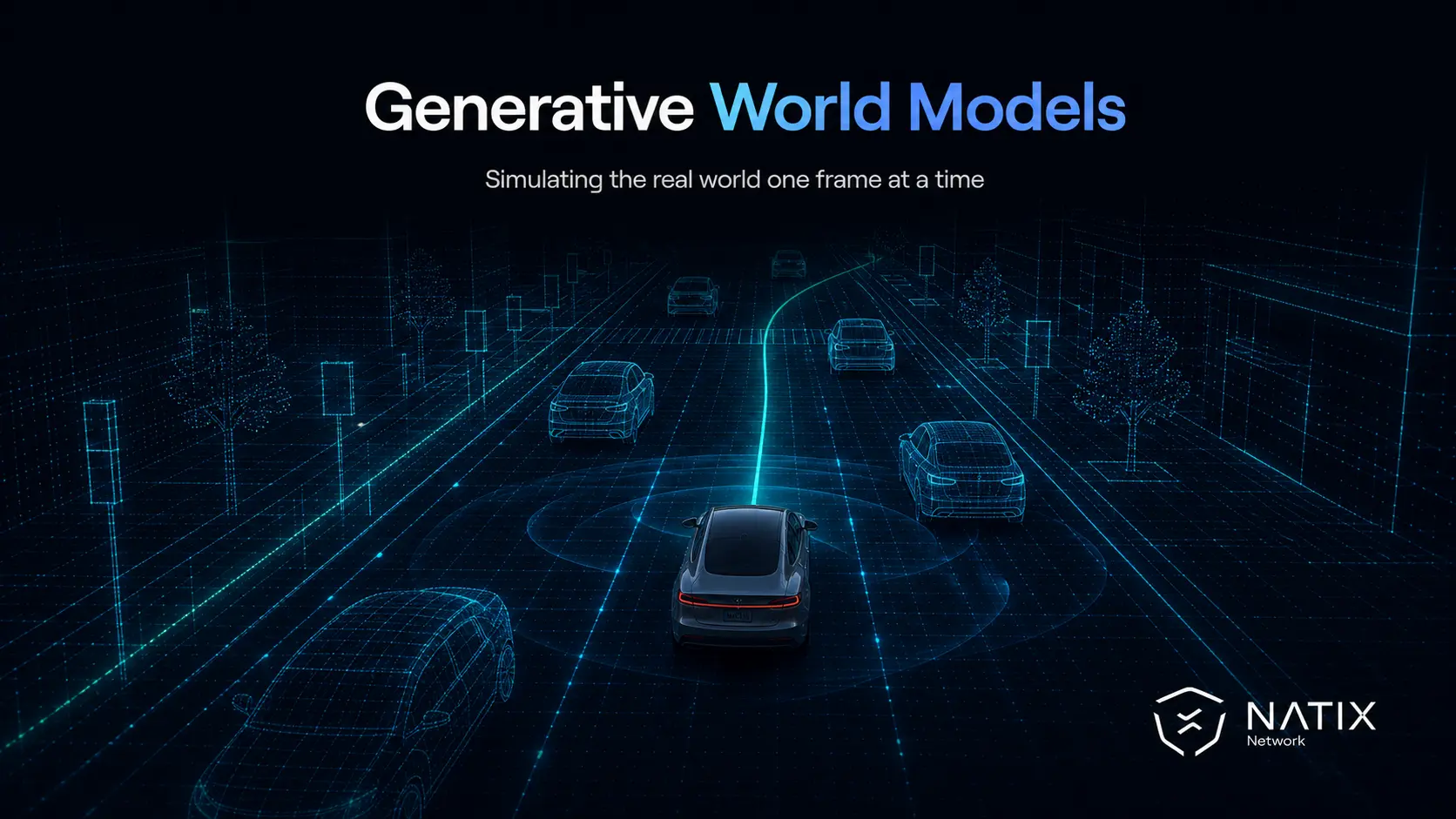
Autonomous driving simulation is entering a different phase. For years, the challenge was building a bigger, more detailed virtual world: more road types, more weather conditions, more scripted pedestrians crossing at more intersections. The challenge now is not how much a team can hand-build, but how much a system can generate on its own, and whether what it generates behaves like the real world when a driving policy pushes back on it.
That is the shift behind generative simulation. Instead of an engineer placing every asset, writing every rule, and scripting every agent's behavior, a model learns how driving scenes evolve from data and produces new, physically coherent versions of them on demand. The traditional simulator was a constructed environment. The generative one is a learned one. That difference sounds subtle until you look at what each approach actually requires to work, and what has to be true about the data feeding it.
Traditional simulators, an open-source example like CARLA among them, work the way a movie set works. Someone decides what the scene needs: a four-way intersection, a rainy night, a cyclist merging into traffic. Artists build the assets. Engineers write the rules that govern how a pedestrian crosses or how a car behaves at a stop sign. The result can look convincing, but it is bounded by what the designer thought to include.
That is the real limitation, and it is not really about graphics quality. A hand-coded simulator can only test what someone already imagined. It cannot produce the version of an event nobody wrote a rule for: the delivery truck that double-parks at an odd angle, the pedestrian who steps off the curb while looking at their phone, the exact lighting condition where a camera briefly overexposes. These are the situations that matter most for safety, and they are also the hardest to author by hand because there is no end to the list of things that could happen next.
Scaling this kind of simulator means scaling headcount and asset libraries, not scaling understanding. Every new scenario is still a manual addition. The system does not get smarter about the world. It just gets bigger.
A generative simulation environment replaces that manual authoring with a model that has learned how scenes unfold, then asks it to keep generating a consistent version of the world as a driving policy interacts with it. That sounds like a small change in wording, but it demands a very different set of technical capabilities.
The first is real-time generation. A simulator that produces a photorealistic frame every few seconds is a rendering demo, not a testing environment. For a driving policy to actually train or be evaluated against the simulation, the environment needs to generate frames fast enough to feed a live control loop, react to a steering or braking decision, and produce the next moment before the system needs it. Recent research, including NVIDIA's OmniDreams project, has focused specifically on getting generative world models to run at speeds that make closed-loop testing possible rather than theoretical.
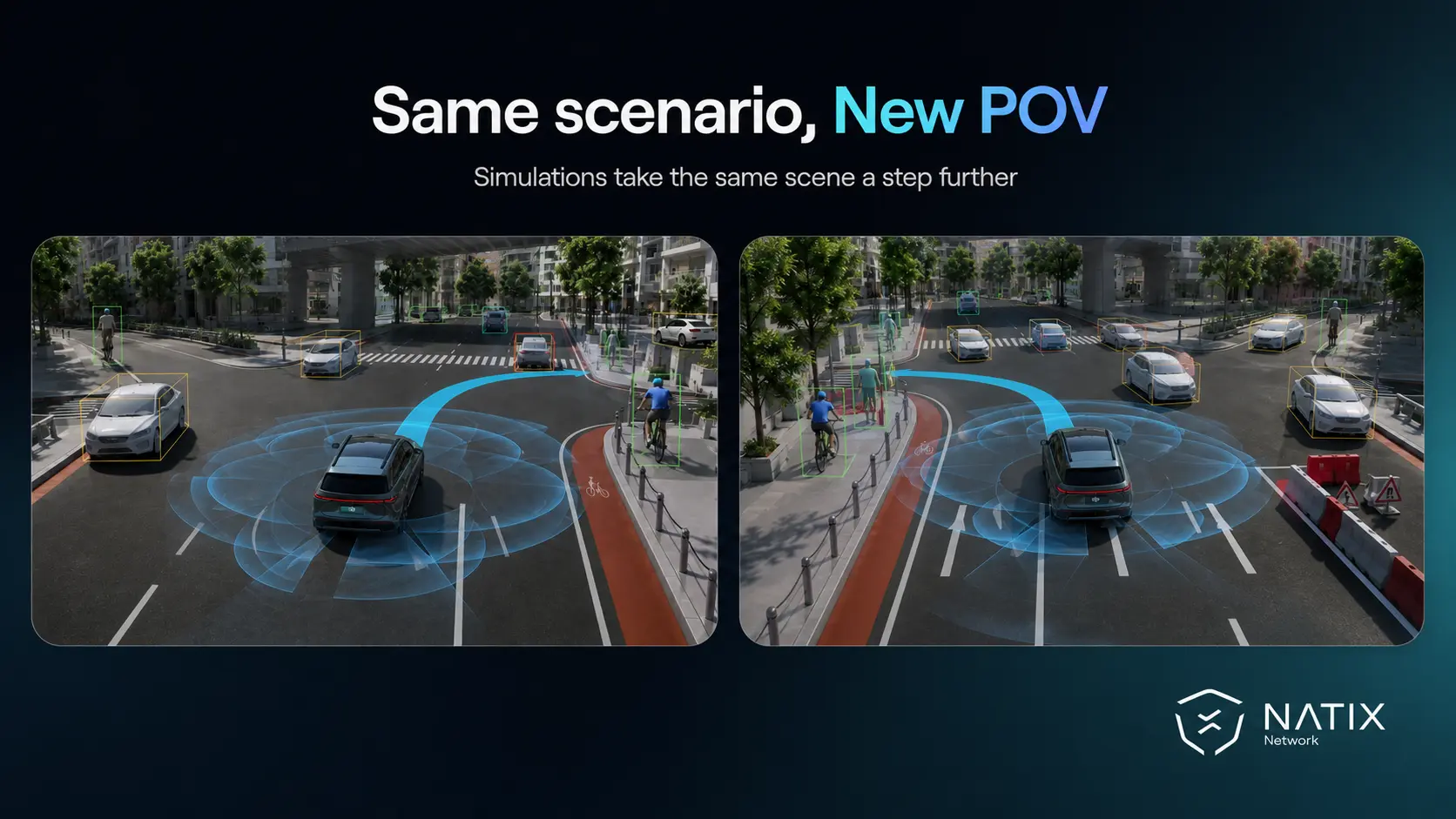
The second is multimodal coherence. Modern autonomy stacks rarely rely on a single sensor. A generative environment that only produces camera video is not useful if the vehicle's stack also depends on lidar or radar. Waymo's generative world model, built on top of Google DeepMind's Genie 3, generates camera imagery alongside corresponding lidar data from the same underlying model, so the sensor streams stay consistent with each other rather than being stitched together after the fact.
The third is geometric consistency. As the ego vehicle's viewpoint shifts because it braked, turned, or changed lanes, every other object in the scene – a parked car, a traffic sign, a pedestrian – has to stay exactly where it should be relative to that new viewpoint. A generative model that redraws the world frame by frame without enforcing that kind of consistency will produce scenes that drift or flicker in ways that would never survive contact with a real driving policy.
The fourth is controllability. Engineers still need to steer what gets tested, not just watch a model hallucinate traffic. This is usually built through a mix of driving inputs, scene-level controls, and in some cases natural language prompts, letting a team ask for a specific counterfactual, what happens if that cyclist enters the intersection two seconds earlier, without hand-building the scene from scratch.
Platforms like NVIDIA's Cosmos are built around this exact combination: World Foundation Models that can act as a physics-grounded simulator, generating plausible futures from real sensor input rather than from a hand-authored scene graph.
The most important distinction between the two approaches is open-loop versus closed-loop testing. A traditional replay simply plays back a recorded drive. The vehicle's own decisions do not change what happens next, because what happens next was already recorded. That is useful for some checks, but it cannot tell you how a policy would have responded if it had braked a moment sooner, or how the world would have reacted to a different choice.
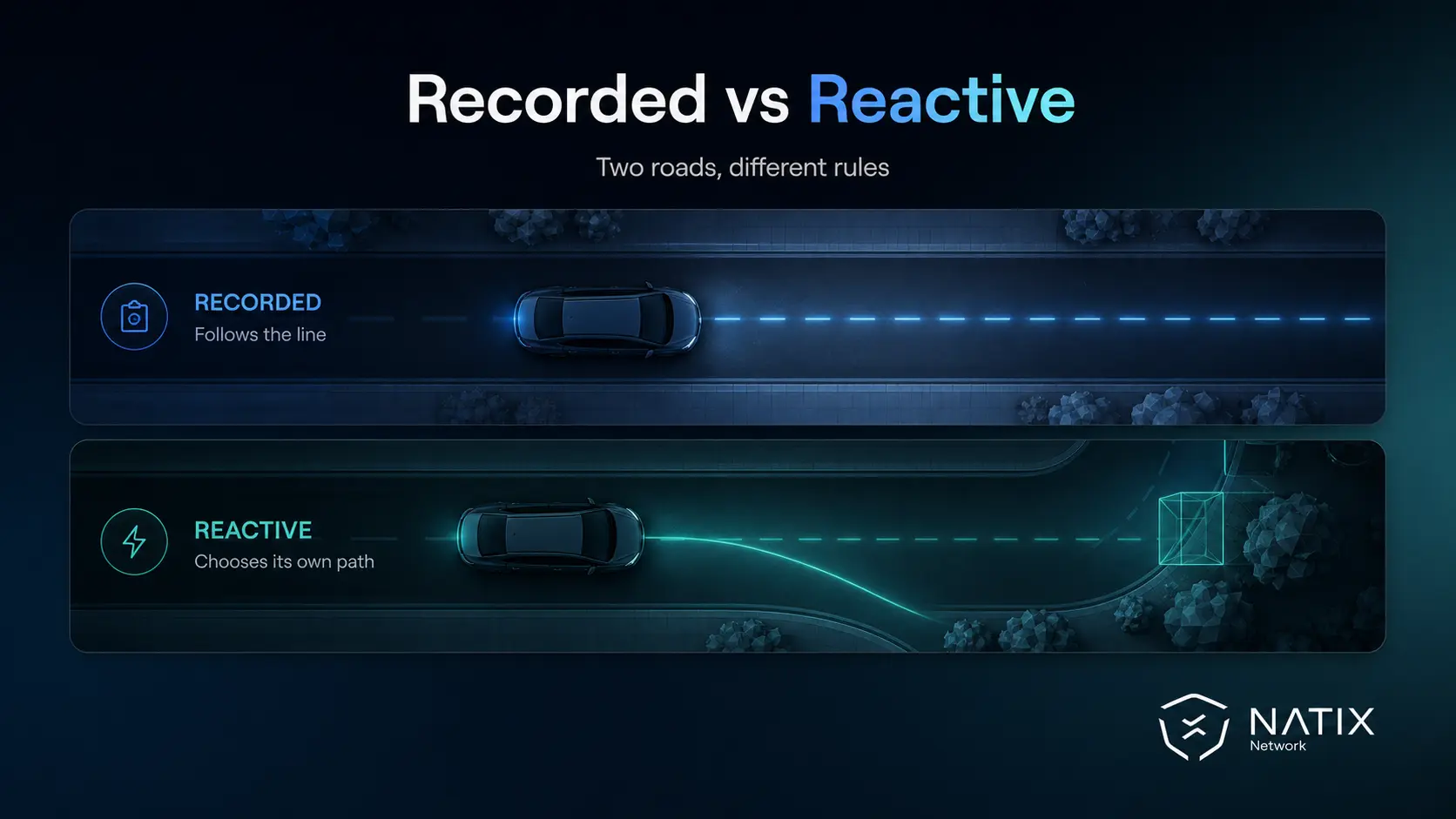
Closed-loop simulation removes that ceiling. The vehicle's decisions genuinely shape what the environment generates next. Wayve's GAIA-4 illustrates one practical way to keep that reactive quality from becoming ungrounded: a constraint the team calls world-on-rails, which keeps other road users faithfully tied to their real recorded behavior while allowing only the vehicle under test to deviate. Reactive agents can be switched on when a team specifically wants to test negotiated interactions, like a merge where two vehicles both have to give way. The point is not to let the simulation run wild. It is to let the vehicle's own choices matter while keeping everything else honest to what actually happened on the road.
This matters because the value of a simulation environment is not just whether it looks realistic. It is whether the outcomes it produces would generalize to a real intersection with a real vehicle in it.
None of this works without the right data underneath it, and this is where the shift becomes a data problem rather than a graphics problem.
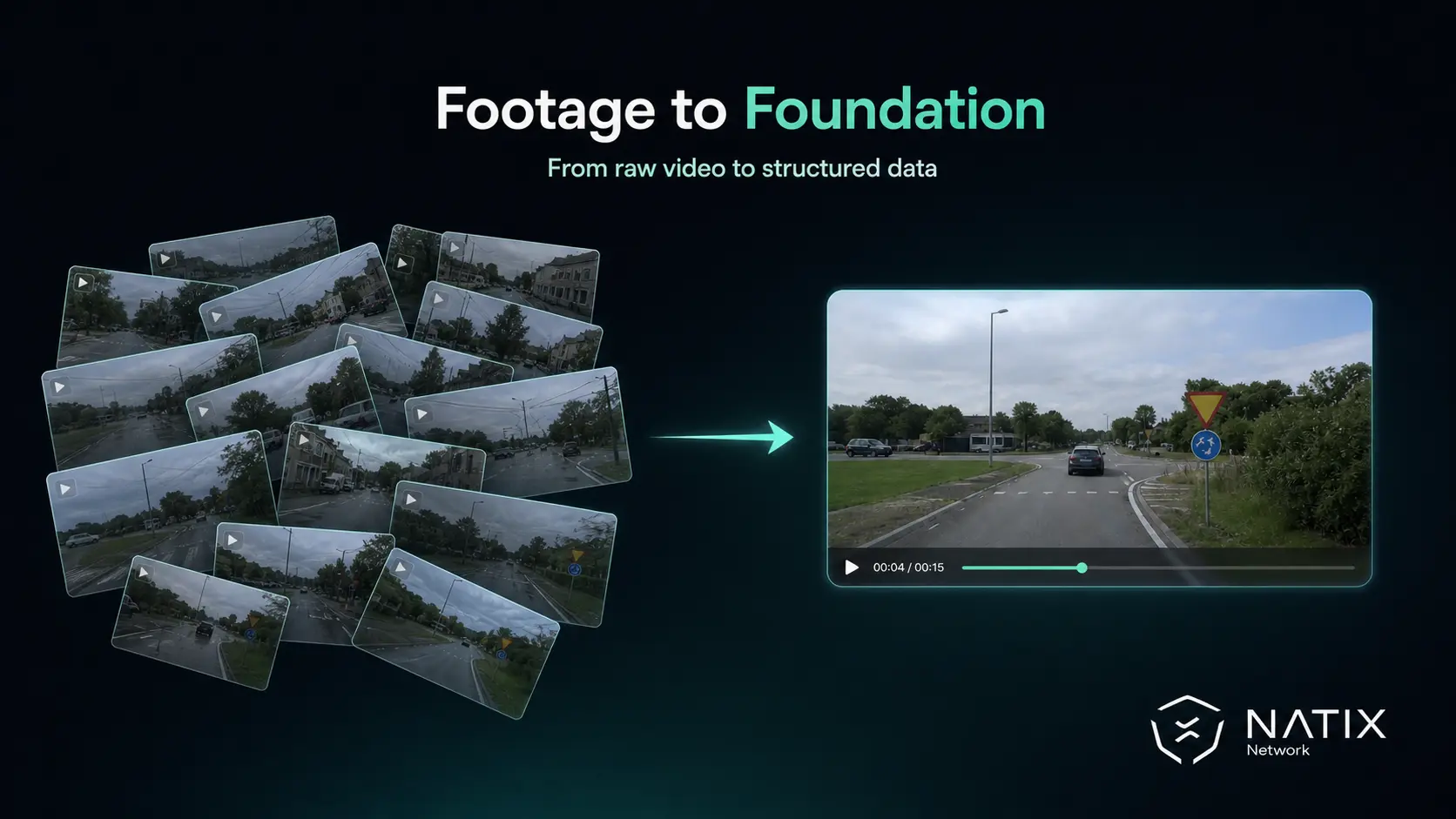
Put together, the pipeline looks less like a simulator being built and more like a loop being run. Real-world, multi-camera video becomes the raw material. That footage has to be structured and made searchable before it is useful, how video AI feeds world models is really a story about turning an unorganized video archive into curated training material, since a large stack of unlabeled footage is just storage cost until it is structured. A world model is trained on that structured data to learn how scenes evolve over time. The model then generates new, physically coherent scenarios, some through amplification for training coverage, others checked closely against real recordings for validation. And the outputs feed back into how the next version of the driving policy is trained and tested, closing the loop.
This is also why the current WFM landscape looks the way it does, with Wayve, NVIDIA, Waymo, and others converging on a similar architecture even though their specific implementations differ. They are all solving the same underlying problem: how to make a model that has genuinely learned the physical world, rather than one that has memorized a fixed set of scenes.
This is exactly where the data problem becomes concrete. A generative world model is only as good as the real-world signal it was trained and validated against, and that signal needs to be large in scale, diverse in geography and condition, and captured from multiple angles rather than a single forward-facing camera.
NATIX's multi-camera data, collected across a global network of vehicles rather than a single purpose-built fleet, is built for exactly that kind of coverage. That is also the premise behind NATIX's partnership with Valeo to build one of the largest open-source, multi-camera World Foundation Models, using real surround-view driving data for both training and, just as importantly, validation. NATIX is not the simulator itself. It is the real-world layer that determines whether the simulator's generated futures are grounded in anything true.
The traditional AV simulator was a constructed product, built once and expanded by hand every time a new scenario mattered. Generative simulation replaces that with a system that has to learn how the world behaves, which means its ceiling is no longer set by how many assets a studio can build, but by how much of the real world it has actually seen. The simulator has stopped being something a team builds. It has become something a system learns, and what it learns depends entirely on the data underneath it.


