

Scenario mining is the work of finding the few seconds that matter inside millions of hours of ordinary driving. For years, the industry's answer to rare events was simple: drive more, record more, and hope the hard cases show up. That approach produced enormous archives, and it also exposed a quieter problem. Most teams now hold far more driving video than anyone can watch. The rare events they need are usually already in it.
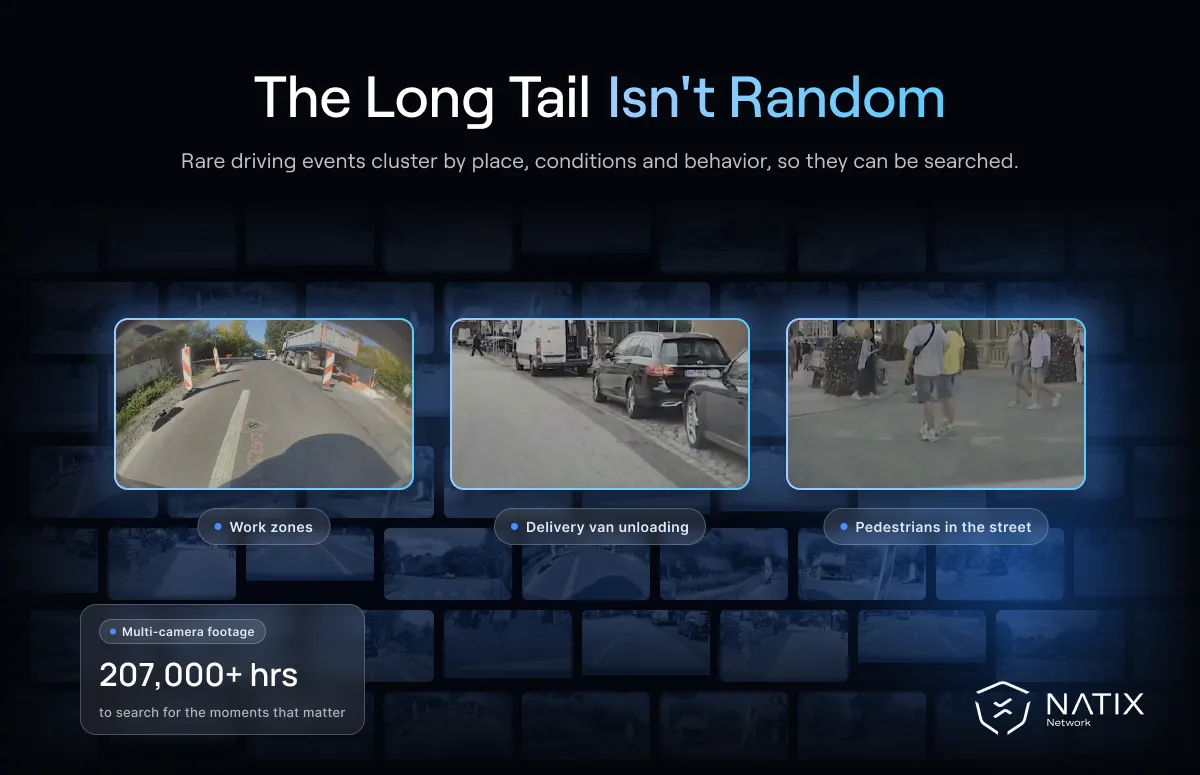
The shift underway is from collecting to searching. Instead of asking how to gather more data, leading teams ask how to retrieve the right moments from the data they already have. That change turns the long tail from a needle-in-a-haystack problem into a retrieval task. It depends on one observation that is easy to miss. The long tail isn't random. Rare events cluster around places, conditions and behaviors, and anything that clusters can be searched for.
In autonomous driving, scenario mining means searching large collections of recorded driving to extract specific scenes, behaviors or edge cases for training and testing. It combines metadata filters, signals from the vehicle and, increasingly, natural-language queries that describe the scene a team wants to find.
It is different from collecting more data. Collection decides what enters the archive. Mining decides what leaves it and reaches a model. A team with a modest archive and good search can often build a stronger training set. A team with a huge archive and no way to find anything in it usually cannot.
It also starts where definitions stop. Knowing what an edge case is, which we cover in our guide to edge case scenarios, is only the first step. The harder question is how to locate a hundred examples of a specific rare situation when they are scattered across thousands of hours of video.
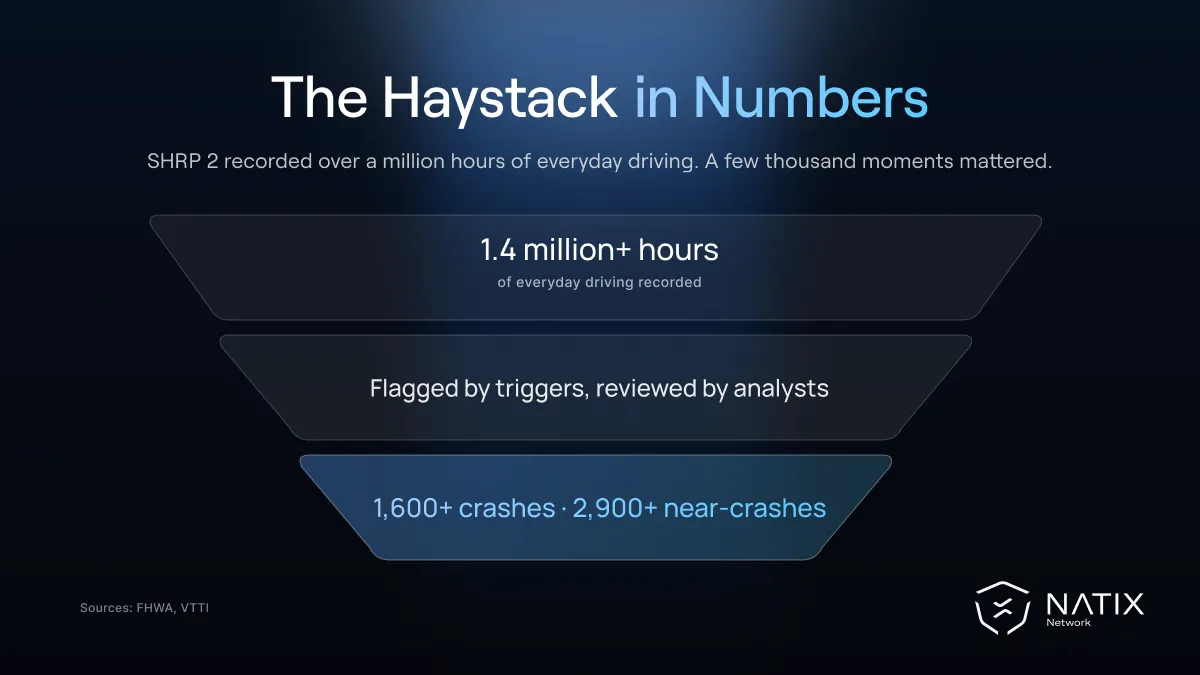
The best public evidence for how rare the important moments are comes from naturalistic driving research. The SHRP 2 Naturalistic Driving Study instrumented the cars of 3,542 volunteer drivers in six US states. Over the study it recorded about 32.5 million miles of everyday driving, according to a summary by the Virginia Tech Transportation Institute, which ran the data collection. From roughly 2 petabytes of data, researchers identified more than 1,600 crashes and more than 2,900 near-crashes.
The Federal Highway Administration describes the same database as more than 1.4 million hours of driving across 5.8 million trips on its SHRP 2 overview page. Put the two sources side by side and the ratio is stark: about 4,500 safety-critical events in well over a million hours of video. Everything else was ordinary driving.
Autonomous vehicle programs face the same arithmetic at a larger scale. A RAND Corporation study, Driving to Safety, estimated that proving safety through miles driven alone could require hundreds of millions to billions of miles. Waymo reports 220.6 million rider-only miles through March 2026 on its safety impact hub, and even at that scale the most serious events remain a tiny fraction of the total.
The lesson from both sources is the same. Adding volume does not make rare events common. It only makes the haystack bigger, which is why the ability to search it matters more with every additional hour.
If rare events were spread evenly and unpredictably across all driving, there would be no shortcut. Teams would simply need more of everything. In practice, rare events follow patterns, and those patterns are what make scenario mining possible.
Some cluster by place. Unusual junction designs, temporary work zones and local traffic customs produce the same kind of difficult moment again and again in the same areas. Others cluster by conditions, such as low sun at certain times of year, heavy rain on roads with faded markings, or night driving near nightlife districts. A third group clusters by behavior, from double-parked delivery vans to cyclists using the road differently in different cities.
This is also why fixed datasets miss so much of the tail. A dataset recorded in a handful of cities captures the clusters that exist there and almost nothing else. We explored that limit in our review of what open driving datasets taught the industry. The long-tail events that matter for a new market often sit in exactly the places a benchmark never recorded.
Consider a team preparing to launch in a new city. Its archive may contain thousands of hours from elsewhere, yet the moments that will trouble its system locally depend on that city's road design, signage and habits. Scenario mining lets the team ask a precise question, such as unprotected left turns across tram tracks in heavy rain. It can then see how many examples it already has before spending money on new collection.
Once you accept that the tail has structure, the question changes. It is no longer "how do we collect everything?" but "how do we describe what we are looking for, and where is it most likely to be?"
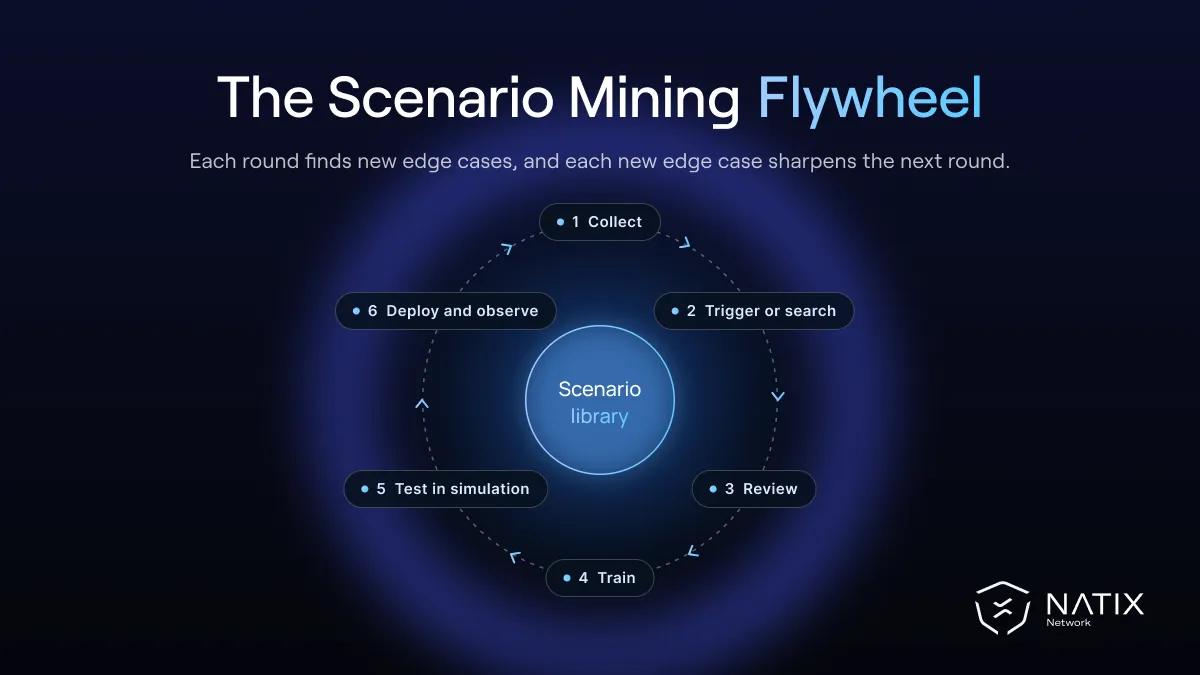
Most production teams combine several methods, because each one catches events the others miss. Four approaches cover most of the field today.
They differ mainly in what tells the system that a moment is interesting. Triggers rely on physical signals from the car. Shadow mode relies on disagreement between a model and a human. Language-based search relies on a description written by an engineer. Scenario-based testing then takes whatever the first three found and makes it repeatable.
The oldest method uses signals from the vehicle itself. Hard braking, sharp steering, sudden acceleration or a collision warning all suggest that something unusual happened. The video around those moments is then flagged for review. This is how the SHRP 2 team worked through its data. An algorithm flagged candidate events, and trained analysts then reviewed the video to confirm crashes and near-crashes, as described in a 2024 analysis of the study's methods. Our article on the naturalistic driving study explains how that approach shaped the methods used today.
A second approach runs a driving model silently in production vehicles while a human drives. Whenever the model's planned action disagrees with what the driver actually did, the moment is logged as a candidate edge case. Tesla has described this kind of setup publicly. At the CVPR 2021 Workshop on Autonomous Driving, its then head of AI said the fleet ran 221 manually written triggers. Each one captured a situation of interest, as summarized in this account of the talk. We look at how this works, and where it falls short, in our guide to shadow mode.
The newest approach lets engineers describe a scene in words and retrieve matching clips. Pipelines built on a vision language model for autonomous driving can tag scenes such as "pedestrian crossing between parked cars at night". That makes an entire archive searchable without writing a new trigger for every situation. The same idea applies to mapping and location data, where natural-language search over street level imagery helps teams find specific road layouts, signs or conditions across many cities.
Finding an event is only half the job. Once a rare situation has been located, teams turn it into a structured test that can be replayed and varied in simulation. That step, known as scenario based testing, is what converts a single clip into lasting coverage of a whole class of situations.
A useful scenario query describes a situation the way an engineer would, not the way a database stores it. Most strong queries combine four parts: where the event happens, what the conditions are, which other road users are involved, and what the ego vehicle is doing. "A cyclist merging into traffic from a bike lane on a two-lane urban road at dusk, while the car is turning right" is far more useful than "cyclist".
Each part narrows the search in a different way. Location and road type often come from map data and GPS. Conditions such as weather and lighting can come from metadata or from the video itself. Other road users and their behavior usually need a model that understands the scene, which is where language-based search earns its place.
Good queries also trade off precision against recall. A narrow query returns fewer clips, most of them correct. A broad query finds more of the rare cases but also more noise, which then needs review. Most teams run a broad search first, check a sample of results by hand, and tighten the query until the hit rate is acceptable.
The final step is human review, and it cannot be skipped. Even the best automated search returns some clips that only look right. A short review pass keeps mistakes out of the training and test sets, where they would be far more expensive to fix later.
It is easy to run searches and much harder to know whether they improve a system. Teams that get value from scenario mining track a few simple measures.
The first is coverage: for each scenario type that matters in the operating area, how many verified examples exist? A list of scenario types with counts quickly shows where the gaps are. The second is hit rate, the share of retrieved clips that turn out to be genuine examples after review. Low hit rates usually mean the query needs refining, not that the events do not exist.
The third measure is impact on the model. Mined scenarios become part of the evaluation set, and every new model version is tested against them. If a model improves on average but regresses on a mined scenario type, the team knows exactly where to look. Over time, that set of scenarios becomes one of the most valuable assets a program owns.
Baselines matter too. The SHRP 2 researchers compared crash and near-crash events against randomly selected stretches of ordinary driving. That let them see what was actually different about the risky moments, according to the same 2024 analysis. Mining teams benefit from the same discipline: without a baseline of normal driving, it is hard to tell which features of a scene really make it difficult.
The goal of scenario mining depends on the system being built. For driver assistance, many of the most valuable finds are false activations and near misses, such as phantom braking under a bridge or a lane-keeping feature confused by worn markings. Those events are relatively frequent in large fleets and easy to flag with vehicle signals.
For full autonomy, the target moves deeper into the tail. A driverless system must handle situations it may never have seen, inside its operating area, with no human to take over. Mining there focuses on rare combinations of place, behavior and conditions that triggers alone rarely catch. That is where language-based search becomes essential. World models add a third use. Teams training models that generate future video need mined scenarios twice: once as training material, so the model learns how rare situations unfold, and once as evaluation material, to check whether generated scenes stay realistic in those situations. A world model that has never seen a rare event cannot be expected to imagine it convincingly.
We compare the ADAS and full-autonomy cases in detail in ADAS data vs full autonomy.
Searchability is also changing what teams look for in a data supplier. A large archive is only useful if the rare moments inside it can be found, filtered and delivered without someone watching every hour.
NATIX holds more than 207,000 hours of multi-camera driving data, collected by everyday drivers through factory Tesla cameras. For a scenario-mining workflow, the number itself matters less than what can be pulled out of it. That might be a specific junction type, a weather condition or a kind of road user, retrieved as synchronized multi-camera clips ready for training or testing. In practice, scenario mining against an external collection starts small. A team first checks whether the scenes it needs actually exist in the data, then retrieves a focused set around the clusters that matter for its operating area, and scales up once its queries reliably return the right clips.
The first mistake is relying on a single method. Triggers catch events that leave a clear physical signal, such as hard braking, but miss situations where a careful driver handled something unusual smoothly. Language-based search finds those calm but rare scenes, while shadow mode finds the moments where a model would have chosen differently. Each method has blind spots that the others cover.
The second mistake is mining once and stopping. Roads, vehicles and behaviors change, and so do the models being trained. A scenario library that is not refreshed slowly drifts away from the conditions a system will meet on the road.
The third mistake is ignoring where the data comes from. Mining can only find what was recorded. An archive collected in a few cities with a single camera will never contain the clusters that exist elsewhere. It will also miss events that are visible only from the side or rear of the vehicle. The value of scenario mining therefore depends on the breadth of the underlying collection as much as on the quality of the search.
They are related but not identical. Active learning selects the examples a model is most uncertain about and sends them for labeling. Scenario mining is broader: it includes searching for situations a team already knows it needs, whether or not the current model is uncertain about them. Many pipelines use both, with active learning ranking candidates that mining has already retrieved.
Mining pays off once an archive is too large to review by hand, which happens quickly with multi-camera video. The SHRP 2 numbers above show why: even a well-funded study produced only a few thousand critical events from more than a million hours. At that ratio, any team with thousands of hours already needs to search to use its data well.
Not on its own. Simulation is excellent for creating variations of a known situation, but it only contains what its designers thought to include. Real recordings reveal which situations actually occur and how people really behave in them. In practice, mining finds the real events and simulation multiplies them.
For a long time, the long tail looked like a problem that only scale could solve. The evidence from naturalistic driving studies and modern fleets tells a different story. Rare events are rare, but they are not random, and patterns can be searched.
Scenario mining is how teams turn that insight into better models. It rewards clear questions, honest review and a broad enough collection to search. The organizations that pull ahead will not simply be the ones with the most hours of video. They will be the ones that can find the right few seconds inside those hours, quickly and repeatedly.


