

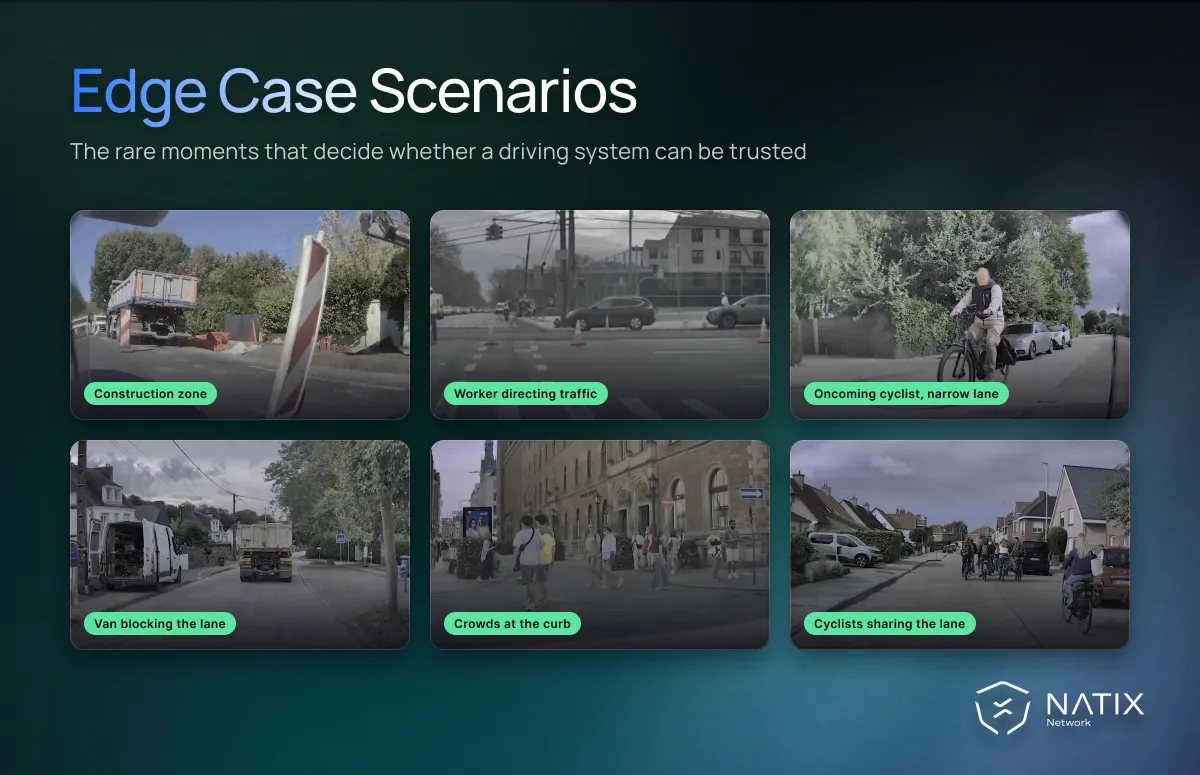
Edge case scenarios are the rare, unusual situations that decide whether a driving system can be trusted. Most hours on the road are uneventful: traffic flows, lanes are clear and other drivers behave as expected. The moments that matter for safety are the exceptions, when a mattress falls off a truck, a police officer overrides a traffic light or a child chases a ball between parked cars.
A system that handles the average case well is not yet safe. It becomes safe only when it handles these exceptions too, which is why the hunt for edge case scenarios has become one of the central problems in autonomy.
An edge case is a situation that sits at the outer limits of what a system was designed or trained to handle. It is usually rare, often unexpected, and sometimes ambiguous even to a human driver.
Common examples include:
What makes these edge case scenarios hard is not only their rarity. It is that each one tends to be different from the last, so a model cannot simply memorize them.
The terms are often used interchangeably, but some engineers make a useful distinction. An edge case pushes one factor to its limit, such as heavy rain. A corner case combines several unusual factors at once, such as heavy rain at night in a construction zone with a cyclist present.
Corner cases are rarer still, and they are often where systems fail. For practical purposes, both belong in the same long tail. The goal is to find them, understand them and make sure the system has seen enough of them.
Most of a system's capability is built on ordinary driving, but most of its risk sits in the long tail. A RAND Corporation study, Driving to Safety, estimated that proving safety by miles driven alone could take hundreds of millions to billions of miles. The reason is simple: serious events are rare, so you need enormous exposure to observe enough of them.
How much this matters depends on the level of automation. For driver assistance, many edge cases are false activations, such as phantom braking under a bridge. For a driverless Level 4 system, the dangerous edge cases are situations it has never seen and must still resolve alone. We compare these two worlds in our guide to ADAS versus full autonomy data.
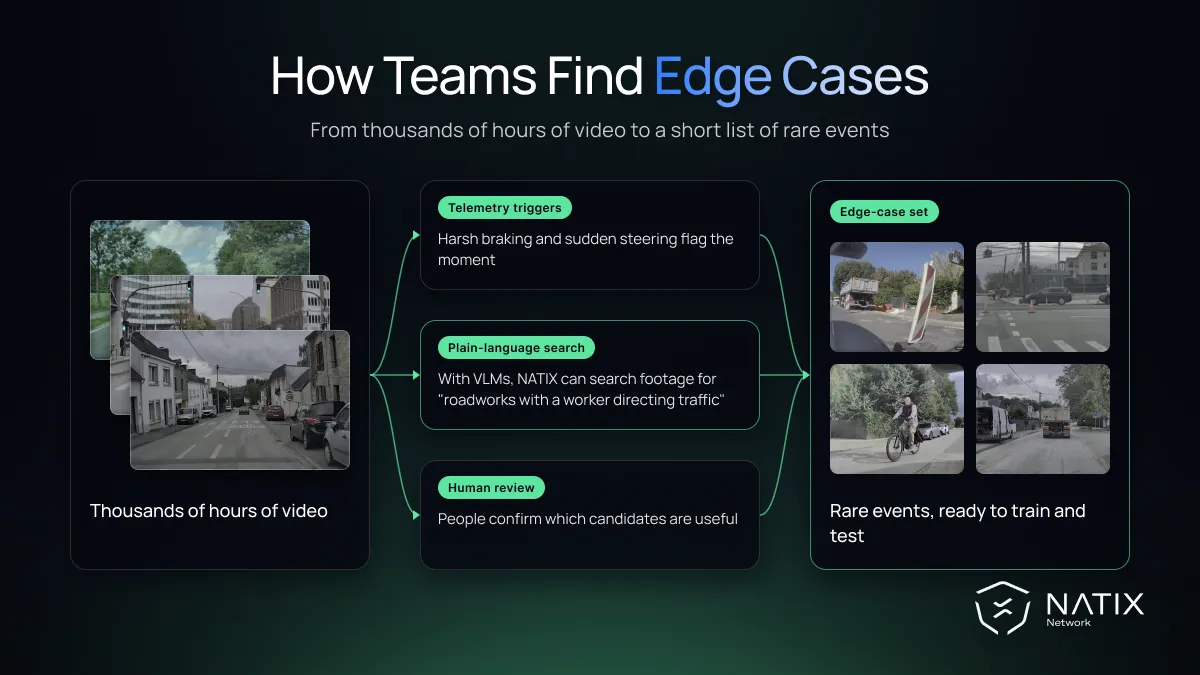
Collecting more driving is only half the job. The harder half is finding the rare moments inside thousands of hours of footage, and teams usually combine three approaches to do it.
The first is telemetry triggers. Harsh braking, sudden steering or strong acceleration often signal that something unusual happened. These events can be extracted automatically from recorded driver actions.
The second is model-based search. Vision-language models can tag scenes in plain language, such as "road works at night" or "pedestrian crossing outside a crosswalk". Teams can then query a large video set the way they would search a document archive.
The third is human review. Automated tagging finds candidates quickly, but people still confirm what is genuinely useful. This matters most for the rarest scenes, where models have the least to learn from.
With VLMs, NATIX can search its own footage in exactly this way, and it publishes open examples of both approaches. Our edge-case driving dataset uses vision-language tagging to surface long-tail events. Our safety-critical driving events dataset uses telemetry to detect harsh braking and similar moments.
For a driver assistance team, the most valuable edge cases are often near misses and false triggers. These are moments where the feature activated when it should not have, or almost missed a hazard. They help tune the system so it stays both safe and comfortable.
For a Level 4 team, the edge-case set must reflect the operating area. A robotaxi in a sunny city needs many examples of local construction, delivery vans and pedestrians. It needs fewer examples of snow. Simulation can help create variations of these scenes, a topic we cover in our article on synthetic data. But the starting point should be real events captured on real roads.
This is where large, diverse collections of multi-camera driving data become valuable. The more varied the drivers, places and conditions, the more of the long tail a dataset naturally contains.
Edge case scenarios will never disappear from autonomy. The world is too varied for that. What teams can control is how many of those scenarios their systems have seen, and how quickly they can find the next ones.


