

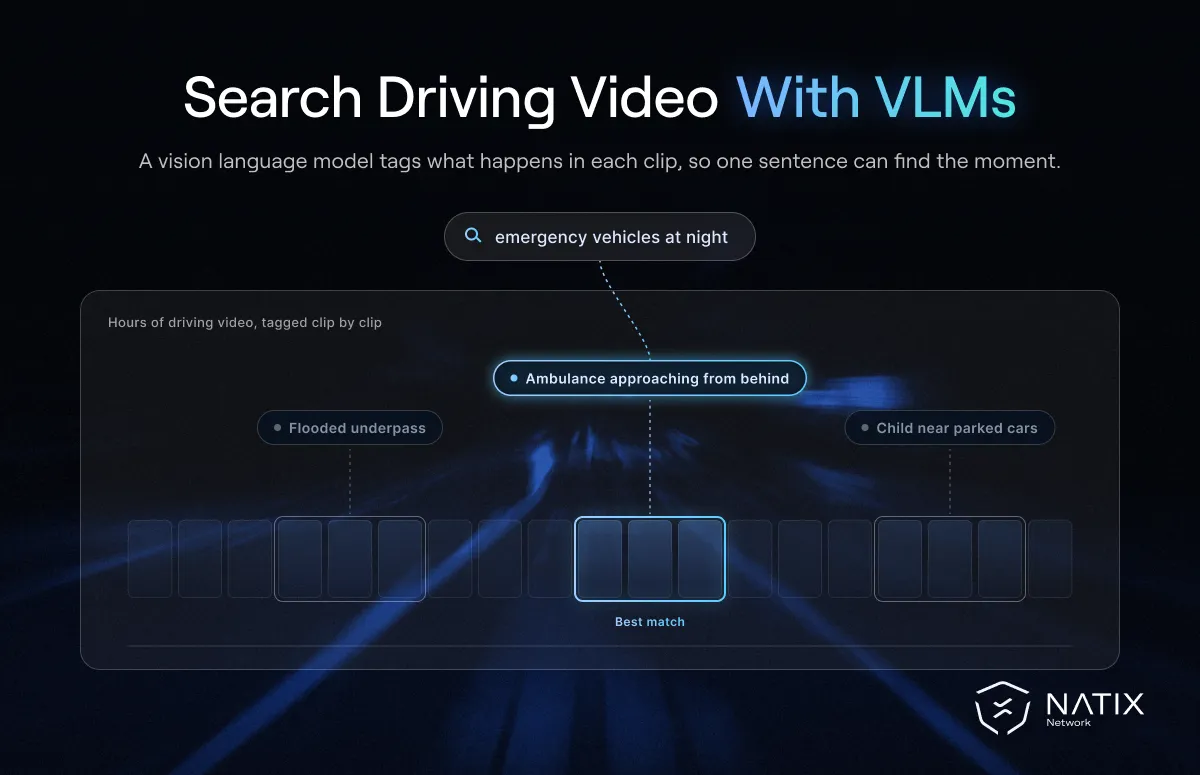
A vision language model in autonomous driving does something older tools could not. It lets engineers search driving video the way they would describe it to a colleague. Instead of writing a custom detector for every situation, a team can ask for "a delivery van double-parked on a narrow street with a cyclist passing". Matching clips come back from a large archive.
That capability is quietly changing how teams find rare events. It moves edge-case discovery from a specialist engineering task to something closer to search.
A vision-language model, or VLM, is trained on images or video paired with text. It learns to connect what appears in a scene with how people describe it. Given a frame or clip, it can produce a description, answer questions about it, or judge how well it matches a written query.
In practice, a vision language model in autonomous driving is mostly used around the driving system rather than inside it. It helps teams understand and organize data: describing scenes, tagging rare events, checking labels and making large archives searchable. That role sits upstream of training, where finding the right data matters most.
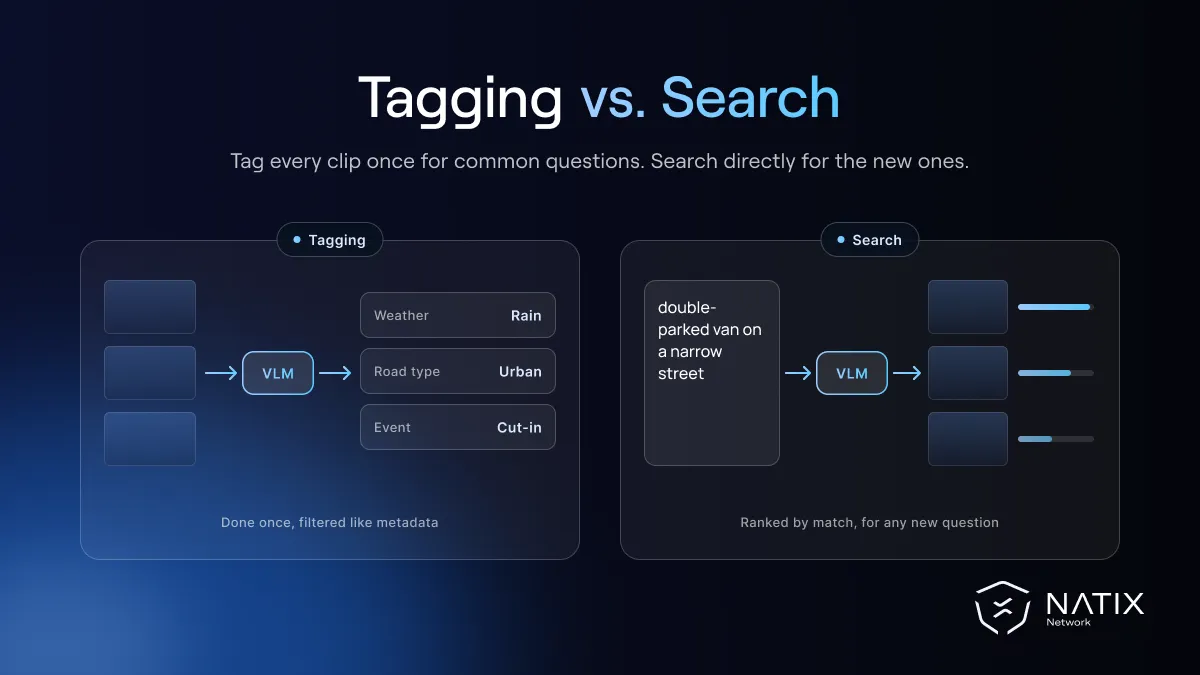
There are two ways to use a VLM on driving video, and they suit different needs. The first is tagging. The model watches every clip once and writes descriptions or labels, such as weather, road type and notable events. Those tags can then be filtered like any other metadata. Tagging is efficient for questions a team asks often, because the work is done in advance.
The second is search. The model compares a written query with the video directly and returns the closest matches. Search is better for new or unusual questions that nobody thought to tag in advance. That is exactly the situation teams face when hunting the long tail. Most production systems combine both: tags for common filters and search for everything else.
The practical shift is in how teams find edge cases. With triggers or shadow mode, someone has to anticipate the signal that marks an interesting moment. With a VLM, the description itself becomes the trigger. If a new failure appears in testing, an engineer can describe it in a sentence. The search then shows how many similar moments already exist in the archive.
That is the heart of modern scenario mining. It works for video and for still images alike; the same approach applied to mapping data powers natural-language search over street level imagery.
VLMs make mistakes. They can describe objects that are not there, miss small details, or confuse similar scenes, especially in poor light or unusual camera angles. For rare events, where the model has seen few examples during its own training, those errors become more likely.
The answer is review, not blind trust. Retrieved clips should be checked by people before they enter a training or test set, and tags used for filtering should be audited on a sample. A short review pass is far cheaper than discovering later that a test set was built on wrong labels.
It is easy to confuse VLMs with the newer vision language action models. A VLM understands and describes scenes. A vision language action model goes further and produces driving actions, such as a trajectory or speed change, along with its reasoning. We cover that second family in our guide to the vision language action model.
The two work well together. VLMs organize and search the data, and VLA models learn to drive from the scenes that search makes available. We trace this broader connection in our article on video AI, VLMs and world foundation models.
Indexing a large archive with a VLM costs compute, so most teams prioritize. A sensible order starts with the footage most likely to contain what the team needs next:
It also helps to decide early which questions will be asked repeatedly. Those become standard tags computed once for every clip. Everything else is left to on-demand search, which keeps costs down while still allowing new questions. As the archive grows, the tag list can grow with it, guided by the searches engineers actually run.
Searching across several synchronized cameras is harder than searching a single forward view. It is also more useful, because many rare events start at the side or rear of the vehicle. NATIX worked with Nomadic ML on exactly this problem. As described in our announcement of the NATIX and Nomadic ML collaboration, Nomadic ML's video agent makes NATIX's multi-camera driving video searchable in natural language. Teams can ask for specific scenes and retrieve them across the collection.
For teams building a self driving car dataset around specific situations, that turns a large archive into something they can query directly. A vision language model in autonomous driving is not a replacement for good data. It is what makes good data findable.


