

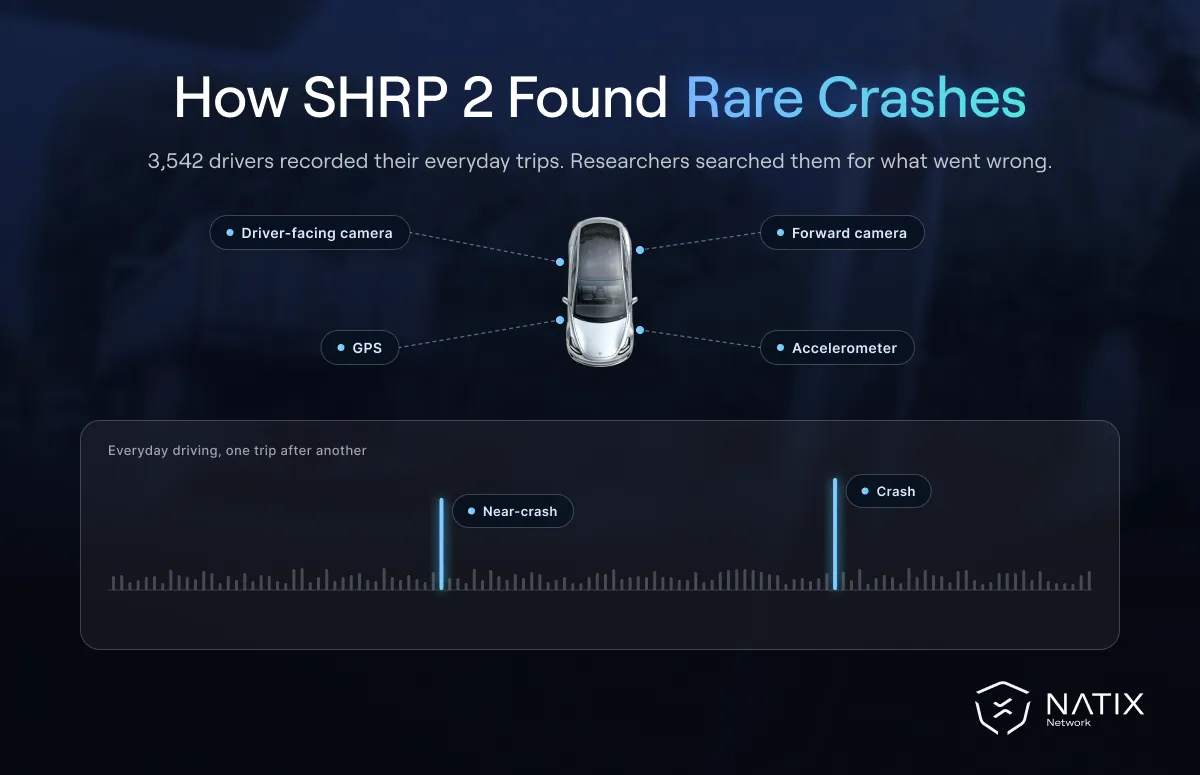
A naturalistic driving study records how people actually drive, in their own cars, on their own trips, with no researcher in the passenger seat. Instead of staging tests on a track, it captures months or years of everyday driving. It then searches that record for the rare moments when something goes wrong. That simple idea produced some of the most valuable crash data ever collected, and it set the pattern modern autonomous driving teams still follow when they look for edge cases.
The largest naturalistic driving study to date is SHRP 2. Its methods explain why finding rare events is hard, and how it can be done well.
The defining feature of a naturalistic driving study is that participants drive normally. Cameras and sensors are installed in their vehicles, and data is recorded continuously during ordinary trips. Because nobody is watching in real time, drivers behave as they usually would. That includes the distractions, shortcuts and habits that stay invisible in controlled experiments, which is why this kind of data is so valuable for studying driver behavior.
That makes the data uniquely honest. It also makes it enormous. Most of what gets recorded is routine, and the events researchers care about, crashes and near-crashes, are buried inside it.
The second Strategic Highway Research Program ran the largest naturalistic driving study to date. The study followed 3,542 drivers at six sites and logged about 32.5 million miles of driving, according to a summary by the Virginia Tech Transportation Institute, which managed the data collection. Researchers identified more than 1,600 crashes and more than 2,900 near-crashes in roughly 2 petabytes of data.
The Federal Highway Administration describes the resulting database as covering more than 1.4 million driving hours and 5.8 million trips on its SHRP 2 overview. The program's oversight body at the Transportation Research Board lists the six participating states as Florida, Indiana, New York, North Carolina, Pennsylvania and Washington.
Those numbers make the central challenge plain. A few thousand safety-critical events sit inside more than a million hours of video. Nobody can watch that much footage, so the study needed a way to find the events without reviewing everything.
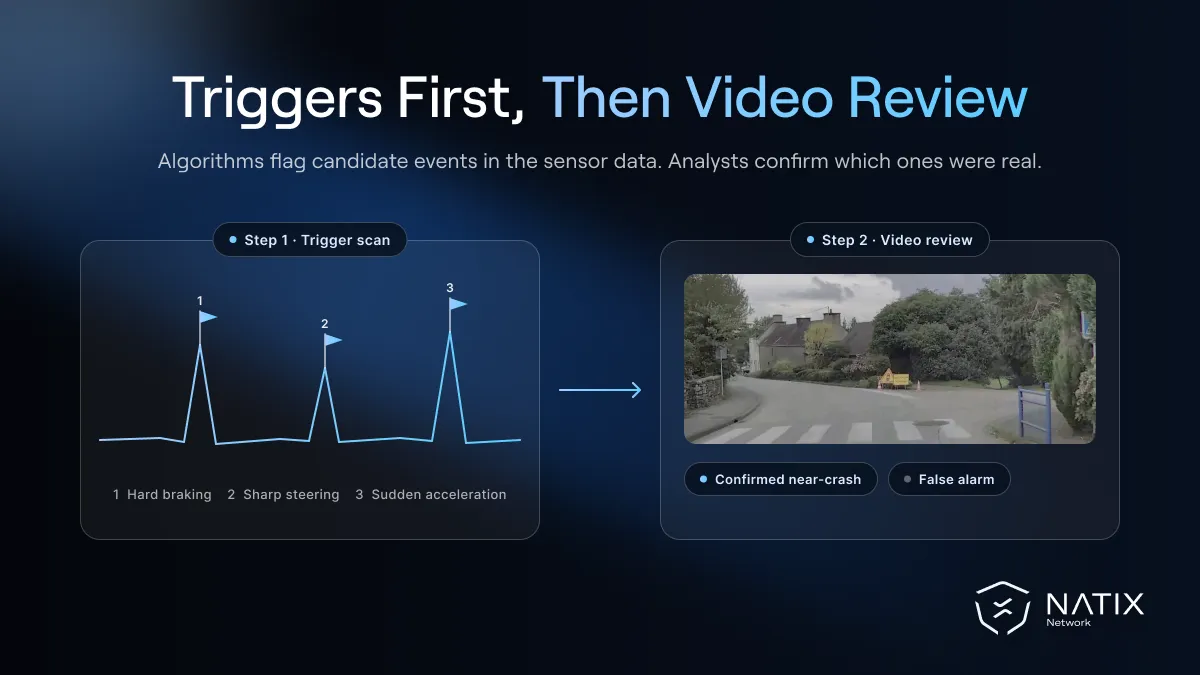
SHRP 2 solved the problem in two steps, as described in a 2024 analysis of the study's data and methods. First, algorithms scanned the continuous sensor data for signs of trouble, such as sudden braking, sharp steering or unusual acceleration. Those signals flagged short stretches of driving as candidate events.
Second, trained video analysts reviewed each flagged stretch to decide whether a crash or near-crash had really occurred. Many flags turned out to be harmless, such as a driver braking firmly at a yellow light. The ones that were real were then classified and annotated in detail.
The approach can be summarized in three parts:
This combination of automatic triggers and human review is still the backbone of many edge-case pipelines. The triggers make the search affordable, and the review keeps the results trustworthy. The same idea now appears in autonomous driving as trigger-based mining and, in a more sophisticated form, as shadow mode in production fleets.
One detail of the SHRP 2 design deserves more attention than it usually gets. Alongside the crashes and near-crashes, researchers selected random stretches of ordinary driving as baselines, according to the same 2024 analysis. Those baselines went through a similar labeling process.
Baselines answer a question that crash data alone cannot. If phone use appears in many crashes, is that because phone use is risky, or because drivers use their phones constantly? Only a comparison with normal driving can tell. The same logic applies to autonomous driving data. A collection of mined edge cases is far more useful when it comes with a matching sample of everyday scenes. Only then can teams see what actually makes the difficult moments different.
Autonomous driving programs borrowed three lessons from the naturalistic driving study approach. The first is that real behavior is the ground truth. Simulated drivers and designed test cases are useful, but the long tail only shows itself in genuine, unscripted driving.
The second lesson is that search matters as much as collection. SHRP 2 was valuable because its events could be found, not only because the data was large. This is the core idea behind modern scenario mining, where teams retrieve rare events from large archives rather than hoping to capture them on demand.
The third lesson is that vehicle signals are powerful but incomplete. Triggers catch events with a clear physical signature, such as hard braking. They miss situations a careful driver handled smoothly, and they can only point to events after something unusual has already happened in the vehicle's motion. Validating a modern system needs both kinds of evidence. We cover that theme in our guide to autonomous driving validation data and in the broader idea of real-world validation.
SHRP 2 relied on instrumented cars owned by volunteers. Today, production vehicles already carry the cameras and sensors that once required custom installation. That shift makes naturalistic-style collection possible at a much larger scale and across many more regions. That matters because, as we argued in the geography problem in autonomous driving, rare events differ from one place to the next.
NATIX applies the same trigger-plus-video idea in its open safety-critical driving events dataset. It pairs multi-camera video with vehicle telemetry, so events such as harsh braking and near misses can be located and studied. It is a direct descendant of the method SHRP 2 proved, applied to camera data from everyday Tesla drivers. Teams that need this kind of autonomous vehicle training data at scale can use the same approach to pull specific event types from a much larger collection.
The naturalistic driving study showed that rare events are hiding in ordinary driving, waiting to be found. The methods have changed, but the goal is the same: search the everyday record carefully enough that the rare moments stop being invisible.


