

Artificial Intelligence has come a long way since large language models first became mainstream. LLMs are now used by hundreds of millions of people, but Physical AI has yet to see the same pace of progress. Why? Because the data needed to train it has largely been locked behind the walls of the companies that collect it.
Imagine trying to train a language model using only short, carefully selected paragraphs instead of the messy, diverse, full-scale internet. The model might learn grammar. It might recognize common patterns. It might even perform well on benchmarks. But it would struggle with the full range of how people actually communicate: rare phrases, unexpected contexts, regional differences, noisy inputs, different languages, and everything that lives outside the clean examples.
Physical AI has a similar problem. To understand the road, models need more than isolated scenes. They need real driving at scale: multiple camera views, motion, route context, weather, road types, driver behavior, and the long tail of rare scenarios.
Public driving datasets have transformed autonomous driving research over the past decade, making it possible for researchers around the world to train and benchmark perception, planning, and prediction models. However, most publicly available driving datasets force researchers into a trade-off: either they are extensive but limited in perspective (i.e., only front-facing video data), or they are rich in sensor coverage but relatively small, geographically narrow, or collected through specialized fleets. Meanwhile, the largest and most diverse driving datasets remain proprietary, available only to the companies that collected them.
Today, we are taking a step toward changing that.
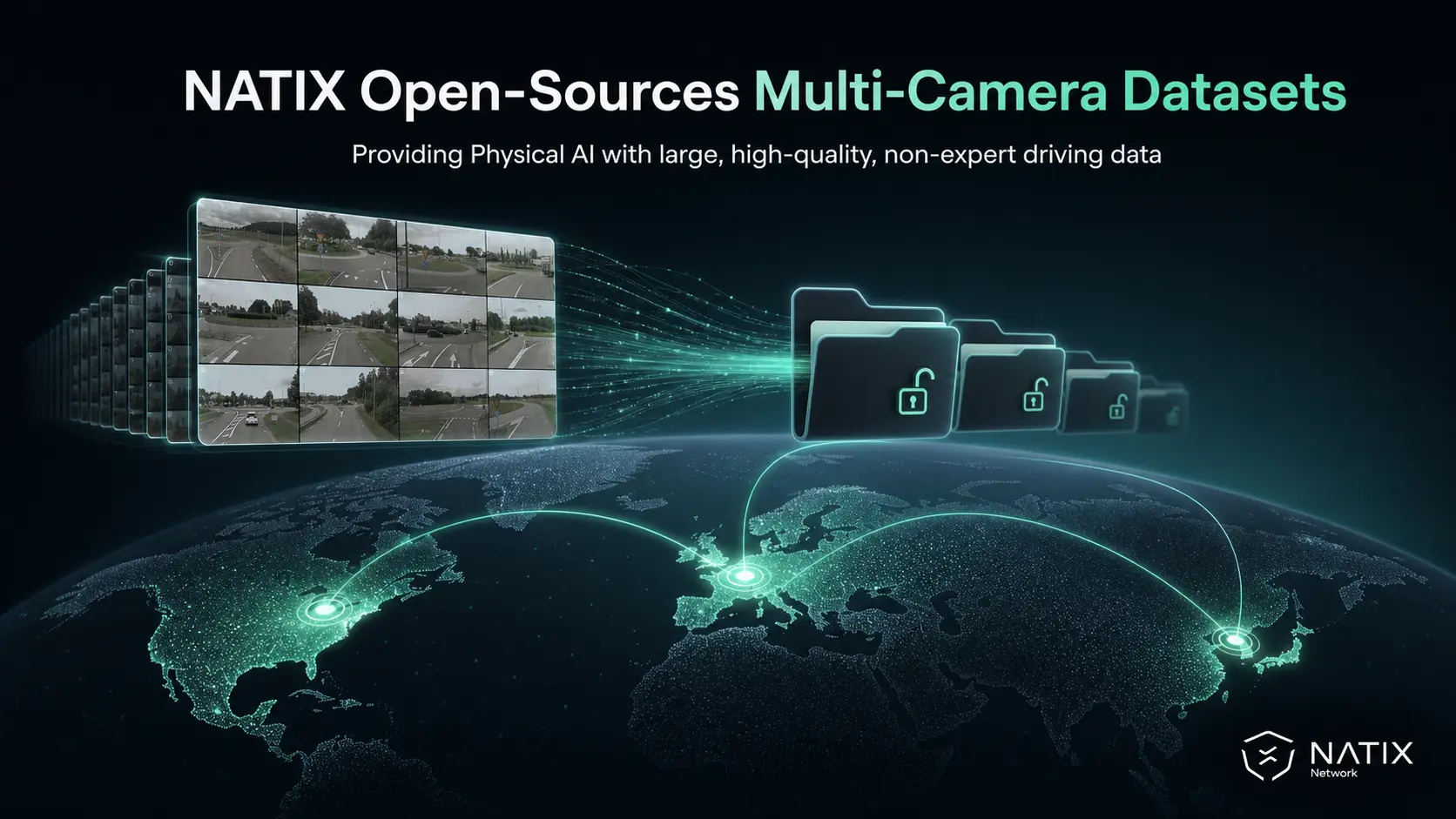
We are open-sourcing two real-world driving datasets on Hugging Face: the NATIX Multi-Camera Driving Dataset and the NATIX Edge Case Driving Dataset.
Together, they provide multi-camera driving footage, GPS/GNSS telemetry, camera calibration, trip-level metadata, and curated long-tail driving scenarios collected through NATIX’s decentralized camera network. Unlike traditional fleet-collected datasets, the data comes from thousands of everyday, non-expert drivers across diverse countries, road types, weather conditions, and driving environments, resulting in a broader and more natural distribution of real-world driving behavior.
This first release is only the starting point. NATIX plans to expand the open multi-camera dataset to 2,000+ hours and the edge-case dataset to more than 1,000 scenarios. Researchers, academic institutions, and open-source teams interested in larger portions of the dataset can also contact us
directly at dataset@natix.io.
Public driving datasets have already proven how powerful open data can be. Datasets like NVIDIA PhysicalAI-AV, L2D, KITTI, BDD100K, nuScenes, Waymo Open Dataset, and others helped turn autonomous driving from a closed industrial problem into a global research field.
But Physical AI is now moving into a different phase.
The next wave is not only about detecting cars, lanes, signs, or pedestrians. It is about learning how the physical world evolves over time: how traffic flows, how drivers behave, how scenes change across camera views, and how rare events unfold before they become critical.
That shift raises the bar for data. Models need more than labeled frames or short benchmark events. They need continuous real-world driving context, multiple viewpoints, motion signals, route-level metadata, and enough diversity to capture both everyday driving and the long tail.
Furthermore, most public multi-camera datasets were collected by purpose-built autonomous vehicle fleets. That makes them incredibly valuable, but it also means they reflect the operating patterns of a relatively small number of vehicles following structured collection programs.
NATIX takes a fundamentally different approach. With nearly 200K hours of real-world multi-camera video data collected in only 1 year, our datasets are not just another benchmark release. They are built from a decentralized camera network designed to capture real-world driving as it naturally happens.
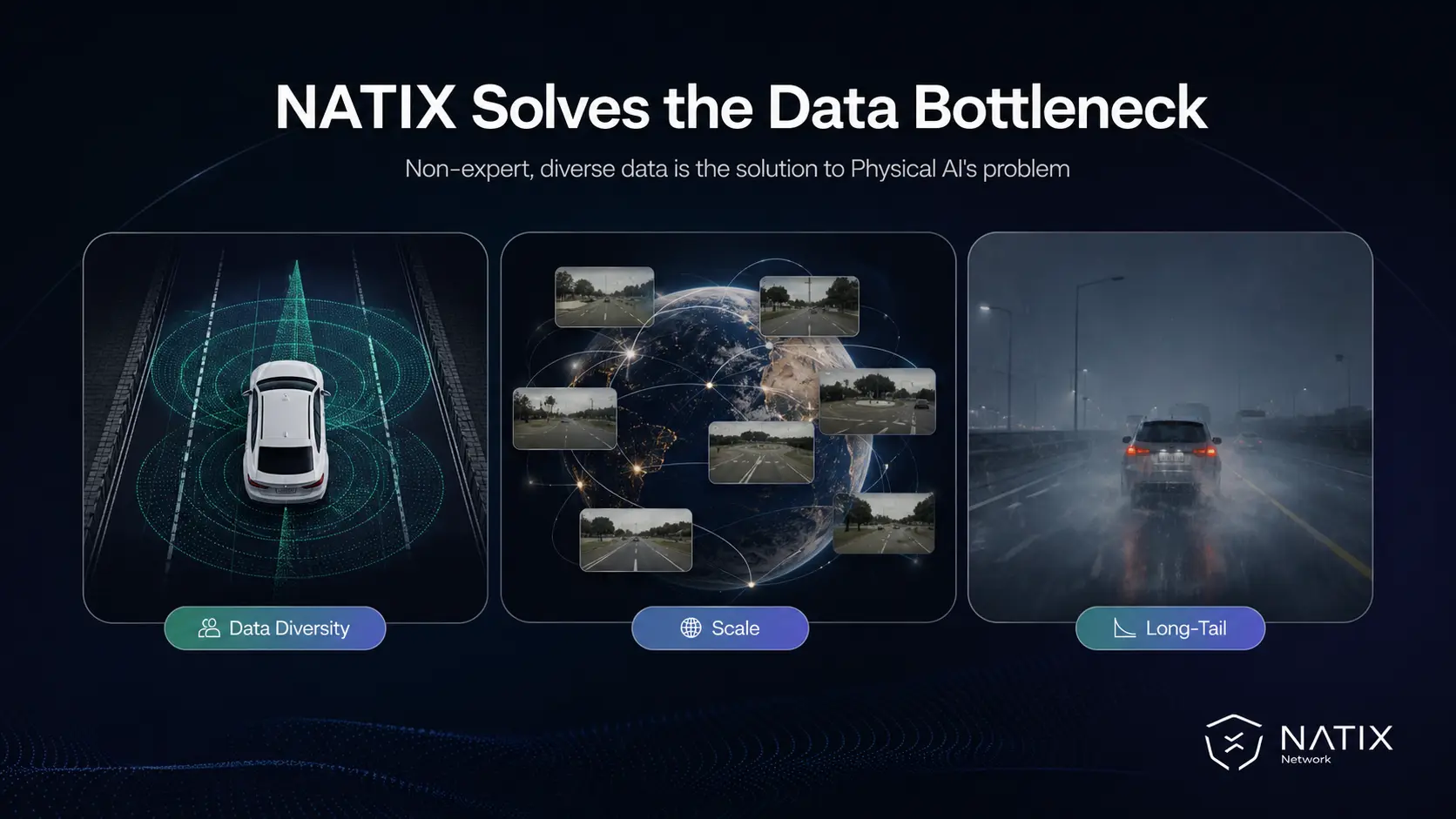
Instead of relying on dedicated fleet vehicles, NATIX collects data through a decentralized camera network made up of thousands of everyday, non-expert drivers. Every trip contributes a slightly different perspective: different cities, different road types, different weather conditions, different driving styles, and different vehicles.
The result is a dataset that captures the variability of real-world driving at a scale that would be difficult for a traditional fleet to replicate. This decentralized approach also naturally produces the long tail. Construction zones, unusual traffic behavior, adverse weather, temporary road changes, and unexpected situations appear because they happen in the real world, not because someone went looking for them.
Here is what we’re releasing:
The NATIX Multi-Camera Driving Dataset is designed as a foundation dataset for real-world driving research.
The first public release contains 100 hours of multi-camera driving footage, with plans to expand the dataset to include over 2,000 hours. While this initial dataset spans across Switzerland and the United States, including California, Florida, Georgia, and Colorado, the broader dataset would cover the US, Europe, and Japan. The data comes from everyday drivers in real conditions, rather than a centralized fleet operating predefined routes.
Each trip includes vehicle camera footage, GPS/GNSS metadata, camera calibration, and trip-level context. Depending on the vehicle and trip, footage is available in 4-camera or 6-camera configurations, including front, rear, side, repeater, and pillar camera views.
The dataset supports research in:
The Hugging Face repository includes a 20-minute sample for quick inspection, while the full 100-hour dataset is hosted externally for download. The complete release contains 2,736 trips, 30,902 MP4 clips, 114,614 total files, and approximately 1.28 TB of data.
The NATIX Edge Case Driving Dataset is built around a different problem: rare events are hard to find.
Most driving footage is routine. The moments that matter most for model evaluation and validation are often scattered across hundreds of hours of video: construction zones, poor visibility, damaged roads, unusual maneuvers, blocked views, and other situations that push models outside clean benchmark conditions.
This dataset focuses directly on those long-tail scenarios.
The first public release includes 86 curated events, with plans to expand the dataset to include over 1,000 events, covering five safety-critical scenario types: construction zones, adverse weather, road surface deterioration, traffic violations, and obstructions by large vehicles.
Each event captured includes multi-camera footage, GPS/GNSS telemetry, trip metadata, and structured VLM-generated annotations. These annotations describe the detected event, the visual evidence, the surrounding context, and whether the footage validates the scenario.
That makes the dataset useful not only for perception but also for scene understanding, scenario generation, VLM research, simulation workflows, and autonomous driving validation.
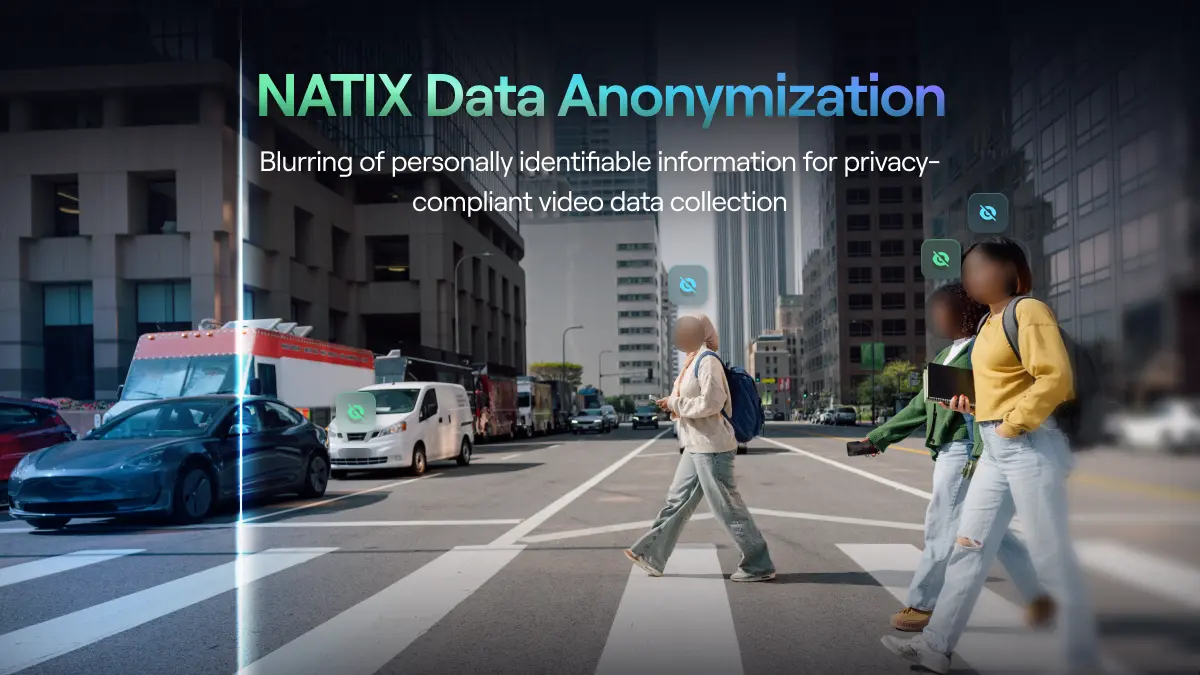
Both datasets are anonymized before release. Faces and license plates are blurred, and known sensitive or military areas are removed. Because the data is real-world and crowd-sourced, NATIX also asks users to report anything that appears sensitive, incomplete, inconsistent, or unexpected so it can be reviewed.
Metadata fields such as weather, temperature, estimated distance, and estimated average speed should be treated as best-effort estimates rather than ground truth. The datasets are released under CC BY-NC 4.0 for non-commercial research and open-source use, with commercial use requiring separate written permission from NATIX.
This release is not the full scale of NATIX data. It is the beginning of a larger open-data effort.
NATIX plans to expand the open multi-camera dataset to more than 2,000 hours and the edge-case dataset to more than 1,000 curated scenarios. The goal is to support researchers working on Physical AI, autonomous driving, world models, robotics, mapping, and simulation with real-world data that is difficult to collect independently.
If you are a researcher, academic institution, or open-source project working in this space and need access to more data, NATIX welcomes collaboration and is happy to support open research initiatives.


