

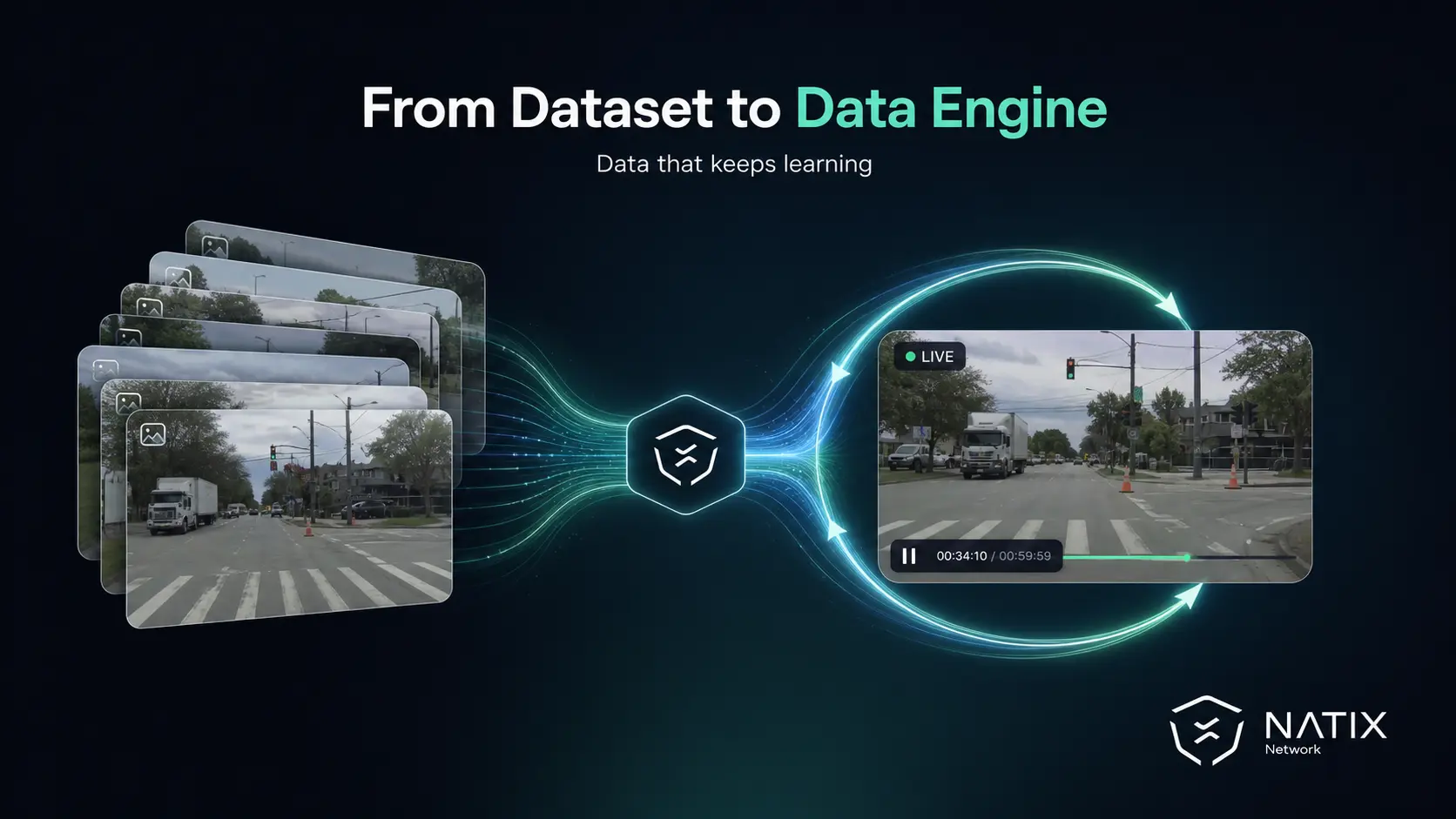
Most of the training data that world models learn from was built around a single forward-facing camera. That choice made sense when the goal was detecting what lay directly ahead: the vehicle in front, the road surface, a pedestrian about to step off the curb. But World Foundation Models are built around a different question. They are not trying to identify individual objects. They are trying to learn how physical scenes evolve: how situations develop across space and time, how objects relate to each other across the full geometry of a scene, and what is likely to happen next in all directions simultaneously.
A single forward-facing camera cannot answer that question completely. And a static dataset, no matter how large, cannot keep up with the situations the real world keeps generating.
That is the core idea here. There is an important distinction between a dataset and a data engine, and it matters more as world models become central to autonomous driving development. Multi-camera capture changes what the model can see. A data engine changes how long it can keep learning. Together, they determine not just what a world model knows at training time, but whether that knowledge stays relevant as the world continues to change.
A dataset is a collection assembled at a point in time, shaped by whoever built it: which roads were driven, which conditions were recorded, which sensor configurations were used, and which scenarios the collection team thought to look for. Once assembled, it is fixed. It reflects the world as it was during the collection window and the implicit assumptions embedded in the curation process.
That is not a criticism of any specific dataset. Benchmarks like nuScenes, Waymo Open Dataset, or Argoverse 2 have done essential work for the field and continue to serve as important evaluation references. The limitation is structural, not a matter of quality. A fixed dataset cannot adapt when driving behavior changes across markets, when new vehicle types appear in new geographies, or when a failure mode emerges that nobody anticipated during collection.
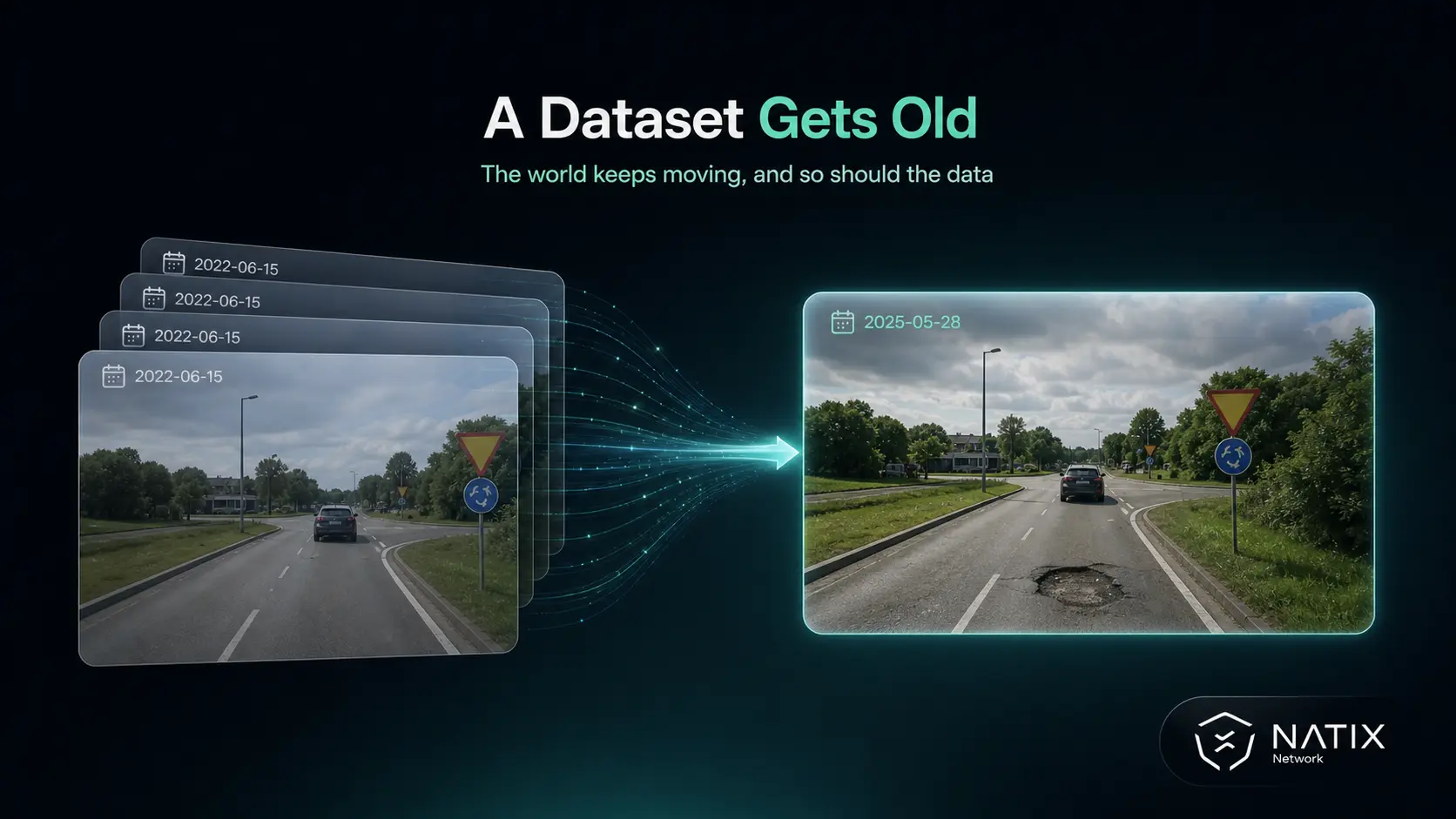
The more efficiently you assemble a dataset, the more it tends to reflect what was common and expected during that window. What gets underrepresented is exactly what matters most: the rare, the unexpected, and the situations that unfold in ways the model has never seen. A dataset grows stale not because the data degrades, but because the world keeps moving while the dataset stays still.
A data engine is something fundamentally different. Rather than a one-time collection effort, it is a continuously running pipeline that identifies where the current model is struggling and routes those failure cases back into the training loop. The model and the data update each other in a closed cycle.
The concept is not new to the industry. Data feedback loops in production autonomous vehicle development work through a similar logic: the system flags clips where its predictions diverged from what actually happened, prioritizes those clips for annotation, and retrains. The key insight is that a data engine does not just collect more data. It collects the data that the model currently fails on. It identifies what is missing and goes to find it, rather than collecting indiscriminately and hoping the right examples appear.
Consider a concrete example. Two cars approach each other in close proximity ahead of the recording vehicle, partially overlapping in the frame, one slightly across the lane boundary as they navigate a narrow stretch of road. The model, trained primarily on clean forward-facing footage where vehicles are clearly separated and lane assignments are unambiguous, becomes uncertain. It cannot confidently determine which car is in which lane, where the lane boundaries are underneath the overlap, or how the situation is about to resolve. A static dataset may contain a handful of instances like that. A data engine, by identifying where the model's confidence collapses, will route more of those situations back into training, gradually closing the gap between what the model has seen and what the real world keeps producing.
That example scales to hundreds of subtler failure modes. Atypical vehicle behavior at unusual intersections. Delivery vehicles are blocking lanes in ways that do not match standard training scenarios. Road conditions vary dramatically from one country or climate to another. A static dataset reflects the scenarios the collectors anticipated. A data engine learns from the scenarios the model did not handle well, which is ultimately a different set.
The limitation of a single forward-facing camera is not just that it covers less of the scene. It is that the spatial information it provides is structurally incomplete in ways that matter specifically for world model training.
A world model is trying to learn how scenes evolve in three dimensions. Where objects are relative to each other. How the geometry of a situation constrains what can happen next. What is occurring in the periphery while the forward view is occupied with something else. A single lens, even a high-resolution one, cannot provide that. Researchers working on world models for autonomous driving have noted that an ideal world model should match the full sensor configuration of the target vehicle, not be trained on a simplified version of it that was chosen for convenience during dataset collection.
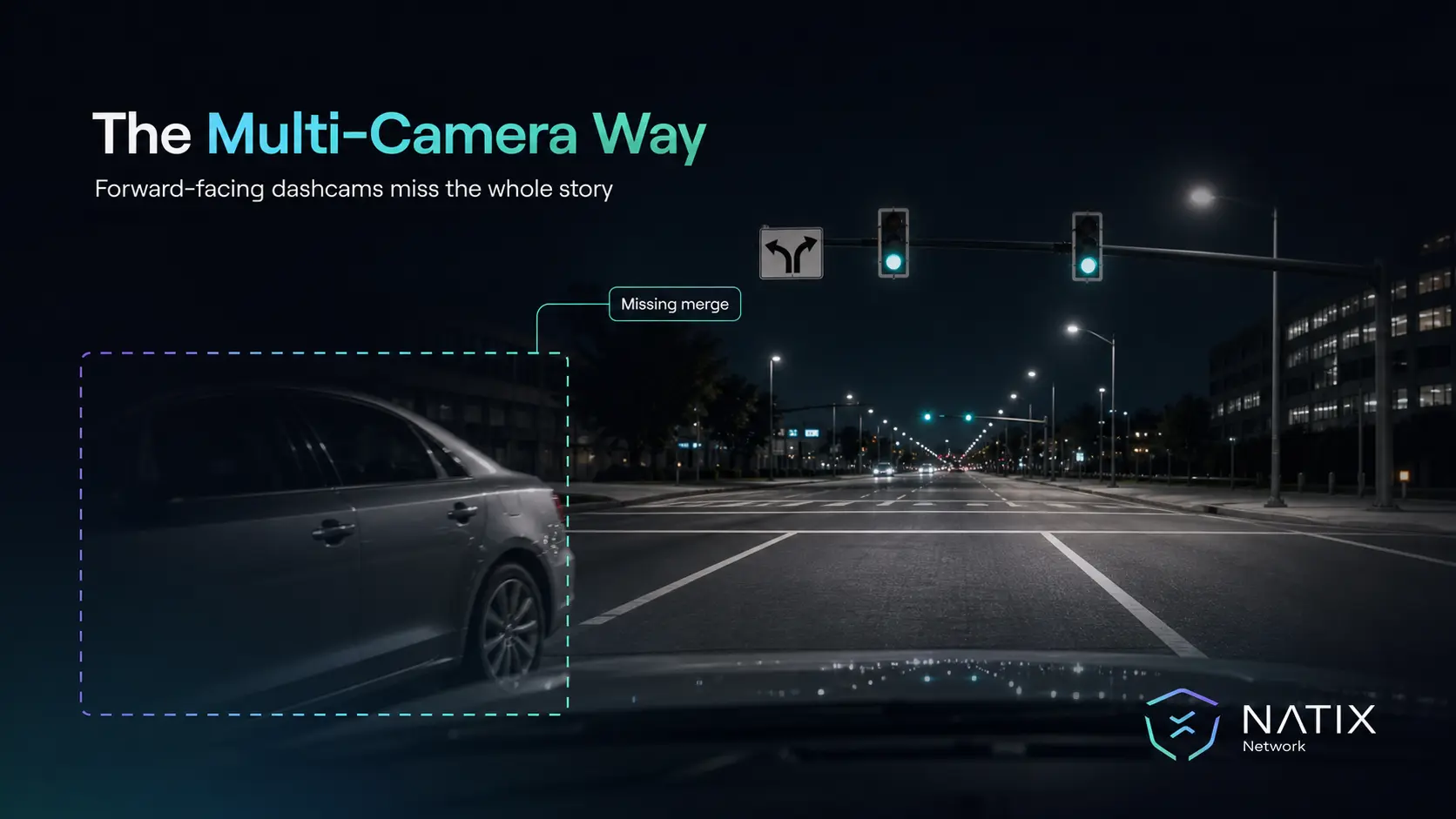
When a vehicle is merging from the left, the forward camera sees its front quarter. It does not see the gap the driver is targeting, the speed of traffic behind, or the full geometry of the lane structure the merge is unfolding within. When a truck runs parallel to the vehicle and is about to enter the same space, the forward camera may not register it at all until the moment of interaction. When an object is occluded by a leading vehicle, a second camera at a different angle often resolves the ambiguity immediately. A single forward camera has no way to recover that information.
These are not edge cases that come up occasionally in unusual conditions. They are routine aspects of real driving that single-camera training data systematically underrepresents, because the camera configuration determines what the dataset can contain. Training on forward-facing data and then deploying on a system with six cameras creates a mismatch that no amount of fine-tuning fully resolves. You can see how this challenge compounds across approaches that rely on camera input alone in the broader discussion of vision-only autonomy, where sensor configuration shapes what the model can realistically learn at every stage.
Surround-view data changes what world models can learn because it changes what the training signal actually contains.
With synchronized footage from multiple cameras, a model can observe how situations develop across angles at the same time. It can learn how an overtaking vehicle on the left relates to a decelerating vehicle ahead. It can understand the geometry of a lane merge from the perspective of both participants simultaneously. It develops spatial intelligence about how physical space is occupied across the full extent of a scene, not just along the forward axis that the single camera happens to point.
This matters for scenario generation specifically. A world model trained on multi-camera data can generate physically coherent variations of complex scenarios because it has learned the spatial relationships that make those scenarios realistic. A model trained only on forward-facing data will produce plausible-looking forward views, but the surrounding geometry will often not be consistent with the scene it is trying to represent. The synthetic data it generates reflects the same structural gap as the training data it learned from. That gap compounds over generations of training.
Multi-camera data also matters for sensor fusion reasoning. When training data includes synchronized footage from all angles, the model learns to reason about what different viewpoints would reveal from different positions, how those views relate to each other, and how scene state can be inferred when one view is ambiguous, but others are not. That is a fundamentally richer kind of learning than what single-view data can support, and it is the kind that translates to more reliable behavior when the model encounters real driving conditions.
More cameras help, but they do not solve the edge case problem on their own. Long-tail events in driving are rare by definition. No single collection effort, however broad, captures them at a meaningful scale.
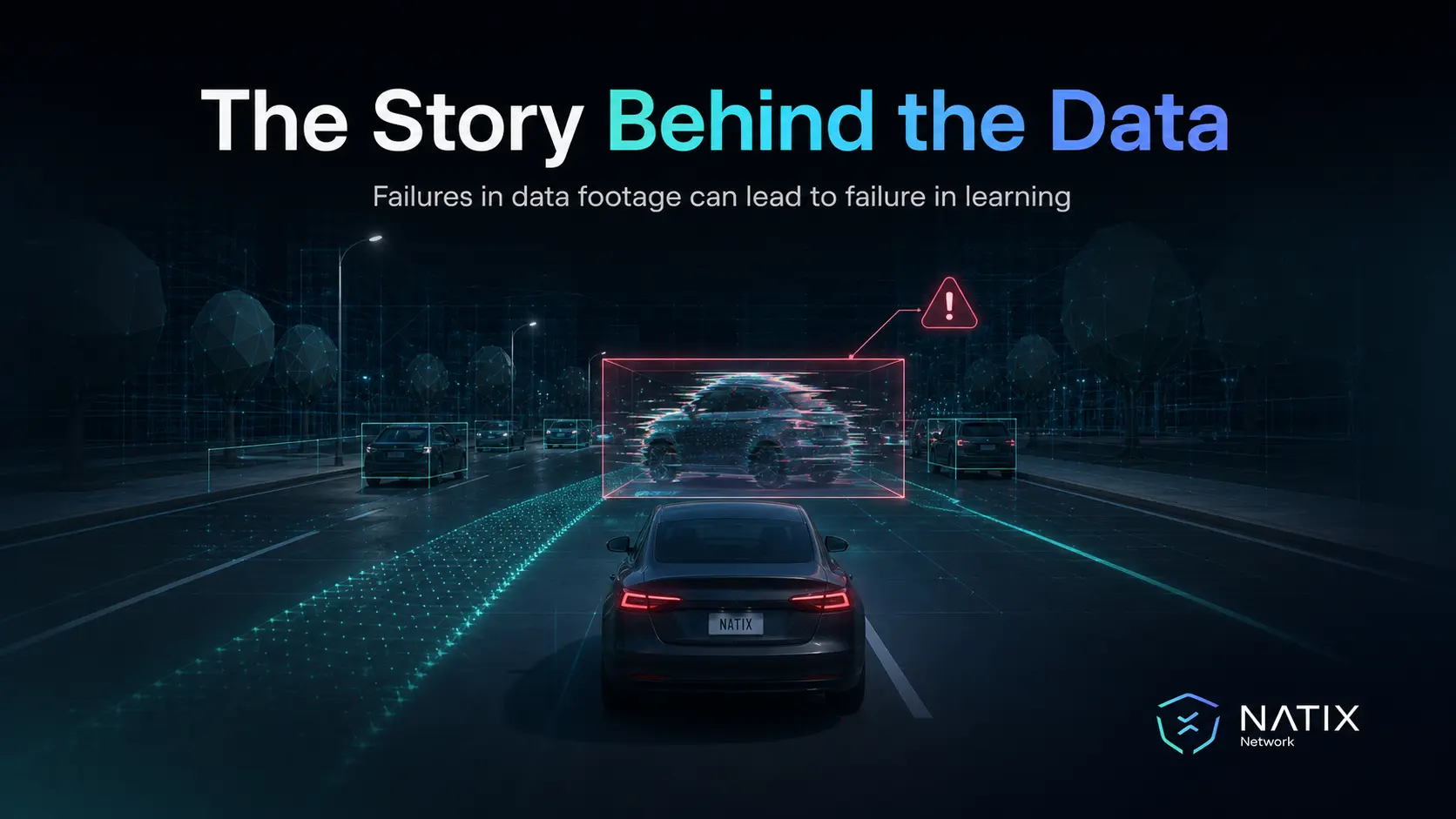
Returning to the two-car overlap example: collecting more general footage will not systematically increase how often that specific failure mode appears in the training set. The only way to get more of those situations into training is to have a system that can identify them when they occur — through model uncertainty signals, through annotation review, or through the kind of active scenario mining that VLMs are increasingly making practical at scale. That is what turns a camera network into a data engine rather than a passive archive.
The real world does not cooperate with collection schedules. Rare situations happen when they happen, across geographies and conditions that no planned effort fully anticipates. A continuously running data engine connected to a live multi-camera network can surface those situations as they occur, rather than waiting for a new dataset release to address them. And because the engine knows what the model currently handles poorly, it can prioritize. Rather than treating all footage as equally valuable, it routes the most instructive situations to the front of the training queue and lets the rest wait.
This is where the combination of surround-view capture and continuously updating pipelines becomes greater than either component alone. The cameras see what a single lens misses. The engine ensures that what the model has not yet learned keeps feeding back into training as the real world keeps producing new situations. The connection to scenario generation in autonomous driving is direct: edge cases discovered in real-world footage become the seeds of synthetic scenarios, which can expand training coverage far beyond what any collection program can directly capture.
This is where the NATIX and Valeo partnership fits naturally into the argument.
NATIX's VX360 network captures synchronized 360° footage from vehicles across the US, Europe, and Asia. By early 2026, the network had collected over 80,000 hours of multi-camera driving from a continuously growing contributor fleet, across a range of road environments, weather conditions, and driving contexts. Importantly, that footage is not a one-time snapshot. The network keeps running. As driving conditions, road structures, and vehicle behaviors evolve across those geographies, the data reflects those changes. That is the structure of a data engine, not a static dataset.
Valeo brings the world model expertise. Together, they are building one of the largest open-source multi-camera world foundation models, trained on data that spans camera configurations, geographies, and conditions that no single institution could assemble on its own. The open-source direction matters because it means the resulting model can serve as a foundation for other research teams and development programs, rather than remaining proprietary infrastructure held inside one organization.
What makes this meaningful for world model training is the combination. Multi-camera capture gives the model the spatial context it needs to learn full scene geometry rather than a flattened forward projection. The continuously updating data pipeline means that new situations, including the failure modes the model currently struggles with, keep feeding back into training as they emerge from real-world driving. The system is not learning from a fixed record of how people drove in 2022 in a handful of cities. It is learning from a living record of how driving actually unfolds across a wide range of conditions, countries, and use cases, continuously extended. For a broader view of how VLMs and world models connect across the full autonomy stack, the technical context in this overview of VLMs and world foundation models is worth reading alongside this.
A dataset teaches a model what the world looked like during collection. A data engine teaches it what the world keeps doing.
Static benchmarks are not going away, and they remain essential for evaluation, comparison, and reproducibility. But as world models move from research artifacts into production systems, the question of where training data comes from becomes harder to separate from the question of how well those systems will actually behave. A model trained on a fixed forward-facing dataset inherits all the structural limits of that choice: the camera configuration, the geographies covered, and the scenarios that happened to fall within the collection window.
Multi-camera data extends what the model can see. A continuously updating pipeline extends how long it can keep learning. Together, they change not just how much a world model knows at training time, but whether that knowledge can keep pace with a world that does not stay still.


