

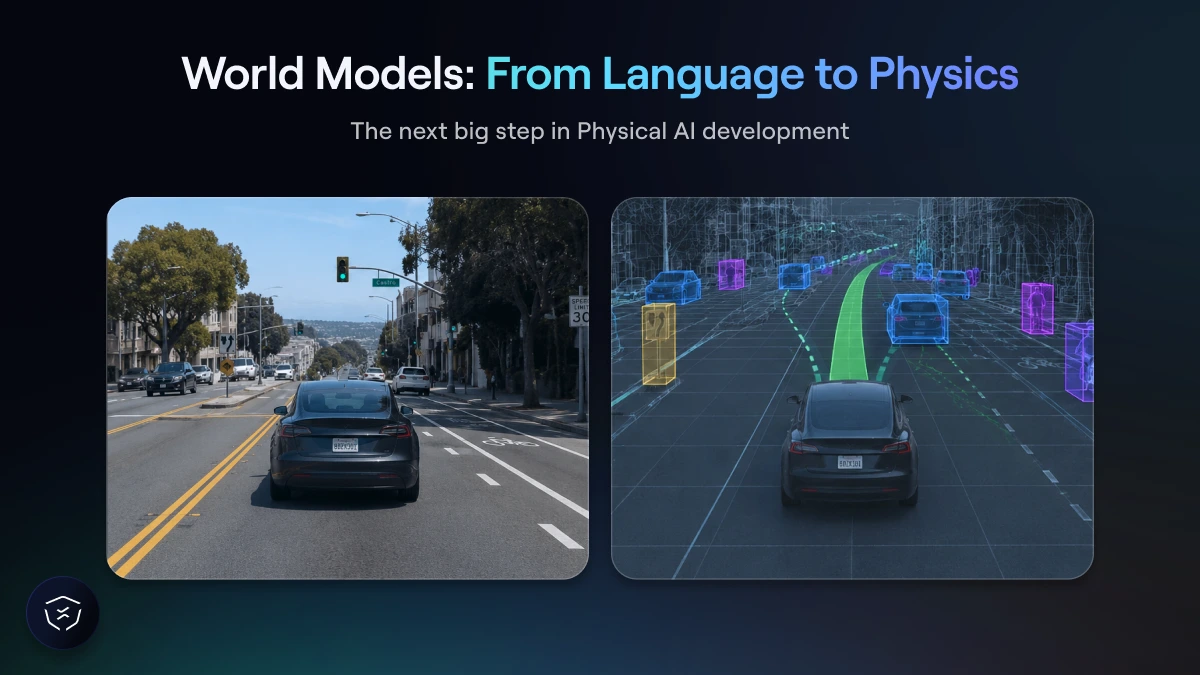
For the better part of a decade, AI progress was mostly a story about language. Systems got better at reading, writing, summarizing, and reasoning through text. That was genuinely valuable, and the results were real. But language is one dimension of intelligence. The physical world runs on different rules. Things move, collide, occlude each other, and evolve in ways that no text description fully captures.
World models are the technology designed to close that gap. They are not a product category yet, and they are not a single architecture. They are closer to a research direction with a clear purpose: teaching AI systems to understand how the physical world behaves over time, well enough to simulate it, reason through it, and act within it. The fact that some of the most respected researchers in AI have left established institutions to build companies around this idea, and that those companies are raising capital at a scale usually reserved for infrastructure bets, tells you something about where the field is heading.
The simplest way to explain world models is by contrast. If large language models predict the next word in a sentence, world models predict the next moment in a scene. They learn from video and sensory data how environments evolve: how objects move, how physics applies, how one action leads to another. The goal is not to generate a pretty picture of the future, but to build an internal model of how the world works that is accurate enough to reason about consequences.
Traditional simulators approached this problem through explicit programming. Engineers wrote rules: this object has this mass, this surface has this friction coefficient, when these two collide, here is what happens. That approach produces controlled environments, but it is also limited by what the engineers thought to include. If a scenario was not anticipated, the simulator cannot handle it. World Foundation Models are different because they learn physical dynamics from data rather than from rules. They observe millions of real-world scenes and infer how things behave, which means that they can generalize situations that were never explicitly modeled.
One way to think about the difference is that a traditional simulator and a world model answer opposite questions. A traditional simulator’s driving policy takes the current situation and decides what action to take. In simple terms: "This is what I see, so this is what I do."
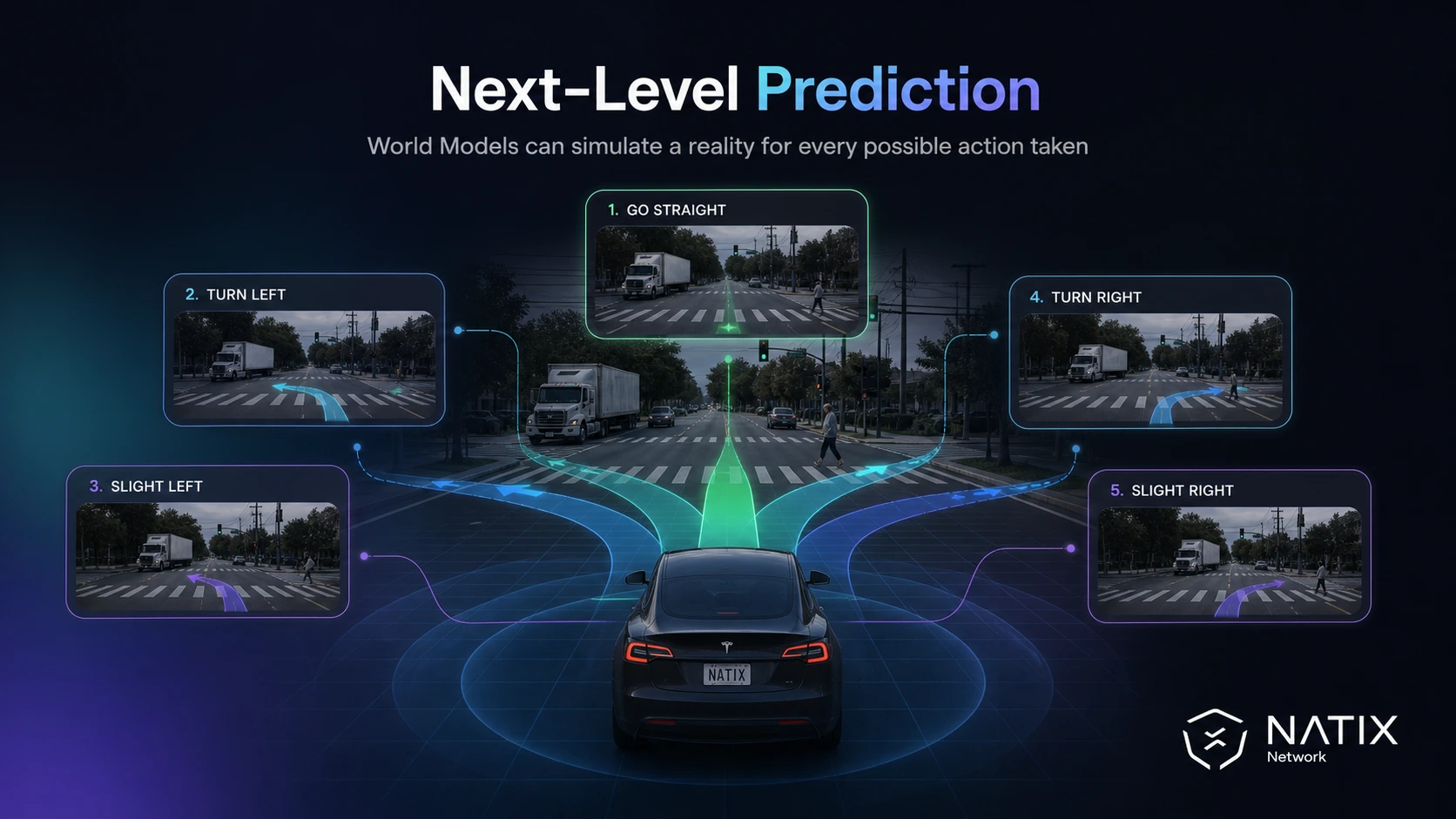
A world model works in reverse. It takes the current situation and a possible action, then predicts what happens next. "If the world looks like this and I do that, what will happen?"
That may sound like a small distinction, but it changes what an AI system is capable of. Once a model can predict consequences, it can imagine many possible futures before acting. Instead of reacting to the world, it can reason through different outcomes and choose the most promising path. In that sense, a world model acts like a learned simulator of reality, allowing an AI system to test ideas internally before committing to them in the real world. Then, assuming that the World Model is good enough at prediction, finding the best possible solution becomes solely a compute problem.
The best sign that a technology is being taken seriously is when serious people leave comfortable positions to build it. In late 2025, Yann LeCun, the Turing Award winner who spent years as Chief AI Scientist at Meta, confirmed he was starting a new company built around world models. His company, AMI Labs, raised $1.03 billion in March 2026 at a pre-money valuation of $3.5 billion. The thesis is direct: language models predict language, and they have become very good at that. But understanding the physical world requires something different, a system that can model cause and effect in three-dimensional space as it evolves over time.
Part of what makes world models so attractive to researchers and investors is that they create a new scaling path for AI. Large language models showed that more data, larger models, and more compute could produce better results steadily. World models may offer a similar dynamic for physical intelligence. If a world model can accurately predict how the world evolves, then improving performance is no longer only about collecting more driving miles or writing better rules. It becomes possible to evaluate thousands or even millions of potential futures, searching for better decisions before taking action. More capable models and more compute can directly translate into better planning.
LeCun is not alone. Fei-Fei Li, whose earlier work helped establish the ImageNet benchmark that defined a generation of computer vision research, co-founded World Labs in 2024 and raised approximately $1 billion in early 2026 to build world-scale spatial intelligence. NVIDIA is building its Cosmos platform around world model generation for robotics and autonomous vehicles. Google DeepMind is pursuing generative world environments through its Genie research line. Meanwhile, companies such as Wayve and Waymo are increasingly combining learned world models with planning and simulation systems that allow autonomous vehicles to reason about future outcomes rather than simply react to the present moment.
This is not one company chasing a trend. It is a convergence of researchers and capital around the same underlying idea. That convergence is worth paying attention to, because it reflects something beyond excitement. Viewed through that lens, world models are not just another AI architecture. They are an attempt to build systems that can imagine consequences before acting, and then improve those decisions through scale.
The applications span more industries than most people realize when they first encounter the technology.
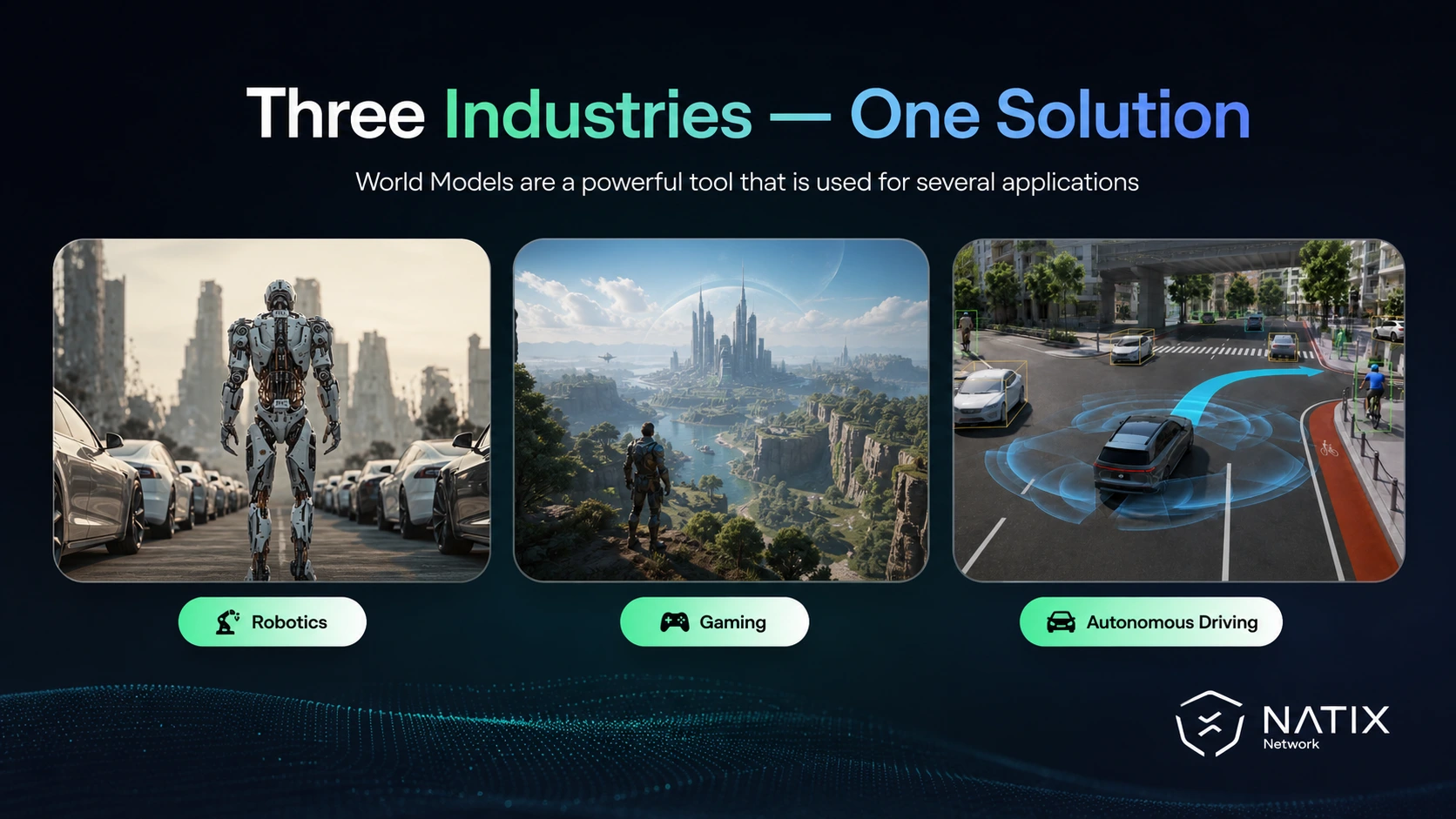
In robotics, world models are used to train physical AI agents before they are deployed into real environments. A robot that needs to learn how to handle objects of varying weight, shape, and surface texture benefits from a world model that can simulate the physics of those interactions at scale, across far more variations than any real lab could produce. Recent research shows that training reinforcement learning policies inside a learned world model, rather than a hand-authored simulator, can produce better real-world performance precisely because the learned model reflects actual physical dynamics rather than programmed approximations.
In gaming, the application is more generative. Google DeepMind's Genie 3 can produce playable 3D environments from text prompts in real time. World Labs released its first world model in 2025, capable of generating and manipulating navigable 3D spaces from images. These tools reduce the time and cost of building game environments, but their deeper significance is what they demonstrate technically: a world model can produce physically coherent spaces that agents can move through and interact with. That same capability is exactly what robotics training and autonomous driving simulation require.
In industrial settings, world models are beginning to appear as components of digital twin systems, where a learned model of a physical environment is used to test process changes or identify failure modes before they are introduced into a real facility. The ability to generate plausible futures from real-world observations, rather than hand-modeling every variable, makes this kind of simulation far more practical at scale.
Autonomous driving is where world models are closest to production use and where their value is most concrete. There are two distinct ways the technology is being applied, and both matter for understanding why real-world training data has become such a critical resource.
A recent example is Orbis 2, a hierarchical driving World Model developed by researchers at the University of Freiburg. Announced this week, Orbis 2 was trained on thousands of hours of real-world driving footage, with NATIX contributing the largest single dataset—more than 2,000 hours, representing over 40% of the training data. It demonstrates how large-scale, diverse real-world driving data is becoming a critical ingredient for building next-generation World Foundation Models.
The first use is as a (neural) simulator. A world model trained on real driving footage can take a seed clip and generate many physically coherent variations of it. A near-miss at an intersection can become dozens of slightly different versions: different vehicle speeds, different pedestrian angles, different lighting conditions, different road surface states. This is extremely valuable because rare events cannot be scheduled. You cannot ask a vehicle fleet to encounter a pedestrian stepping unexpectedly into traffic from behind a parked truck exactly fifty times before you need to ship software. The term "neural simulator" is important because it represents a meaningful step beyond traditional simulation. A neural simulator trained on real-world data can produce those scenarios on demand, which means engineering teams can test how their systems respond to situations that may occur only once in millions of miles of driving.
Conventional driving simulators rely on rules written by engineers. Developers define how vehicles move, how objects interact, and how different events unfold. These systems can be highly detailed, but they remain constrained by the assumptions and scenarios that were explicitly programmed. A neural simulator learns these dynamics directly from data. Instead of following a fixed set of rules, it observes millions of real-world examples and learns how the world changes over time. Given the current scene and a possible action by the ego vehicle, it can predict what the next state of the world is likely to look like.
This makes the simulator interactive in a much deeper way. The future is not predetermined by handcrafted logic. It emerges from the model's learned understanding of how traffic participants behave, how objects move through space, and how cause and effect operate in the real world. The result is a simulation environment that can generate far more realistic and diverse scenarios than would be practical to design manually. This is closely related to the broader challenge of scenario generation in autonomous driving, where the quality of the seed data determines the quality of the generated scenarios.
The second use is in training end-to-end driving systems directly. End-to-end models learn to drive from raw video data, without the hand-coded module boundaries that defined earlier autonomous driving architectures. They observe situations and learn what actions to take, at scale. World models expand the training distribution for these systems by generating novel scenarios that were not present in the original dataset. A model trained only on what a fleet has actually encountered will be unprepared for situations outside that distribution. A model trained with a world model generating variations, edge cases, and rarely observed conditions can develop more robust behavior. The current World Foundation Model landscape shows that Wayve, NVIDIA, Tesla, and several others have all moved toward architectures that combine real-world data with learned generative simulation in exactly this way.
Here is the part that is easy to miss when reading about world models as a category. A world model is only as useful as the data it learned from. If it was trained primarily on synthetic environments or limited geographic data, its predictions will reflect the assumptions baked into that data, not the actual messiness and diversity of the real world. This is the sim-to-real gap, and it does not disappear just because the simulator is now a neural network rather than a game engine.
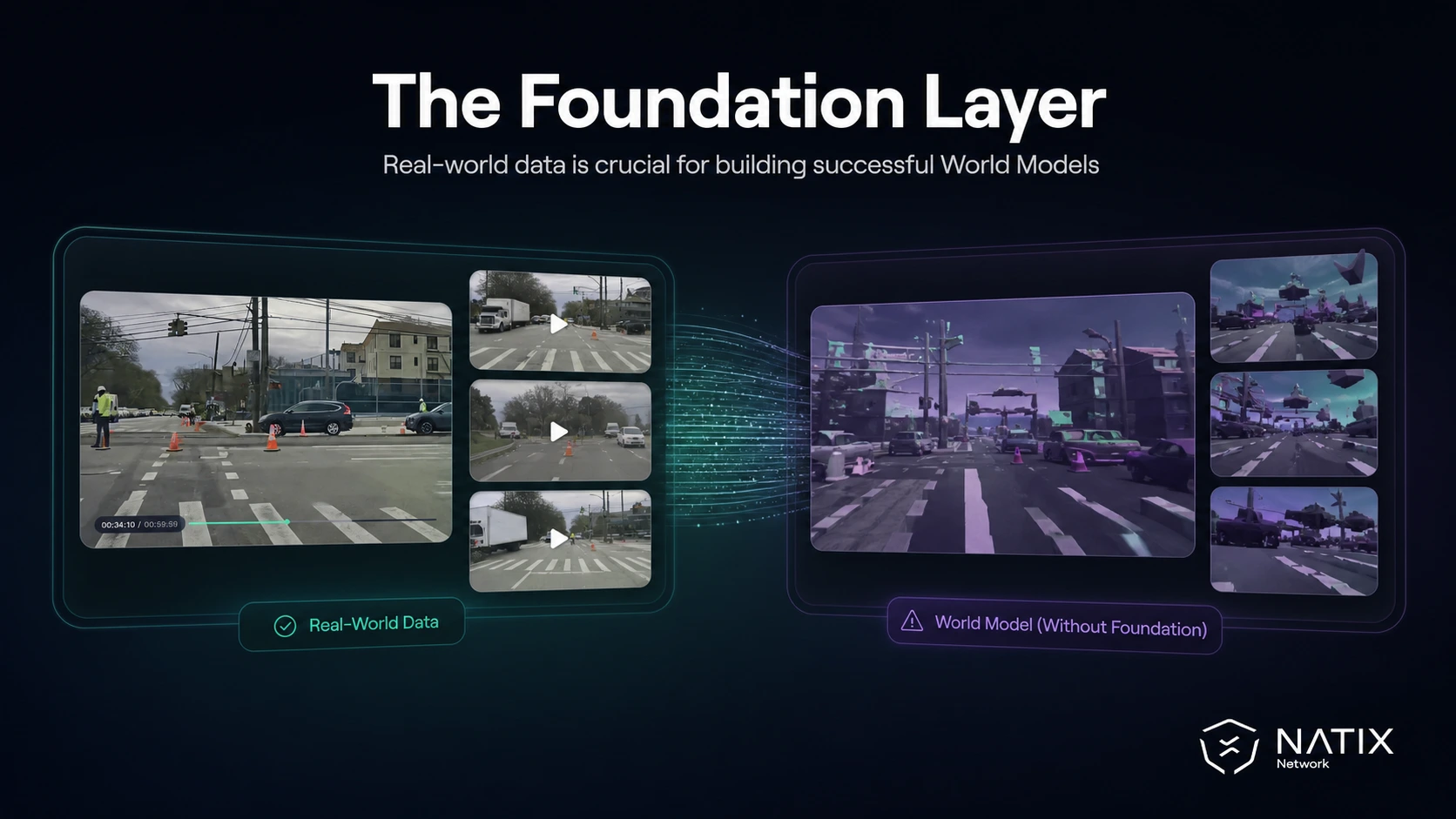
Synthetic data is genuinely useful during training because it provides volume and control. It can generate rare scenarios, systematically vary weather and lighting, and stress-test edge cases that would take years of real-world driving to encounter naturally. But during validation, the situation changes. To know whether a model is actually ready for real conditions, you need to test it against real-world data. Footage captured in a physics engine, however sophisticated, cannot fully replicate the unpredictability, cultural variation, and physical imperfection of actual environments. Training benefits from amplification. Validation depends on fidelity.
This is where multi-camera, real-world data becomes foundational. NATIX's approach, building a global layer of multi-camera video captured from vehicles in everyday use across diverse geographies, is designed to address exactly this bottleneck. The recently announced Orbis 2 World Model, where NATIX contributed the largest single training dataset, and the multi-camera World Foundation Model built in partnership with Valeo are concrete examples of what becomes possible when real-world data is applied to world model training and validation at scale. Surround-view matters here for a specific reason. The world does not happen only in front of the vehicle. Edge cases often unfold across multiple camera angles simultaneously, and a dataset that captures only the forward view misses the lateral and rear context that a world model needs to produce physically coherent predictions.
Understanding how VLMs connect to World Foundation Models is useful context here, because the two technologies sit at different layers of the same stack and are increasingly built to work together. The common thread is clear. World models require data that reflects how the world actually behaves, collected across diverse conditions, geographies, traffic patterns, and rare events. The quality of the model is ultimately bounded by the quality and diversity of what it was trained on.
World models are moving from a research concept to an infrastructure bet. The capital flows are real, the applications are concrete across robotics, gaming, and autonomous driving, and the underlying technical argument is sound. AI systems that need to act in the physical world need to understand how that world behaves. Language models were a meaningful step toward general intelligence. World models are a step toward physical intelligence.
The interesting question now is not whether world models matter, but what they require to work well. The answer keeps pointing to the same place. The quality of a world model depends on the quality and diversity of the data it learned from. In the end, the systems that see the most of the real world will be the ones best equipped to teach machines how to operate within it.


