

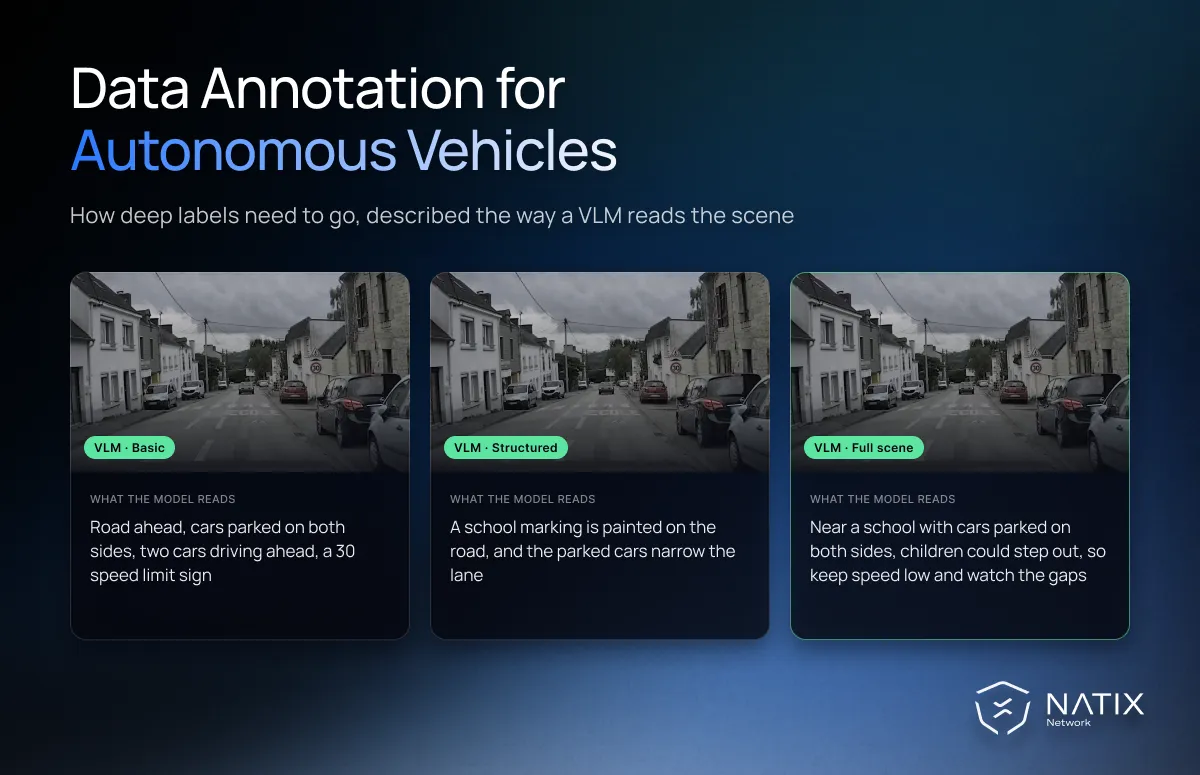
Data annotation for autonomous vehicles is the work of adding structure to raw driving footage so a model can learn from it. A camera records pixels, and annotation tells the model that these pixels are a cyclist, that line is a lane edge and that car is about to turn. Without it, much of the value in driving video stays locked away.
Annotation is also one of the most expensive parts of building a driving system, so the real question is not whether to label data, but how deep the labels need to go for the system you are building.
At its simplest, annotation means drawing and naming things in images. In driving, it covers a wide range of tasks. Some are quick, such as tagging a traffic sign, while others are slow and demanding, such as tracking every road user in 3D across a long video.
Annotation also includes scene-level information. A clip might be tagged as "night", "rain" or "highway merge". These tags help teams search and balance their datasets, even when objects are not labeled individually.
Quality control is part of the job too. Labels must follow clear guidelines, so that two annotators label the same scene the same way, and disagreements are reviewed and resolved. In data annotation for autonomous vehicles, small inconsistencies add up. A model trained on uneven labels learns uneven behavior, and the error may only show up in rare situations on the road.
The most widely used label types include:
Each step down this list adds information and cost. A 2D box can be drawn in seconds. A full 3D track across a busy junction can take far longer and needs careful quality control.
To keep costs under control, many teams now use auto labeling. A trained model drafts the labels, and human annotators review and correct them. For frequent objects, such as cars and lane lines, this saves a great deal of time.
Auto labeling also improves over time. As more reviewed labels flow back into the labeling model, its drafts get better and reviewers correct less. Many teams treat this as a flywheel at the heart of their data annotation for autonomous vehicles.
Auto labeling has limits, though, and works best where the labeling model has seen plenty of similar examples. It struggles with unusual scenes, which are exactly the edge case scenarios that matter most for safety. In practice, the rarer the event, the more human attention its labels still need.
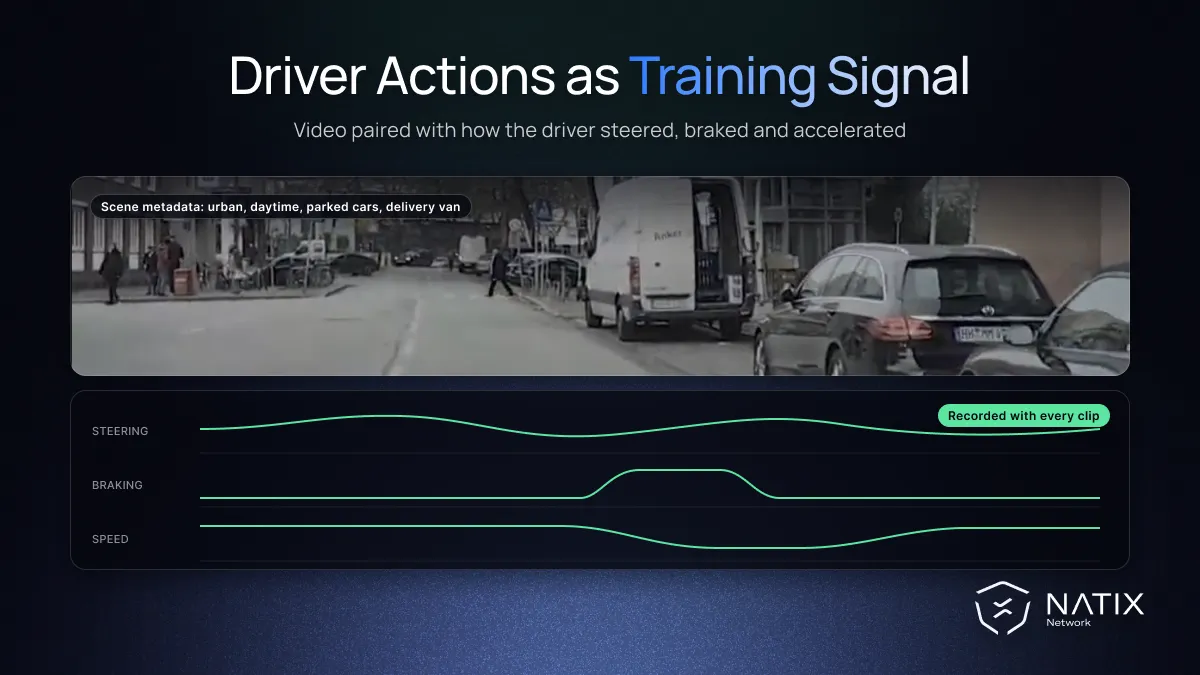
Model design is changing what good annotation looks like. End-to-end driving models learn to map raw video to driving behavior. For them, an important training signal is what a human driver actually did in each moment.
When video is paired with high-frequency driver actions, the recording itself becomes a form of supervision. Steering angle, braking, acceleration and turn signals tell the model how a person handled the scene. Combined with rich scene metadata for search and filtering, this can reduce the need for dense hand labels on every frame. Dense labels remain valuable, especially for validation and specific perception tasks, but they are no longer the only path to useful data.
The right depth depends on what the system must do. We explore the broader differences in our guide to ADAS data needs versus full autonomy.
For driver assistance, labels are usually focused and well defined: a lane-keeping feature needs precise lane lines, and an emergency braking feature needs reliable boxes around vehicles and pedestrians. Consistency matters more than breadth of label types.
For Level 4 autonomy, the system must understand the whole scene. That calls for 3D structure, tracking and some sense of what other road users will do. Teams building end-to-end models may also lean heavily on driver actions and metadata, using dense labels mainly to measure progress.
A sensible approach is to treat data annotation for autonomous vehicles as a budget. Spend the most expensive labels on the scenes and tasks that need them. Use automatic metadata and recorded behavior to cover the rest.
NATIX supplies autonomous vehicle training data in that spirit. Every trip ships with automatic metadata for filtering and with driver actions recorded at 30 to 36 Hz. Dense annotation, such as 3D boxes or segmentation, is available through a partner where a project needs it.
Good data annotation for autonomous vehicles is not about labeling everything. It is about labeling the right things to the right depth, so that every hour of footage teaches the model something it actually needs.


