

NATIXIANs, summer is officially behind us, and Q4 is knocking on the door, but September was anything but a slow wind-down. The month brought the biggest research milestone in NATIX history so far, a brand new open dataset, and a fresh batch of deep dives into where autonomous driving is heading next. Let's jump right into it.
The NATIX Network keeps growing where it matters most for Physical AI. We've now collected over 198K hours of multi-camera footage, the exact kind of real-world data that world models and end-to-end driving systems need to learn how the world actually behaves. To put that into perspective, Valeo's entire VATIX research effort (more on that below) was built entirely on 5.5K hours of NATIX footage, and even that hadn't reached its limit. Every hour our VX360 drivers add makes the network more valuable for the next generation of autonomy!

The first major research result from our partnership with Valeo is here, and it's a big one. How do you actually build a better driving world model? Bigger models, longer training, more data, more compute? Until now, nobody had a clear answer. Valeo set out to find one by training over 200 models on 5.5K hours of real-world driving footage, provided entirely by NATIX and spanning 28 countries across Europe, North America, and Japan.
The result is a set of scaling laws for driving world models: predictable rules for how performance improves with model size and training time. To prove those rules hold, Valeo trained VATIX 9B, a model around eight times larger than any used to establish the pattern, and its final performance landed within 3.6% of the prediction. VATIX is the largest open-source video-generation model trained from scratch specifically on driving data, and it beat the leading open driving world models on both image quality and scene consistency, cutting the key scores by over 60% and nearly 70%, respectively. It also performed strongly on nuScenes, a separate driving dataset it wasn't trained on, showing that diverse real-world data teaches models to generalize rather than memorize.
What makes this especially exciting for us: this is the largest single-source dataset used to train an open driving world model from scratch, and it came from the NATIX community. Valeo only used the front-facing camera stream for this first paper, which means the full 360° context of our data is still waiting to be put to work.
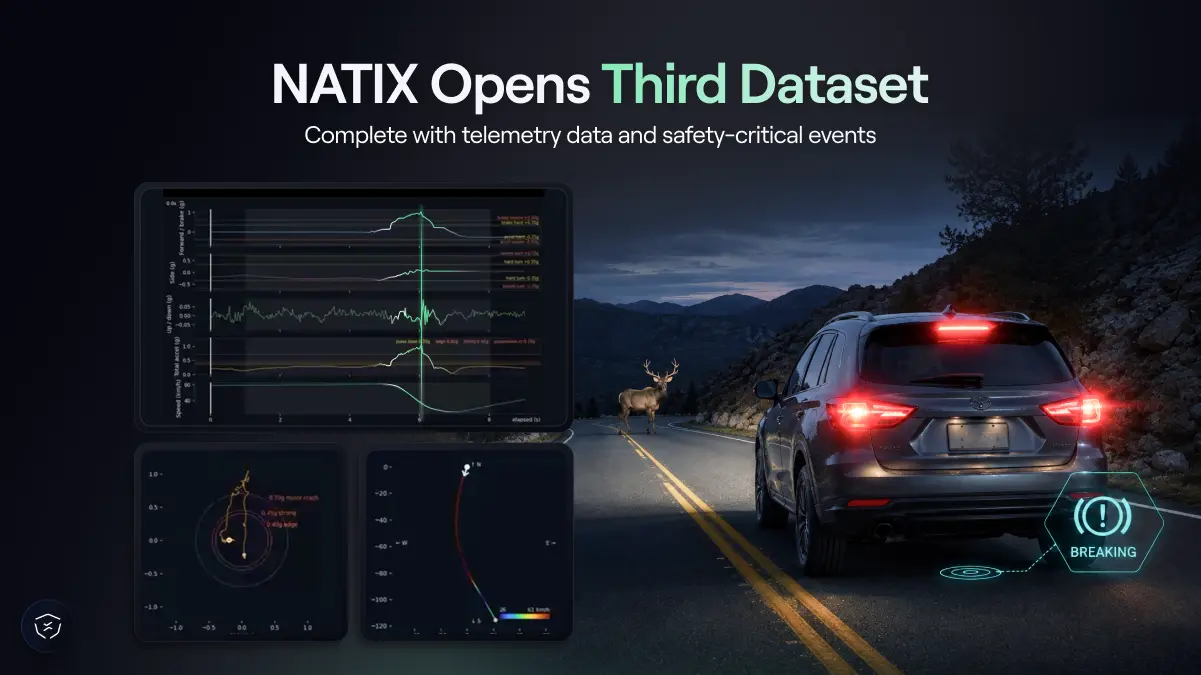
Shortly after, we open-sourced our third dataset on Hugging Face, and this one adds a whole new layer to NATIX data: vehicle telemetry. The Safety-Critical Driving Events Dataset pairs driving footage with signals such as automotive-grade GPS, wheel angle, pedal position, brake state, turn-signal status, and Autopilot state, and uses them to detect harsh braking, harsh acceleration, sharp turns, and aggressive driving patterns. The first release covers 45 telemetry-detected events across ten U.S. states, each time-stamped to the second.
This gives us a second way to mine the long tail of driving. Our Edge Case Driving Dataset uses Vision-Language Models (VLMs) to spot unusual scenes visually, while telemetry flags the moments when the vehicle itself reacted to something. Put simply, telemetry finds the event, and visual AI explains it. Together, they make it far easier to surface the few seconds that matter most inside thousands of hours of ordinary driving.
We also kept the educational content flowing this month. We kicked things off with a look at why generative world models are replacing hand-coded driving simulators, and why the quality of the simulation now depends on the real-world data underneath it rather than how many assets a team can build by hand.
From there, we explored why reasoning is becoming the next layer of autonomous driving AI, as models move beyond perceiving and predicting toward working through cause and effect, and why that requires data that captures the full scene around a decision. Finally, we broke down what it actually takes to validate a self-driving car for regulators, and why a strong benchmark score is only a sample, while real-world, geographically diverse driving data is what a safety case is built on.
Q4 is here, and we intend to close out the year strong. The VATIX results showed just how much value our data holds, and we're only getting started on what the full multi-camera picture can unlock. We have more in the works for the coming months, so stay tuned.
As always, make sure to follow our Twitter @NATIXNetwork to stay up-to-date with our announcements and releases.


