

The Bittensor space is entering a period of transparency and ferocious accountability. For most of the past two years, the loudest pitch in this category was the same one repeated across dozens of projects: build a subnet, attach a token, generate emissions, and call the result "decentralized AI."
Real customers were rarely part of that pitch. Real workloads were rarely part of it either. The market is moving towards something bigger, and NATIX is perfectly positioned to play a big part in it. Physical AI (autonomous machines that perceive, reason, and act within the physical world, such as robots and autonomous vehicles) is the next frontier of intelligent systems; it’s where NATIX’s impact is greatest, and as part of our decision to concentrate all of our efforts on the industry’s most urgent demand, we want StreetVision (Subnet #72) on Bittensor to reflect that.
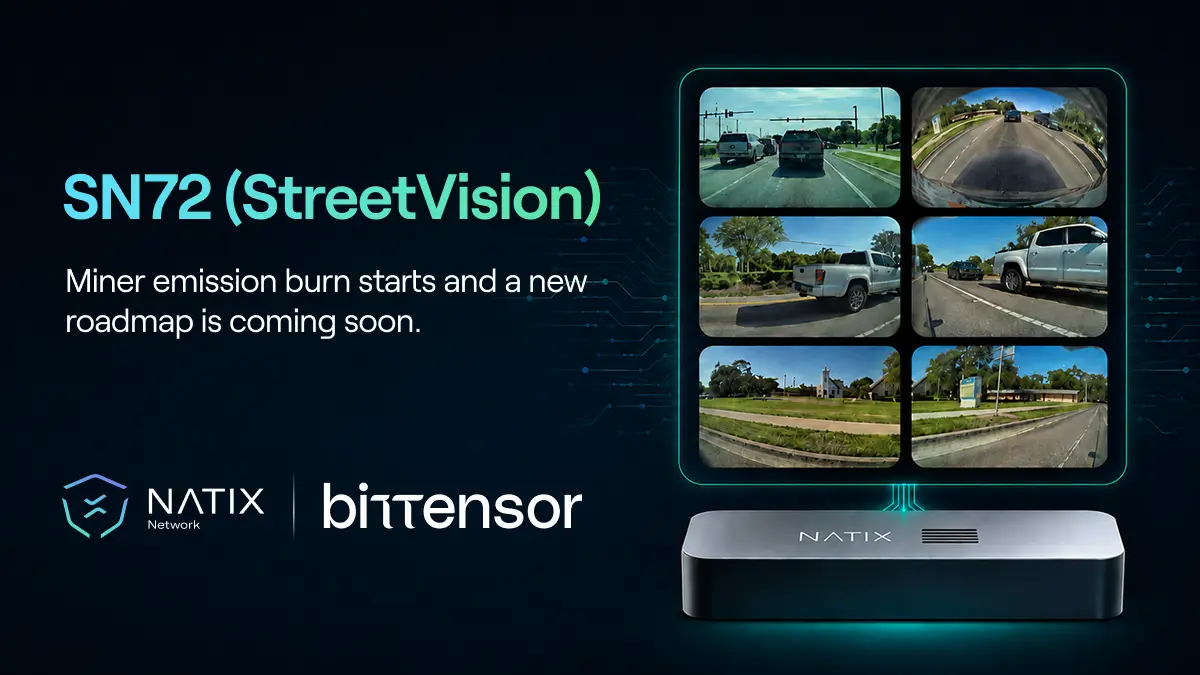
For that reason, within the next 24 hours, 100% of miner emissions on the NATIX StreetVision subnet will be burned. This will remain in place until we publish the subnet's new roadmap, which we expect to share over the next 6-8 weeks.
This is not a retreat from Bittensor. It is the opposite. We are pausing miner emissions on purpose, so that when the subnet comes back online with its new direction, the economics already reflect what we are actually building. The reasoning behind that decision, what the next chapter looks like, and what we want the community to take away from it today are all worth explaining clearly.
When we launched StreetVision on Bittensor in May 2025, the goal was to bring NATIX's real-world driving data into a decentralized training loop. The initial use cases focused on roadwork detection, scenario classification, and other map-relevant signals. That work was meaningful and proved the basic idea: real-world data from an existing physical infrastructure network could be processed inside a decentralized AI subnet to produce models with practical value.
In the year since, two things have changed in the world around the subnet.
The first is that the bar for what counts as a serious AI subnet has risen sharply. Speculation alone does not carry a subnet through a full market cycle. Subnets that produce real outputs, with real customers and real workloads, are now clearly distinguishable from the ones that do not. With NATIX moving from mapmaking to focusing on physical AI, we wanted to make this clear: As part of NATIX, StreetVision will be a subnet for physical AI.
The second is that NATIX itself has moved further into Physical AI. In April, we announced the sunset of Drive&, the smartphone app that originally powered our DePIN network for mapping. That decision was not taken lightly, as Drive& was the world's largest mapping-focused DePIN by contributor count. We sunset it because the most valuable problem in our space is no longer mapping. It is Physical AI, and specifically the multi-camera driving data that autonomous systems and robotics models need to learn from.
The subnet was originally designed inside a different chapter of the project. Pausing miner emissions now is the cleanest way to align its economics with the shift in subnet design.

The NATIX StreetVision Subnet operates under Bittensor's Dynamic TAO (dTAO) model. Each block produces a small number of alpha tokens, distributed among miners, validators, and the subnet owner. These emissions are not freely supplied. They reflect a claim on the subnet's future utility. When emissions flow without that utility clearly defined, the result is downward pressure on the subnet's alpha token, with no corresponding contribution to its long-term value.
Burning 100% of miner emissions removes that imbalance during the transition period. From now until the new roadmap is live, every alpha token that would have gone to miners and does not match where the subnet is going next is removed from circulation rather than entering the market.
This is not a punishment for the miners. It is a temporary design choice. The subnet is in transition, and during transition, emissions should reflect that. When the new roadmap is published, the emission structure will reflect the new direction, with miner participation re-aligned to workloads we believe will be among the most valuable in decentralized AI.
NATIX did not start out as a Physical AI company. We started as a DePIN for street-level data, with a clear application in mapping. Over time, the most demanding AI customers stopped asking only for road information. They started asking for everything else that a multi-camera, real-world dataset can provide. Driving scenes, surround-view footage, long-tail scenarios, and edge cases. The kind of structured visual intelligence that can be used for a self-driving system to learn how the world actually behaves.
The shift from mapping to Physical AI was not a pivot away from our roots. It was a recognition that the same DePIN philosophy that worked for mapping applies, with even more leverage, to the data layer underneath autonomous driving and robotics. That is why we built the VX360 for Tesla vehicles, and that is why we sunset Drive& to concentrate our efforts on multi-camera data collection.
The results are already showing, with customer relationships such as building one of the largest open-source multi-camera world foundation model with Valeo, our work with the AutoWare foundation on an open-source End-to-End autonomous driving model, and several other Physical AI initiatives that now sit at the center of NATIX's revenue.
The subnet on Bittensor needs to reflect the same direction, not as a decoration, but as a real workload.
Physical AI sounds abstract from the outside, but the underlying problem is simple. Self-driving systems and physical agents need to learn how the world behaves. Not just what objects look like, but how scenes evolve, how rare events unfold, how vehicles and pedestrians and weather all interact in places the system has never seen before.
The real bottleneck in Physical AI is not a lack of compute. The bottleneck is a lack of high-quality, multi-camera, real-world data at a global scale.
Synthetic data helps. It expands coverage, especially for events that are too rare to wait for, and it helps create different variations of existing scenarios. But synthetic data alone is not enough, because simulation reflects assumptions, and the real world is too chaotic for that. Real-world data is what grounds models when those assumptions break.
This is where NATIX's data layer is positioned to do the most work. Multi-camera Tesla footage from VX360. Continuous global capture. Long-tail driving scenarios that no synthetic generator can fully anticipate. The same data that makes our customer partnerships valuable is the data that a serious decentralized AI workload should be trained and validated against.
In the next 6-8 weeks, the subnet is being redesigned around exactly that pairing.
It’s important to clarify this: The StreetVision Subnet Token and the $NATIX Token are two separate token economies with different mandates, and are distantly related.
The miner emission burn we are announcing today applies to the StreetVision Subnet's Alpha token under Bittensor's dTAO mechanics. It does not affect the $NATIX token. The NATIX Deep Staking Platform, the existing token economics, and everything tied to $NATIX value accrual remain unchanged.
What is changing is the supply behavior of the subnet's alpha token during the transition. Every alpha token that would have flowed to miners is being burned instead of issued. This is meant to keep the subnet's economics clean and aligned with the rebuild, not to introduce any change to the broader $NATIX token.
It would be easy to keep emissions running, let the subnet drift, and announce the next chapter with a soft pivot in a few weeks. We are choosing not to do that. The Physical AI moment is happening now. The companies, datasets, and infrastructure layers that define this period are being built in 2026, not by teams that wait for the noise to settle.
For NATIX, that means concentrating force. Sunsetting Drive&. Doubling down on VX360. Moving the subnet into a deliberate pause so that its emissions, its workloads, and its narrative line up with what we are actually building. None of these are independent decisions. They are part of the same direction of travel.
In the end, decentralized AI does not become serious because more subnets exist. It becomes serious because a subset of subnets do real work, on real data, for real customers, and align their token mechanics to that reality. That is the version of the NATIX StreetVision Subnet we are now building toward.
The next update will arrive in 6-8 weeks. Until then, miner emissions are burning, and the work to rebuild is already underway.


