

Every DePIN has two things to prove.
The first is supply: ordinary people contributing something useful to a network, at scale. The second is demand: someone on the other side actually wants what the network produces and is willing to pay for it.
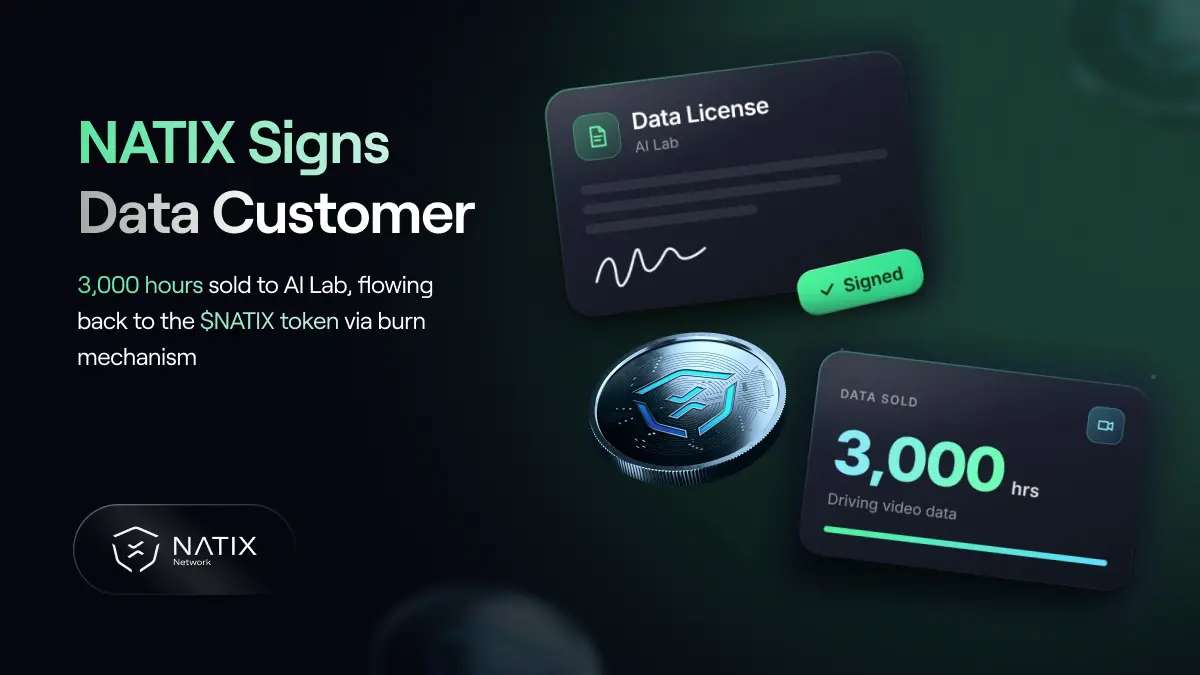
Today we can say NATIX has proven both. We have signed a six-figure commercial agreement to provide 3,000 hours of real-world driving data to an AI lab pioneering general world models. It is not a research collaboration, an open dataset release, or a future commitment. It is a paying customer buying data collected by NATIX drivers, showing more proof of demand for decentralized data.
NATIX began with a simple observation. Every day, drivers already have cameras built into the cars they drive. Connect those cameras to a network, reward the people behind them, and you can capture the physical world with a scale and variety that dedicated survey fleets struggle to match.
That idea has grown into more than 200,000 hours of real-world, multi-camera driving data, collected across cities, road types, and conditions that no single fleet would ever plan for. Supply was the first thing we had to prove, and our drivers proved it.
Collecting data is only half of the equation. The harder question is whether that data matters to the people building the next generation of AI.
Over the past year, the answer has become clear. Physical AI labs have been training on NATIX data, and some of the strongest open-source world models have learned the road from it. VATIX, the multi-camera World Foundation Model we built with Valeo, outperforms open-source models such as GEM and Vista. Orbis 2, developed at the University of Freiburg with NATIX as its largest single data contributor, is 3x faster and 4x more stable than NVIDIA Cosmos 2.5. NATIX data is becoming a benchmark for world models teams.
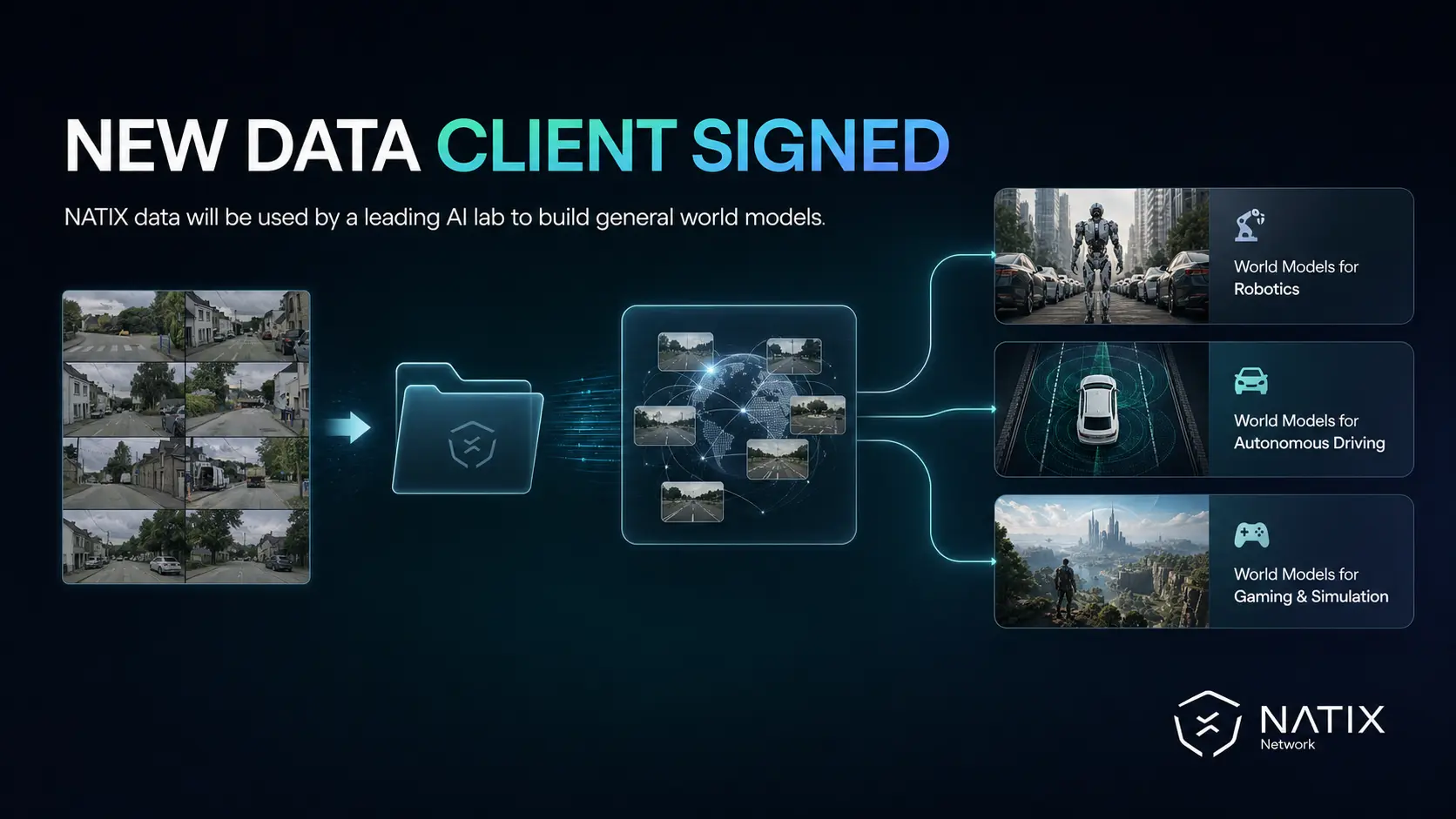
This agreement is the next step. Our customer is an AI lab building general world models: systems designed to understand physics, motion, and cause and effect across both physical and virtual environments. The Unicorn lab has already developed several world models and is now using NATIX driving data as part of that work.
What makes this customer different is the scope of what it is building. A general world model is not trained for one vehicle or one task. The same underlying intelligence could eventually support robots, humanoids, self-driving cars, drones, simulated environments, and any other system that needs to understand how its actions affect the world around it. That takes NATIX data beyond autonomous driving and into the wider Physical AI economy.
The reason a lab like this needs our data is simple. General world models cannot learn everything they need from internet video. They need large volumes of real-world footage showing how environments change, how objects move, how people behave, and what happens when different actions are taken. That is exactly what NATIX drivers capture every time they drive.
Demand only matters to a network if the value flows back to the people who create it. NATIX is designed so that it does.
Customers pay for NATIX data in stable or fiat currencies. That revenue becomes protocol revenue that flows back to the network with our buy-back and burn mechanism. This creates a truly deflationary token economy where drivers help build the network, the network produces data, the data generates revenue, and that revenue buys back and burns $NATIX, our token on Solana.
With our Q2 and Q3 burns combined, we burned 224,971,878 $NATIX, removing them from supply permanently. It’s not just the number that matters, it’s also the monetary value that comes with it. This burn was issued with strong numbers backing our token, meaning that this burn is bigger in monetary value than any previous two quarters combined, and that’s all thanks to our network.
.webp)
This is what value accrual looks like when it is tied to something real. The burn is not funded by a promise about the future. It comes from customers paying for data that our drivers collected, and every new sale feeds the same mechanism.
The Physical AI data economy is no longer theoretical. The companies building the next generation of AI need real-world data, and they are paying for it. Each new customer strengthens the same loop: more demand creates more revenue, more revenue flows back to the network, and a stronger network attracts more drivers and more data. The best part is that there is more to announce soon.
NATIX drivers capture the physical world, and we turn their contributions into the data Physical AI needs. DePIN is here to stay.


