

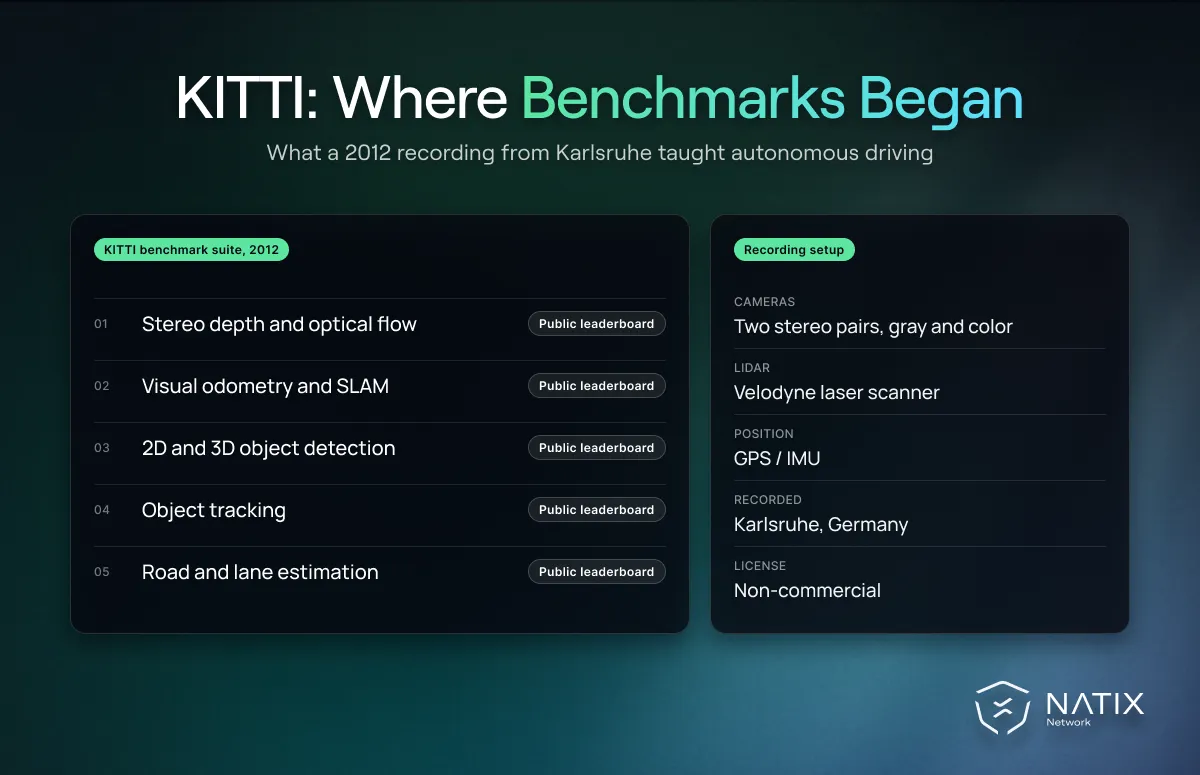
The KITTI dataset is where modern autonomous driving benchmarks began. It was released in 2012 by the Karlsruhe Institute of Technology and the Toyota Technological Institute at Chicago, and introduced in the CVPR paper "Are we ready for Autonomous Driving?". It gave researchers something the field had never had at scale: real driving data from a car-mounted sensor suite, paired with public tasks and a shared leaderboard.
For most of the following decade, a new idea in 3D perception was not taken seriously until it showed results on KITTI. That influence is worth understanding, both for what it made possible and for why the dataset now looks dated next to what modern models need.
The KITTI dataset was recorded around Karlsruhe, Germany, with a station wagon carrying two stereo camera pairs (grayscale and color), a Velodyne lidar scanner and a GPS/IMU unit. The team drove through city streets, rural roads and highways, then calibrated and synchronized the sensors so that camera images and lidar point clouds lined up.
The official KITTI page hosts the raw recordings along with curated subsets for specific tasks. The data is released under a Creative Commons non-commercial license, which suits academic research but rules out direct commercial use.
What made KITTI so influential was not only the data but the benchmarks built on top of it. The KITTI benchmark suite covered several core problems:
Each task came with a fixed test set and a public leaderboard. Researchers submitted results, the server scored them, and the ranking was visible to everyone. That simple loop turned scattered research into a measurable race, and it created a habit that every later dataset copied.
KITTI's influence also shows up in less visible places. Its calibration files, coordinate conventions and label formats became a template that many tools and later datasets borrowed. Even today, conversion scripts that turn other datasets into "KITTI format" are common, because so much software was written to read it.
The way KITTI defined difficulty levels was another lasting idea. Objects were grouped as easy, moderate or hard depending on their size, occlusion and truncation, and results were reported for each group. That made it clear that a method could look strong on large, fully visible cars while still failing on small or partly hidden pedestrians. Later benchmarks adopted similar breakdowns.
Finally, the KITTI dataset showed how much careful sensor calibration matters. Aligning a spinning lidar with stereo cameras on a moving car is hard, and the precision of that alignment directly affects how good the labels and the resulting models can be. Many teams learned their calibration habits from working with KITTI.
KITTI arrived at the right moment. Deep learning was about to transform computer vision, and the field needed a realistic driving benchmark to test it on. Many of the first deep networks for 3D detection from lidar, and later from cameras alone, were developed and compared on KITTI.
It also set expectations for what a driving dataset should include: calibrated multi-sensor data, careful labels and clear evaluation rules. Later releases such as the nuScenes dataset and the Waymo Open Dataset expanded on that template rather than replacing it. We trace that whole lineage in our article on what open datasets taught the industry.
The same qualities that made KITTI a great benchmark limit its usefulness today.
Age. The recordings are more than a decade old. Vehicles, road furniture, e-scooters and sensor hardware have all changed since then, so the data shows a world that modern systems will not drive in.
One region. Nearly everything was recorded in and around one German city. Models trained there learn a narrow slice of road design and driving behavior.
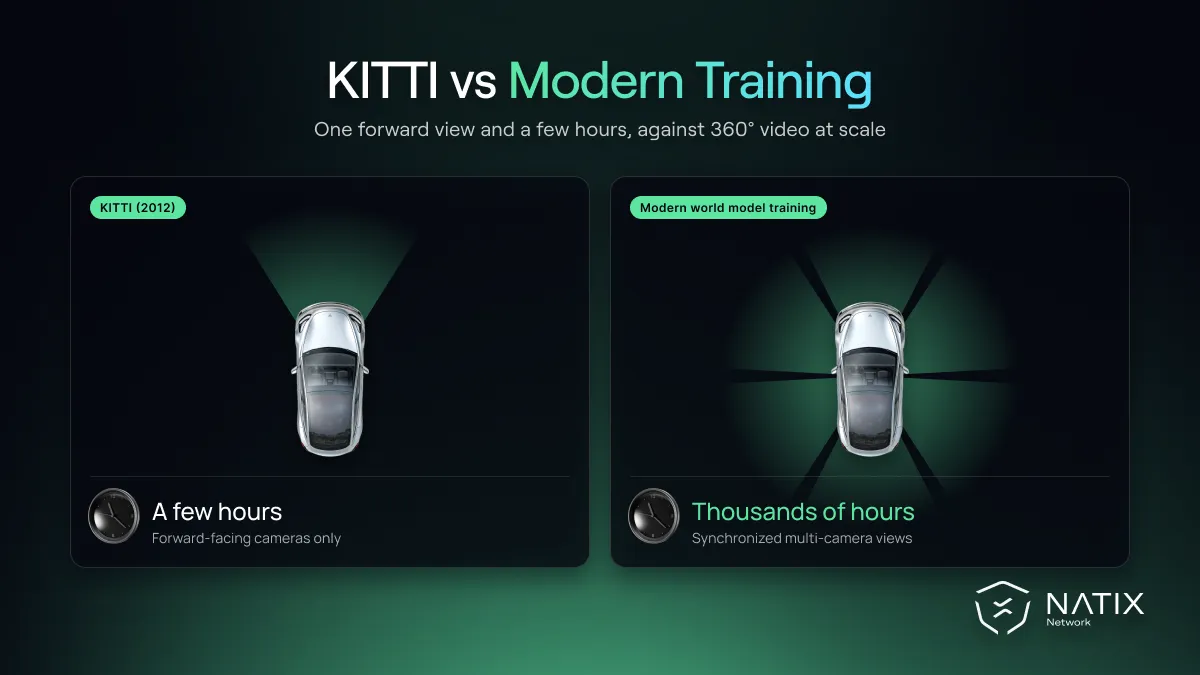
A research sensor rig. The roof-mounted stereo cameras and lidar differ from the cameras production cars carry. KITTI also lacks a full view around the vehicle; its cameras face forward.
Small scale. The raw recordings total about six hours of driving. Modern methods such as World Foundation Models learn from thousands of hours of continuous, multi-view video, which puts KITTI orders of magnitude below what they consume.
Saturated benchmarks. On several KITTI tasks, top methods now differ by small margins. At that point, further gains often reflect tuning to the test set rather than real-world progress.
KITTI is still useful in the right role. It remains a clean, well-understood benchmark for teaching, for quick experiments and for checking that a method behaves sensibly before moving to larger data. Its stereo and odometry tasks are still a common first test for new depth and localization ideas.
For production work, though, teams need data that reflects today's roads, many regions and the camera setups that cars actually use. Our articles on the world foundation model landscape and on building a multi-camera data engine for world models explore what that next generation of data looks like.
Large collections of multi-camera driving data from everyday vehicles are one answer. NATIX collects synchronized multi-camera footage from factory Tesla cameras across the USA, Europe and Japan, continuously, and has already passed 200,000 hours.
The KITTI dataset proved that shared data and public benchmarks could move an entire field. Its lasting lesson is that the data has to keep up with the world, and a single snapshot from 2012 cannot.


